Analysis and evidenceAnalysisJustice
Just Transition Platform
Just transition is not only a climate or labour agenda. It is becoming a strategic capability for countries, companies, public authorities, universities, funders, insurers, communities, and development actors navigating the combined effects of climate disruption, artificial intelligence, automation, energy transition,…
वैश्विक जोखिम और नवाचार केंद्र (Global Centre for Risk and Innovation, GCRI)
Just transition is not only a climate or labour agenda. It is becoming a strategic capability for countries, companies, public authorities, universities, funders, insurers, communities, and development actors navigating the combined effects of climate disruption, artificial intelligence, automation, energy transition, biodiversity loss, disaster risk, infrastructure change, demographic shifts, and economic restructuring. Our area of activity helps institutions understand how transition affects people, places, industries, public systems, and national resilience. It connects workforce intelligence, skills development, technology governance, climate adaptation, community safeguards, finance-readiness, public-good tools, and responsible implementation pathways so that transition can move from aspiration to structured capability
PARTNERSHIP



###### Transition Intelligence
Transition intelligence structures how institutions understand the effects of climate change, automation, AI, energy transformation, disaster risk, biodiversity loss, infrastructure change, and economic restructuring on workers, communities, sectors, regions, and national systems. It turns labour-market signals, risk indicators, sector data, skills gaps, vulnerability records, and resilience needs into usable intelligence for policy, technical, enterprise, finance, and public-good audiences
###### AI Work
AI is changing tasks, occupations, management systems, service delivery, education, technical work, knowledge work, and public administration. This area develops public-good methods for understanding automation exposure, human-AI collaboration, AI augmentation, algorithmic management, worker safeguards, AI governance literacy, task redesign, and the responsible use of AI in transition planning without enabling automated worker ranking, unfair profiling, or employment decisions by default
###### Community Safeguards
Just transition must protect people and places from extractive, symbolic, or top-down approaches. This area structures community participation, accessibility, youth safeguards, disability inclusion, Indigenous protocol-sensitive controls where applicable, protected knowledge handling, local context, public-safe communication, consent boundaries, and correction channels so transition work remains grounded, inclusive, and accountable
###### Workforce Data
Transition planning depends on responsible data about occupations, tasks, skills, learning, employment pathways, informal work, gig work, care work, displaced workers, youth pathways, migrant and refugee skills, employer demand, regional labour markets, and AI-era work. This area structures data-use labels, privacy controls, aggregation rules, fairness safeguards, public-safe summaries, and correction pathways so workforce intelligence supports planning without becoming social scoring or employment decision infrastructure
###### Early-Warning Social Protection
Protection that arrives when it’s needed—by design. Forecast thresholds (heat, flood, drought, outage) automatically trigger pre-arranged cash, vouchers, or service credits for vulnerable households and critical SMEs. Disbursements and delivery verification ride the same rails as capital—fast, fair, and auditable. Powered by NE early-warning + parametric rails
###### Compliance, Disclosure & Control
Policy-as-code, role-based approvals, immutable logs, and jurisdiction-aware permissions reduce internal control cost while raising assurance. One system powers Sendai/SDG reporting, ISSB/CSRD/GRI disclosures, lender covenants, and board oversight—without recreating data. Powered by NE for access control, attestations, and change logs
###### Skills Architecture
Skills architecture organizes the competencies, knowledge, abilities, practices, judgment, digital literacies, AI collaboration skills, technical capabilities, green skills, resilience capabilities, and public-good competencies required for future-ready work. It supports competency maps, learning pathways, micro-credentials, badges, integrated learning records, work-integrated learning models, and contribution recognition systems that help people and institutions adapt to changing labour markets
###### Climate Labour
Climate transition is reshaping work across energy, buildings, agriculture, manufacturing, transport, infrastructure, finance, insurance, public services, health, food systems, water systems, and nature-based sectors. This area connects climate adaptation, mitigation, disaster risk reduction, green skills, industrial transition, regional development, and workforce resilience into practical transition pathways for institutions and countries
###### Learning Systems
Learning systems provide the infrastructure for transition capacity at scale. This area supports courses, modules, labs, studio exercises, apprenticeships, internships, cooperative education, public authority learning placements, employer-linked learning, Foundry contribution pathways, campaign-based learning, and national capability pathways that connect education, work, public-good contribution, and workforce resilience
###### National Portfolios
Country-level transition work requires more than isolated projects. National portfolios organize transition priorities, sector pathways, workforce needs, regional gaps, learning systems, public authority dependencies, community safeguards, finance-readiness questions, technical needs, and handoff pathways. They help countries build structured public-good memory and capability around transition without turning portfolio records into official national plans, rankings, procurement signals, or implementation mandates by default
###### Nexus Architecture
Transition work must eventually connect to actors that can implement lawfully: public authorities, education systems, employers, unions, training institutions, National Consortium Companies, Project SPVs, funders, insurers, donors, providers, and community actors where appropriate. Handoff architecture transfers evidence, workforce data context, learning models, safeguards, dependencies, finance-readiness questions, recipient responsibilities, correction routes, and archive status to competent actors that decide and execute separately


The Nexus Reports provide comprehensive evaluations of country-specific risks and opportunities, focusing on biodiversity, ecosystem services, climate change vulnerabilities, socio-economic risks, the food-water-energy nexus, and exponential technologies. Drawing on authoritative sources, these reports offer tailored policy recommendations, detailed analyses, and practical case studies, integrating global scientific research to manage risks and drive sustainable development
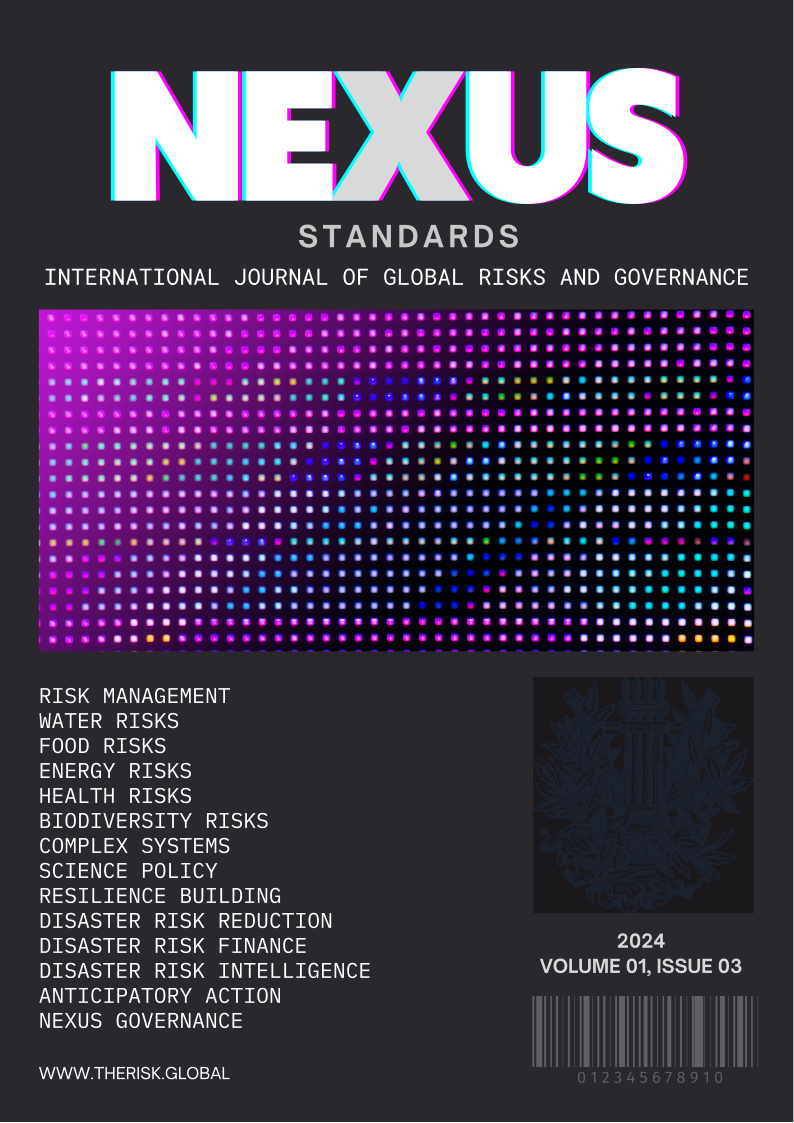
The International Journal of Global Risks and Governance (IJRG) is revolutionizing the understanding and management of global challenges with an integrated nexus approach. Aspiring to be the first decentralized scientific journal in global risks, IJRG leverages Web3 principles to foster an open, transparent, and collaborative ecosystem for researchers, policymakers, and practitioners
Get Access Start a Transition Lab Build Resilience Masterplan Design a Trigger Launch a Data Commons Train Your Model
Building Tribes for Impact
###### Consortium Pathways
Consortium pathways provide the formal entry point for institutions seeking structured participation in anticipatory action, early risk intelligence, preparedness, disaster risk intelligence, humanitarian readiness, climate risk, finance-readiness, and national capability-building. They allow governments, enterprises, universities, funders, insurers, public authorities, civil society, humanitarian actors, technical partners, and communities to engage through global, regional, and national channels while keeping collaboration distinct from public warnings, finance, procurement, or implementation Learn more
###### Global Guilds
Anticipatory Action Working Groups turn expert knowledge and institutional experience into structured public-good outputs. They may focus on signals, indicators, trigger logic, forecast interpretation, scenario workflows, humanitarian sensitivity, community safeguards, public authority learning, finance-readiness, national portfolio inputs, technical notes, public-safe reports, and readiness questions that can be reviewed, corrected, archived, and routed for further use Learn more
###### Network Memory
Network memory preserves signal records, indicator histories, scenario outputs, trigger notes, public-safe summaries, learning materials, reports, datasets, technical objects, registry entries, listings, correction histories, archive records, and continuity pathways. It ensures that anticipatory action improves over time rather than resetting after each event, crisis, exercise, pilot, or annual cycle Learn more
###### Project Vehicles
National Consortium Companies and Project SPVs provide separate implementation-adjacent vehicles that may receive handoff context when anticipatory action work is mature enough for downstream consideration. These vehicles are distinct from the public-good layer and require their own legal, financial, public authority, humanitarian, procurement, operational, safeguard, liability, and governance conditions before any implementation activity occurs Learn more
###### National Councils
National Councils and Helix Councils organize country-level participation across public authorities, emergency institutions, academia, industry, technology, infrastructure, capital, insurance, donors, civil society, communities, media, humanitarian actors, and public-interest stakeholders. They translate anticipatory action priorities into national portfolios, preparedness learning agendas, working groups, capability needs, public-safe outputs, finance-readiness questions, and responsible handoff pathways Learn more
###### Competence Cells
Competence Cells provide focused expert capacity for anticipatory action challenges, including disaster risk intelligence, climate forecasting context, geospatial analysis, hazard modelling, trigger design, scenario simulation, humanitarian data governance, cyber risk signals, public health risk intelligence, food and water stress, finance-readiness questions, and public-safe reporting through bounded, reviewable, correctionable work Learn more
###### Annual Build
Nexus Universe provides the annual build and convergence cycle where anticipatory action work can be prepared, reviewed, demonstrated, routed, and advanced. It brings together national portfolios, risk signals, indicator sets, public authority learning rooms, finance-readiness rooms, working groups, competence cells, scenario workflows, public-safe reports, registry updates, and handoff pathways without becoming a warning center, emergency command body, investment platform, procurement forum, or execution event Learn more
###### Nexus Pathways
Handoff pathways transfer structured anticipatory context from public-good preparation to competent actors that may decide, warn, command, finance, procure, insure, implement, maintain, or operate separately. They preserve evidence, signal context, forecast assumptions, trigger logic, preparedness gaps, safeguards, public authority dependencies, finance-readiness questions, procurement boundaries, recipient responsibilities, correction routes, recall pathways, and archive status Learn more
Cite this article
The Global Centre for Risk and Innovation (2026, May 29). Just Transition Platform. The Global Centre for Risk and Innovation. https://therisk.global/just-transition-platform/
@online{the2026justtransitionplatform,
  author = {{The Global Centre for Risk and Innovation}},
  title = {{Just Transition Platform}},
  publisher = {The Global Centre for Risk and Innovation},
  year = {2026},
  month = {5},
  url = {https://therisk.global/just-transition-the network's own records,
  language = {en}
}
TY - ELEC AU - The Global Centre for Risk and Innovation TI - Just Transition Platform PB - The Global Centre for Risk and Innovation PY - 2026 DA - 2026/05/29 UR - https://therisk.global/just-transition-platform/ LA - en ER -
Republish
Republish or translate this article free of charge, in print or online, under CC BY 4.0: keep the byline and The Global Centre for Risk and Innovation, link to the original and note any change. Figures, maps and twins made by the institutions carry the same licence; third-party data keeps its own credit line.
Attribution to paste
<p>Just Transition Platform — The Global Centre for Risk and Innovation, The Global Centre for Risk and Innovation. First published 29 May 2026 at <a href="https://therisk.global/just-transition-platform/">https://therisk.global/just-transition-platform/</a>. Republished under CC BY 4.0 (https://creativecommons.org/licenses/by/4.0/).</p>