Google, UN deploy AI Flood Hub for local-level flood warnings
Summary
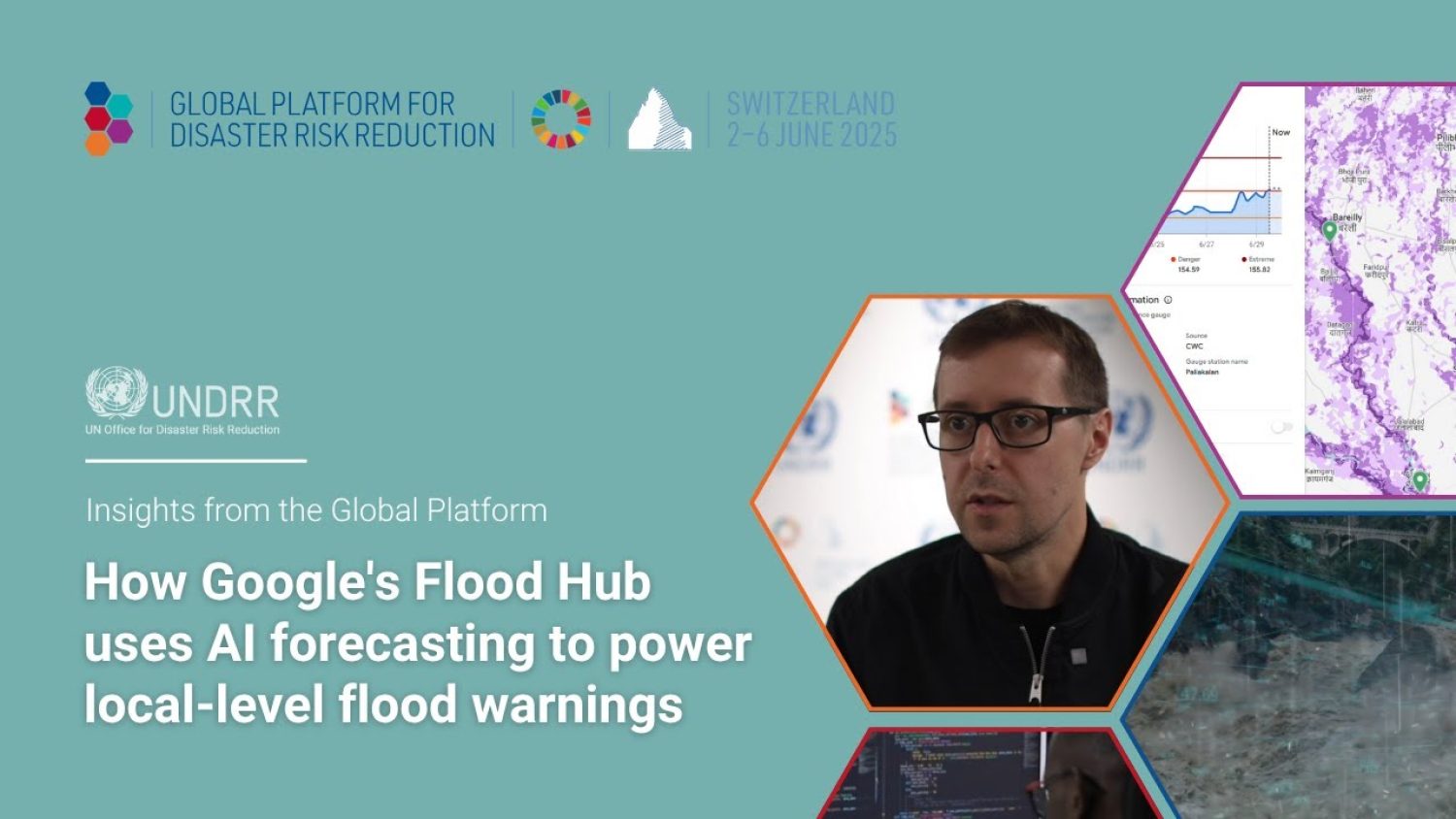
A video released by the United Nations Office for Disaster Risk Reduction (UNDRR) features Google Research Scientist Grey Nearing presenting the Google Flood Hub, an artificial intelligence-driven platform for disaster risk management. The system provides local-level flood forecasts up to seven days in advance through a publicly accessible web interface. The core takeaway for risk management experts is that the platform leverages globally trained AI models to overcome regional data limitations, aiming to provide equitable access to early warning systems and demonstrably reduce the post-disaster costs for affected communities through collaboration with governments and NGOs.
Key Points
The presentation outlines a multi-faceted approach to flood risk reduction, centered on advanced technology and collaborative implementation. The Flood Hub platform is presented as a significant development in the application of artificial intelligence to disaster forecasting. According to Nearing, the system’s AI model analyzes vast, global datasets to learn the fundamental relationships between rainfall and river behavior. This methodology addresses a critical challenge in traditional hydrology, as Nearing notes, “The geographic distribution of high quality data is non uniform” (29.76). By identifying these universal patterns, the model can generate forecasts for regions that lack the dense network of ground sensors and historical data typically required for accurate predictions. This effectively levels the technological playing field, offering advanced forecasting capabilities to national agencies that may have limited resources or data infrastructure.
A central theme of the initiative is its partnership-driven model designed to ensure the technology translates into tangible impact. The development and deployment process involves close cooperation with national governments, non-governmental organizations (NGOs), and specialized United Nations agencies, specifically citing the World Meteorological Organization (WMO). This collaborative framework is intended to integrate the AI-powered forecasts into existing national disaster management workflows. The project’s philosophy emphasizes local ownership and empowerment, with a stated goal that “We really want to have the disaster warning owned by the government” (81.0). The tools are described as open, available, and adaptable to support the varying technical capacities of different national hydrometeorological agencies, positioning the technology as a support mechanism rather than a replacement for sovereign warning systems.
The video provides a specific, quantitative example of the system’s effectiveness from a field study conducted in Bihar, India. The study surveyed 319 communities, encompassing a population of approximately 1.8 million people, to compare outcomes between communities that received an early warning alert and those that did not. The findings indicated a significant reduction in the secondary impacts of flooding for alerted populations. Nearing reports that in communities with access to early warnings, “Post-disaster medical costs at the individual level, the family level, was reduced by about 30%” (101.92). This metric offers concrete evidence for risk managers and policymakers of the direct economic benefits of implementing such AI-powered early warning systems, demonstrating a clear return on investment in terms of reduced household financial shock and improved community resilience following a disaster event.
Context
The Google Flood Hub is an open-access, web-based tool that utilizes an artificial intelligence model to deliver riverine flood forecasts with a lead time of up to seven days. The platform’s primary innovation lies in its approach to data scarcity. It overcomes the common limitation of insufficient local data by employing a model trained on global patterns of rainfall and riverine system responses. This enables the system to generate credible forecasts in data-poor environments, which are often the most vulnerable to flood hazards. The initiative is framed within the broader context of the UNDRR’s mission to promote disaster risk reduction and resilience-building worldwide. The UNDRR operates on the core principle that disasters are not natural phenomena but are the result of the intersection of natural hazards with societal vulnerabilities, such as poverty and exclusion. Therefore, technologies that provide timely and accessible early warnings are positioned as critical tools for mitigating these vulnerabilities and preventing hazards from escalating into full-blown disasters. The collaboration with the World Meteorological Organization further situates this project within the established global framework for weather, climate, and water services.
Implications
For risk management practitioners, the Flood Hub represents a potentially powerful and freely available resource for enhancing situational awareness and extending planning horizons. The seven-day forecast window allows for more proactive and comprehensive preparedness measures, from public information campaigns to the pre-positioning of assets and personnel. For governments and public sector agencies, the platform offers a scalable and cost-effective solution to bolster national early warning capabilities, directly supporting international goals such as the “Early Warnings for All” initiative. The evidence from the Bihar study provides a compelling case for adopting such technologies, linking them directly to reduced post-disaster socio-economic burdens on citizens. The primary challenge, as noted in the video, remains the effective operational integration of these AI-generated forecasts into established governmental crisis management and public alerting protocols. For the private sector and investors, improved flood forecasting capabilities can lead to more accurate risk assessments for infrastructure, supply chains, and other assets, potentially reducing financial losses and enhancing operational continuity in flood-prone regions.
A policy and action framework for stakeholders could include the following steps:
- Evaluation: National and local agencies should conduct pilot studies to validate the Flood Hub’s forecast accuracy and reliability within their specific geographical and hydrological contexts.
- Integration: Technical teams should explore methodologies for integrating the platform’s data outputs into existing national warning systems, decision-support dashboards, and public dissemination channels.
- Capacity Building: Governments should engage with the program’s partners to leverage the available support for implementation and training, ensuring that local experts can effectively utilize and interpret the AI-driven forecasts.
- Benefit Analysis: Public authorities can undertake localized socio-economic studies, similar to the one in Bihar, to quantify the specific benefits of enhanced early warnings and build a robust domestic case for continued investment in disaster risk reduction technologies.
Data gap: The provided materials do not contain specific technical details about the AI model’s architecture, its complete range of input data sources, or its independently verified performance metrics such as false alarm rates or probability of detection. Furthermore, a comprehensive list of countries where the service is currently operational and the formal process for a new national agency to partner with the initiative are not detailed.
Disclaimer
This document is an analytical summary intended for informational purposes for risk management professionals and is based exclusively on the content of a video presentation published by the United Nations Office for Disaster Risk Reduction (UNDRR). The information herein is derived solely from the provided title, description, and transcript and has not been independently verified. The analysis does not constitute an endorsement of the Google Flood Hub or its associated technologies. The performance claims of the AI forecasting model and the findings of the study cited in Bihar, India, are reported as presented in the source material without independent validation. Artificial intelligence-based forecasting systems are inherently probabilistic and subject to margins of error. Their outputs should be considered as supplementary guidance and not as a definitive prediction of future events. The accuracy of such models can vary significantly based on local conditions, the quality of input data, and the nature of the specific event being forecast. Ultimate responsibility for the issuance of official disaster warnings and the execution of emergency response actions rests with mandated governmental authorities. The platform provider and the author of this analysis assume no liability for any actions taken or decisions made based on the information presented in this summary or the source video. Users should consult official national and local disaster management agencies for authoritative warnings and guidance.