Nineteen countries from Egypt and the Horn of Africa to the Great Lakes share basins, grids, rains, outbreaks and displacement. This page explains what the planned Kenya hub of the Nexus Consortium would coordinate, what the evidence shows, and what is and is not on record.
Key takeaways
- The Kenya hub is one of three planned coordination roles in the Africa programme of the Nexus Consortium; it would coordinate shared-system work for 19 countries from the Horn of Africa to the Great Lakes and Central Africa, and no hub host decision is on record [1, 2].
- No East Africa Nexus Consortium and no Nairobi hub office are on record. Earlier versions of this page described both, with a 2030 anchor; those descriptions are withdrawn [2].
- The region’s risks are coupled and large: the 2020 to 2022 drought was the longest in 40 years, over 50 million people in the Greater Horn faced acute food insecurity in 2022, and the 2024 floods killed an estimated 315 people in Kenya [3, 4].
- The 19 countries hosted millions of refugees at the end of 2025, led by Uganda with 1.94 million, while Sudan alone counted 9.14 million internally displaced people [5].
- The programme is in formation at service level R0: a government, operator or university starts with an enquiry to africa@therisk.global and receives a reference [1].
What the Kenya hub is
The Kenya hub is a planned regional coordination role in the Africa programme region of the Nexus Consortium, the public-good programme through which The Global Centre for Risk and Innovation (GCRI), The Global Risks Forum (GRF) and The Global Risks Alliance (GRA) help countries examine interconnected risk with shared methods. It is one of three planned hubs in Africa, beside Senegal and South Africa, and one of fifteen across the six programme regions [1, 2]. Its recorded focus is drought, pastoral systems, geothermal energy, health, ports and regional connectivity [1].
A planned hub coordinates shared-system work for a group of countries. It is not an office, an operational site or an exclusive territory, and it operates only once its host decision is on record; today none is [1, 2]. The hub is named for a country, not a city: no host institution or city has been decided. The Africa region is in formation, no regional host is on record, and no named consortium programme is recorded in the region [1]. The programme’s service level is R0, information and enquiries.
This page therefore keeps three things apart: the planned Kenya hub (a coordination role, planned), country programmes in the group (none constituted), and research coverage of each country (a profile, not a programme). Each has its own record on programme status and countries and research profiles.
Why East and Central Africa need shared risk evidence
The largest risks in this group of countries travel along systems that no single government controls. Rain that fails in one season sets off a chain through pasture, livestock, food prices, nutrition, displacement and public budgets. The World Meteorological Organization reported in August 2022 that parts of the Greater Horn were entering a fifth consecutive failed rainy season, in a drought already the longest in 40 years; the October to December season provides up to 70% of annual rainfall in the equatorial parts of the region, particularly eastern Kenya, and over 50 million people in the Greater Horn faced acute food insecurity in 2022 (WMO) [3].
The opposite extreme follows quickly. Between 1 March and 18 June 2024, heavy rains and floods in Kenya killed an estimated 315 people, injured 188 and displaced more than 293,200, according to the National Disaster Operations Centre as reported by OCHA (OCHA) [4]. Pests ride the same weather: in February 2020, FAO described the desert locust upsurge as the worst in 25 years for Ethiopia and Somalia and in 70 years for Kenya (FAO) [6].
Health threats cross borders as fast. When WHO declared the mpox upsurge a public health emergency of international concern on 14 August 2024, the Democratic Republic of the Congo had reported more than 15,600 cases and 537 deaths that year, and Burundi, Kenya, Rwanda and Uganda had reported clade Ib cases for the first time (WHO, 14 August 2024) [7]. All five are in the Kenya hub group. Coupled failures of this kind are why interdependent systems are more fragile than isolated ones: a failure in one network can cascade into another, and beyond a threshold the joint system can collapse abruptly (Buldyrev et al.) [8].
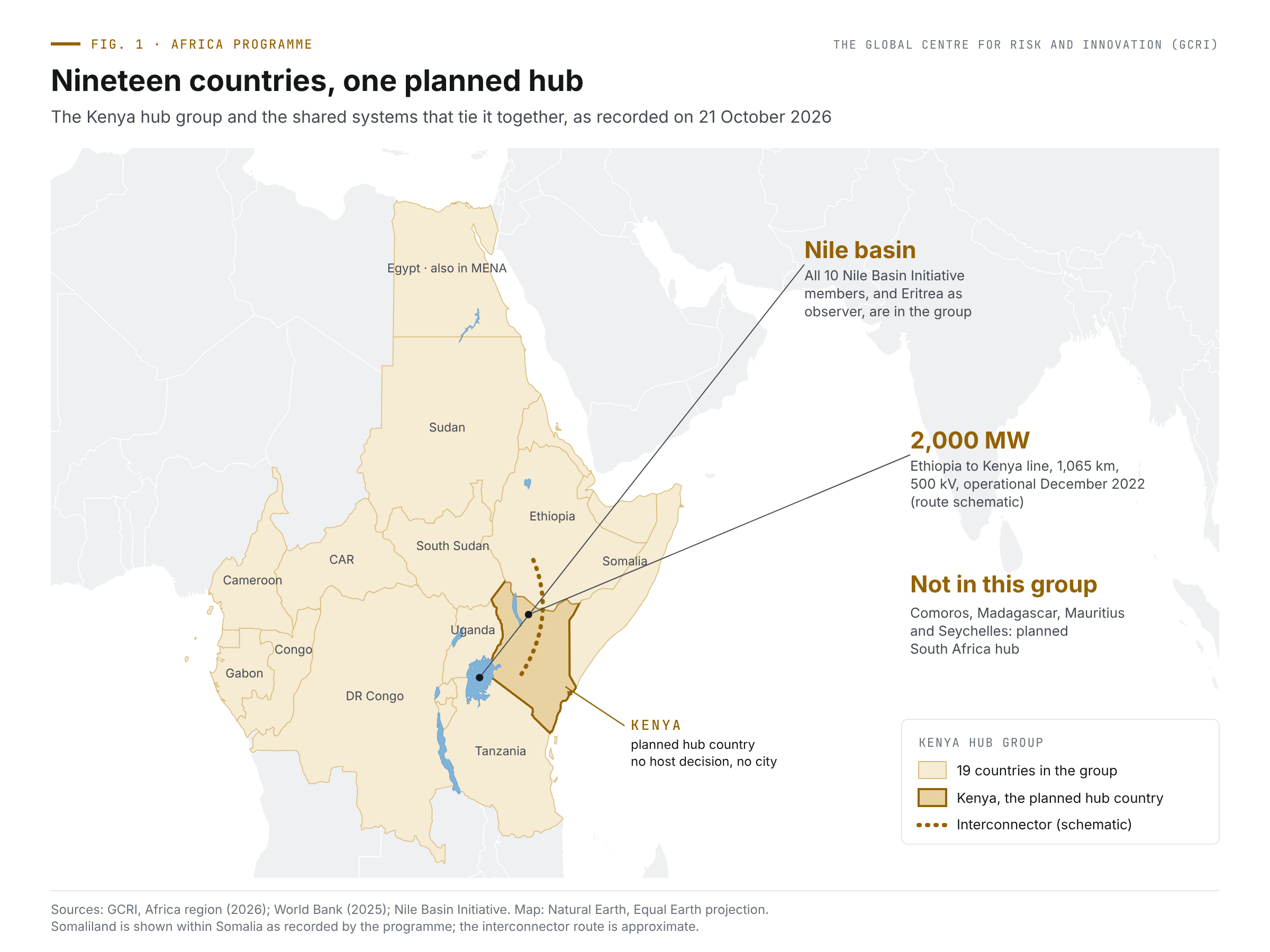

Shading shows the planned Kenya hub group; no host decision is on record and no city is named. The interconnector route and basin outline are schematic. [1, 9, 10]
The countries the hub would serve
The Kenya hub group covers 19 countries: Kenya, Egypt, Djibouti, Eritrea, Ethiopia, Somalia, South Sudan, Sudan, the United Republic of Tanzania, Uganda, Burundi, Rwanda, Cameroon, the Central African Republic, Congo, the Democratic Republic of the Congo, Equatorial Guinea, Gabon and Sao Tome and Principe [1]. Listing a country in a hub group records research coverage and the scope for formation enquiries; it does not give that country a constituted programme [1].
Regions describe relationships, not territory. Egypt also takes part in the Middle East and North Africa programme, because its water, energy and food-import dependencies are shared in both directions [1, 2]. The Indian Ocean island states, Comoros, Madagascar, Mauritius and Seychelles, are covered by the planned South Africa hub, not by the Kenya hub; an earlier version of this page grouped them under Nairobi, and that grouping is withdrawn [1].
Six shared systems, six questions
Regional work starts from shared systems, not from institutions. The Africa programme names six, each with the question it examines; the cross-border risk systems page sets the rule for all of them: shared-system work compares governed outputs and preserves dissent, and it creates no treaty, no transfer of sovereignty and no right to move data [1].
| Shared system | The question it examines | Evidence for the Kenya hub group |
|---|---|---|
| Transboundary river basins | How do upstream storage, irrigation and hydropower decisions change downstream water, food and energy security across the Nile, Niger, Congo and Zambezi basins? [1] | All ten Nile Basin Initiative member states, and Eritrea as observer, are in the group [10] |
| Regional power pools | Which interconnectors, generation mixes and drought conditions create common-mode failure across national grids? [1] | A 1,065 km, 500 kV line carries up to 2,000 MW between Ethiopia and Kenya [9] |
| Trade and mineral corridors | Where do port, rail and road corridors concentrate exposure for landlocked economies and critical-mineral supply? [1] | Ethiopia, South Sudan, Uganda, Burundi, Rwanda and the Central African Republic are landlocked and trade through neighbours’ ports |
| Food and pastoral systems | How do rainfall anomalies, market prices and mobility interact before a food-security shock becomes visible? [1] | Over 50 million acutely food insecure in the Greater Horn in 2022 [3] |
| Cross-border health | Which surveillance, laboratory and logistics dependencies determine how quickly an outbreak can be detected and contained? [1] | Clade Ib mpox reached four neighbours of the DRC by August 2024 [7] |
| Subsea and terrestrial connectivity | How concentrated are international bandwidth and cloud dependencies, and what continuity options exist? [1] | Recorded as a regional question; no public dataset is cited here |
The six shared systems of the Africa programme as recorded on 21 October 2026, with public evidence that shows why each matters for the Kenya hub group.


Each box is a separately measured effect with its own source; the arrows show the order of the cascade, not a modelled causal weight. [3, 4, 7, 11]
Water: the Nile, the lakes and the rains
The Nile system binds the group together. The Nile Basin Initiative is a partnership of ten Nile Basin countries, Burundi, the Democratic Republic of the Congo, Egypt, Ethiopia, Kenya, Rwanda, South Sudan, Sudan, Tanzania and Uganda, with Eritrea participating as an observer [10]. Every one of them is in the Kenya hub group, which makes the basin the clearest case in the programme for comparing compatible evidence across borders without merging national data: upstream storage and hydropower, irrigation in the middle basin and the downstream water balance are measured by different authorities with different methods.
Rainfall variability is the other half of the water question. Because the short rains of October to December provide up to 70% of annual rainfall in parts of the equatorial Horn, a single failed season removes most of a year’s water for pastoralists and farmers [3]. The programme’s drought scenario shows how the same shortfall propagates through water supply, food, energy and health, and is used as a teaching context, not a forecast.
Power: one interconnector, very different grids
The region’s power systems are starting to couple. The Ethiopia to Kenya line, 1,065 km at 500 kV, became operational in December 2022 and allows bi-directional transfers of up to 2,000 MW; Kenya now imports lower-cost renewable power from Ethiopia, and the line is expected to connect to Tanzania and the Southern African Power Pool (World Bank) [9]. Kenya’s own system rests heavily on geothermal energy, which became the country’s foremost source of generation after 2014 and supplied 43.6% of its electricity in 2020, according to UNIDO from IRENA and national statistics (UNIDO) [12].
Coupling grids raises a reliability question the programme names directly: which interconnectors, generation mixes and drought conditions create common-mode failure across national grids [1]? A drought that lowers hydropower reservoirs in one country changes what it can export to another. The answer differs sharply across the group, because access itself differs: in 2024 the share of people with electricity ranged from 5.4% in South Sudan to 100% in Egypt, with Kenya at 77% (World Bank) [13].


One measure, one scale. Kenya, the planned hub country, is highlighted; the regional pattern, not a ranking, is the point. [13]
Country Access, % Country Access, % Egypt 100 [13] Uganda 55.3 [13] Gabon 95.1 [13] Eritrea 55.3 [13] Sao Tome and Principe 77.7 [13] Somalia 54.4 [13] Kenya 77.0 [13] Congo 53.0 [13] Cameroon 72.0 [13] Tanzania 52.4 [13] Rwanda 72.0 [13] Dem. Rep. of the Congo 22.5 [13] Djibouti 69.2 [13] Burundi 20.1 [13] Sudan 66.0 [13] Central African Republic 18.2 [13] Equatorial Guinea 65.1 [13] South Sudan 5.4 [13] Ethiopia 56.6 [13]
Data of Figure 3. Access to electricity, per cent of population, 2024, for the 19 countries of the Kenya hub group (World Bank, World Development Indicators, updated 8 October 2026).
Health and displacement across borders
Health security in the group depends on surveillance, laboratories and logistics that cross borders. The 2024 mpox upsurge showed the speed: four neighbours of the Democratic Republic of the Congo reported clade Ib cases for the first time within months [7]. On 5 September 2025, WHO’s Director-General determined that the upsurge no longer constituted a public health emergency of international concern, citing a sustained decline in cases across the continent; standing recommendations remain in place (WHO Emergency Committee report) [11].
Displacement is the largest and most persistent cross-border system of all. At the end of 2025, Uganda hosted 1,936,719 refugees, Ethiopia 1,010,466, Sudan 809,816, Kenya 617,125, South Sudan 601,818 and the Democratic Republic of the Congo 503,732, according to UNHCR’s population statistics (UNHCR) [5]. Internal displacement was larger still: 9,139,309 people in Sudan, 5,669,479 in the Democratic Republic of the Congo, 3,347,408 in Somalia and 2,378,000 in Ethiopia [5]. More than 2.8 million refugees from Sudan were recorded in other countries at the end of 2025 [5]. Hosting areas carry the drought, flood and health exposure described above, which is why displacement is treated as part of the coupled system rather than as a separate humanitarian file.


Two measures on two scales, not summed. Refugee figures count refugees only, without asylum-seekers; internal displacement figures are as reported in UNHCR’s population statistics. [5]
Three levels of cooperation, one rule of subsidiarity
The programme organizes cooperation at three levels, and each level takes up a question only when it cannot be settled below it. At the national level, a National Nexus programme belongs to its country, with a National Desk that collects material questions, the National Nexus Consortium (NNC) as its institutional pillar, a National Leadership Council (NLC) and National Working Groups (NWG), whose experts are organised in Competence Cell units at institution, community or agency level [2]. No country in the group has a constituted programme today [1].
At the regional level, a Regional Nexus Consortium would compare compatible evidence on the six shared systems and support regional profiles of Nexus Reports in the second and fourth quarters, which never override a country’s own findings; the Kenya hub is a coordination role at this level [2]. At the global level, the Consortium Secretariat, held by GCRI through GCRI Canada in Toronto, keeps the programme’s records and routes each enquiry to the regional desk [2]. Decisions stay with the competent government, operator or financial institution, outside the programme.


Each level takes up a question only when it cannot be settled below it; the decision stays with the competent authority, outside the programme. [1, 2]
The instruments that already govern shared risk
Cooperation in the group starts from instruments the countries already own; the programme aligns its evidence to them and never substitutes for them. The Sendai Framework for Disaster Risk Reduction 2015 to 2030, adopted by 187 UN Member States with seven targets and four priorities, is the shared frame for disaster risk (UN News) [14]. The International Health Regulations (2005) govern how a public health emergency of international concern is declared and ended [11]. The Nile Basin Initiative is the cooperative frame for the basin [10]. The programme’s proposed hydrometeorological hazard standards and its Sendai Framework alignment set out how Nexus Standards would map onto these instruments; each country decides adoption.
| Year | Instrument | Status and relevance |
|---|---|---|
| Continuing | Nile Basin Initiative | Ten member states and one observer, all in the group [10] |
| 2005 | International Health Regulations | In force; used to declare the 2024 mpox emergency and to end it on 5 September 2025 [7, 11] |
| 2015 | Sendai Framework for Disaster Risk Reduction 2015-2030 | In force to 2030; seven targets, four priorities [14] |
| 2022 | Ethiopia to Kenya interconnector | Operational since December 2022; up to 2,000 MW each way [9] |
Selected instruments that govern shared risk in the Kenya hub group, with their status on 21 October 2026.
How the region’s risks are measured
Most of the evidence the region needs already exists, held by different authorities in incompatible forms. Seasonal climate outlooks come from WMO’s regional climate centre for East Africa [3]; flood impacts from national disaster operations centres, compiled by OCHA [4]; pest upsurges from FAO [6]; outbreaks from WHO under the International Health Regulations [7]; displacement from UNHCR [5]; and infrastructure and access from the World Bank [13, 9]. Each has its own definitions, dates and revisions, and the figures on this page carry their own.
The programme’s shared evidence environment would organize this work through systems named by their Nexus Standards codes. For this region the most used are NXS-GRX (canonical data, provenance and risk), NXS-EOP (earth observation and digital twins), NXS-EWS (multi-hazard monitoring and warning), NXS-AAP (anticipatory action and triggers) and NXS-DSS (decision cases and deliberation) [1]. Every record carries an evidence class and its source, and verification under the Nexus Standards means that each figure can be traced back to its issuer. Participation states are kept in the programme’s participation records.
What is changing
- From drought to flood within two years. The 2020 to 2022 drought was followed by deadly floods in 2024, a swing that stresses the same households, roads and health posts [3, 4].
- Grids are interconnecting. The 2,000 MW Ethiopia to Kenya line links hydropower and geothermal systems and is expected to extend south [9].
- Displacement is growing and lasting. With more than nine million internally displaced in Sudan alone, hosting areas need evidence on water, food and health capacity [5].
- Outbreaks move along trade and mobility corridors. Mpox clade Ib reached four neighbouring countries in months [7].
- Access gaps shape exposure. With electricity access below a quarter of the population in four countries, warning and health systems cannot assume power [13].
Three faces of regional cooperation
The same regional question looks different to a scientist, a convenor and a financier, and all three are needed for a decision to hold. GCRI leads on science, methods and evidence and keeps the regional desk. GRF leads leadership, institutional dialogue and the governance of Nexus Universe; its regional view is on regional cooperation in Africa and its own account of the hub on GRF’s page for the Kenya hub [15]. GRA reads the region’s evidence for finance, on sovereign exposure to drought, flood and commodity shocks and on protection gaps in agricultural and infrastructure insurance, on its Africa regional programme; it never lends, underwrites, rates or invests [1, 16]. Risk Academy teaches the same systems for the region.
What institutions in the region can do now
At service level R0, participation begins with a question. Applications, payments, computing allocations and registrations open only when their team, terms and review capacity exist [1].
- Ministries, disaster agencies and cities: send a material question on a shared system to africa@therisk.global or through the enquiry form; the reply gives a reference and the next step [1].
- Governments considering a country programme: begin with a country programme enquiry; formation follows the National Nexus pathway and is decided nationally.
- Basin, power-pool and port operators: propose a dependency to examine; operators keep full responsibility for their systems.
- Universities and research institutes: contribute a method, dataset or case to Nexus Reports, credited to the contributor.
- Finance ministries, insurers and development lenders: read the region’s finance questions with GRA on its Africa regional programme [16].
Boundaries. What this page does not claim: the Kenya hub is a planned coordination role with no host decision on record; it is not an office in Nairobi or anywhere else, a public authority or a representative of any government, community or institution. No East Africa Nexus Consortium is on record, and no country in the group has a constituted programme. The current service level is R0. Engagement follows the programme’s sanctions and eligibility policy. GCRI does not regulate or certify, GRF does not regulate, finance or procure, and GRA does not lend, underwrite, rate or invest. Naming an agency, instrument or organization is not a claim of partnership or endorsement.
Questions and answers
Is there a GCRI office or hub in Nairobi?
No. The Kenya hub is a planned coordination role with no host decision on record, and it is named for a country, not a city. The Consortium Secretariat sits with GCRI Canada in Toronto.
Does an East Africa Nexus Consortium exist?
No such consortium is on record. The Africa programme is in formation, and no named consortium programme is recorded in the region. Earlier descriptions of it on this page are withdrawn.
Which countries does the Kenya hub cover?
Nineteen countries from Egypt and the Horn of Africa to the Great Lakes and Central Africa. Comoros, Madagascar, Mauritius and Seychelles are covered by the planned South Africa hub; Egypt also takes part in the Middle East and North Africa programme.
How does a country in the group start a national programme?
Through a country programme enquiry to the regional desk. Formation is decided nationally, follows the National Nexus pathway, and is recorded as a separate programme state.
Can the programme fund projects or insurance in the region?
No. GRA reads evidence for finance, insurance and development readiness, but the programme never lends, underwrites, rates or invests. Financing decisions stay with competent financial institutions.
Glossary
- Planned hub: A regional coordination role for a group of countries; it operates only once a host decision is on record, and is never an office or an exclusive territory.
- Shared system: Infrastructure or an ecosystem that crosses borders, such as a basin, a power pool or a corridor, examined with compatible methods.
- Internally displaced person: Someone forced to flee home who remains within their own country’s borders.
- Public health emergency of international concern: An extraordinary event declared under the International Health Regulations (2005) by WHO’s Director-General.
- Short rains: The October to December rainy season, which provides up to 70% of annual rainfall in parts of the equatorial Horn.
- Service level R0: The programme’s current state: information and enquiries, with a reference for each enquiry.
Further reading across the network
- Africa region at GCRI
- Six programme regions
- Regional cooperation in Africa at GRF
- Africa at GRA
- Africa at Risk Academy
- Regions and hubs (documentation)
- National Nexus: how a country programme works
- Programme status
References
- The Global Centre for Risk and Innovation (2026). Africa region. Accessed 2026-10-21.
- Nexus programme documentation (GCRI) (2026). Regions and hubs. Accessed 2026-10-21.
- World Meteorological Organization (2022). Greater Horn of Africa faces 5th failed rainy season. Accessed 2026-10-21.
- UN Office for the Coordination of Humanitarian Affairs (data from Kenya’s National Disaster Operations Centre) (2024). Kenya: heavy rains and flooding, Flash Update No. 7 (19 June 2024). Accessed 2026-10-21.
- UN High Commissioner for Refugees (2026). Refugee Data Finder, population statistics for 2025 (end-year, by country of asylum). Accessed 2026-10-21.
- Food and Agriculture Organization of the United Nations (2020). FAO and OCHA call for support against massive swarms of crop-destroying locusts. Accessed 2026-10-21.
- World Health Organization (2024). WHO Director-General declares mpox outbreak a public health emergency of international concern. Accessed 2026-10-21.
- Buldyrev, Parshani, Paul, Stanley and Havlin, Nature 464 (2010). Catastrophic cascade of failures in interdependent networks. Accessed 2026-10-21.
- World Bank (2025). Africa’s Eastern Electricity Highway. Accessed 2026-10-21.
- Nile Basin Initiative (2026). Nile Basin Initiative. Accessed 2026-10-21.
- World Health Organization (2025). Fifth meeting of the IHR (2005) Emergency Committee regarding the upsurge of mpox 2024. Accessed 2026-10-21.
- United Nations Industrial Development Organization (2023). Geothermal fact sheet for promoting public-private partnerships: Kenya. Accessed 2026-10-21.
- World Bank, World Development Indicators (2026). Access to electricity (% of population), EG.ELC.ACCS.ZS, 2024. Accessed 2026-10-21.
- United Nations (UN News) (2015). Sendai: UN conference adopts new, people-centred disaster risk reduction strategy. Accessed 2026-10-21.
- The Global Risks Forum (2026). Africa region (regional cooperation). Accessed 2026-10-21.
- The Global Risks Alliance (2026). Africa region (finance-readiness view). Accessed 2026-10-21.
Editorial record
Facts and programme states are given as of 21 October 2026. This page is reviewed at least every 180 days and whenever a hub host decision, a programme state or a cited figure changes. It replaces an earlier version of this post, published in 2026, which described an East Africa Nexus Consortium anchored through a Nairobi cluster hub by 2030, placed the Indian Ocean island states under it, and set out country pathways and records that are not on the programme’s records; those descriptions are withdrawn.
Published by the GCRI editorial desk under the editorial integrity policy. To report an error or request a correction, use the corrections route; corrections are dated and listed with the page.