




The Global Centre for Risk and Innovation (GCRI)

Resilience Building

Design and run resilience programs that keep critical functions—power, water, health, mobility, communications, finance, food and public safety—operating under stress. We make resilience investable and auditable: hazard foresight → dependency mapping → resilient design → financed implementation → live operations → open assurance. Participation is federated through NWGs so local knowledge shapes national policy and regional/international commitments—without sacrificing speed, consistency, or legal defensibility. Aligned with: Sendai Framework • SDGs (3,6,7,9,11,12,13,16,17) • Paris/UNFCCC (adaptation, L&D) • WHO IHR (health emergencies) • IFC Performance Standards • ISO/IEC risk & continuity standards • regional/sectoral safety regimes (ICAO/IMO/ITU/WMO) • disclosure interfaces where relevant (ISSB/CSRD/GRI/TCFD/TNFD)

  • Compound extremes: heat + drought + wildfire + grid stress; floods with landslides and disease spikes
  • Aging, over-connected infrastructure: small failures cascade across energy–water–health–digital systems
  • Service-level accountability: continuity, safety, and equity now sit in laws, licenses, and financing covenants
  • Data exposure vs. sovereignty: collaboration is essential—but so is lawful basis and privacy-preserving analytics
  • Budget stress: every dollar must reduce Expected Annual Loss (EAL) and improve service KPIs, not just build assets

Image Link
Hazard Foresight
Price the peril, not the guesswork. Our modeling stack fuses Earth Observation, in-situ sensors, supervisory data, and NGFS/CMIP pathways to deliver finance-grade hazard curves at asset, network, and municipal scales. Outputs include EL/EAL and tail metrics (VaR/TVaR) with disclosed uncertainty bands and covenant-ready thresholds you can drop into underwriting, ICAAP/ORSA, and rating files. The result is actionable, auditable pricing of acute and chronic risk—so buffers, reinsurance, and portfolio tilts are sized before losses hit the balance sheet
Stress Simulator
Stress that connects to capital. Agent-based and system-dynamics twins run base/adverse/severe scenarios—heat + outage + smoke, flood + landslide + supply delays—over hours to decades. Deliverables include PD/LGD shifts, liquidity draws, continuity SLA impacts, and cure/waiver playbooks, aligned to NGFS. Supervisors, boards, and credit committees see precisely how shocks flow to losses and capital plans—so guarantees, first-loss tranches, and reinsurance are right-sized, not improvised
Pathways & Adaptation
The cabinet slide everyone aligns on. Side-by-side options (gray/green/hybrid) compare CAPEX/OPEX, EAL reduction per dollar, co-benefits, and uncertainty bands—plus distributional and nature impacts. Portfolios are ranked by risk removed and service impact, with staged milestones and decision gates. Leaders get transparent, defensible choices; investors get clarity; communities see who benefits, where, and when
Continuity-as-a-Service
Pay for uptime, not just equipment. Outcome-based contracts tie vendor payment to verified continuity and time-to-restore, with runbooks, escalation ladders, and measurement methods encoded as clauses. Cash flows align with SLAs; disputes drop; incentives shift from capex installed to downtime avoided. Better reliability, cleaner governance, fewer stranded assets
Nature-Positive Resilience
Make nature a performance asset. Floodplains, wetlands, reefs, and urban forests operate as first-line defenses with hydrologic, thermal, and air-quality benefits tied to service KPIs (peak shaving, cooling degree reductions). Term sheets define O&M trusts, inspection regimes, and thresholds; MRV aligns with TNFD and environmental safeguards. Co-benefits improve economics and broaden investor appetite—turning NbS into financeable, auditable continuity
Cyber-Physical Guardrails
Emergency mode, still compliant. Controls for OT/IT failure modes, communications fallbacks, and identity federation ensure incident response never breaks security or lawful basis. Playbooks integrate cyber events into multi-hazard ops; attestations and immutable logs prove integrity to supervisors and courts. Resilience that’s secure-by-default and auditable end-to-end
Interdependency Graphs
See the system, not just the site. A continuously updated graph maps asset → service → population → counterparty dependencies across energy, water, health, digital, and transport. It surfaces cascade paths, critical hubs, equity-sensitive exposure, and the cheapest “cut-points” for risk removal. Finance teams get dependency-adjusted EL/EAL and concentration limits; operators get rerouting options and mutual-aid triggers. Fewer correlated losses, faster restoration, stronger rating cases
Resilience Performance
Bankability by design, not afterthought. We turn foresight into enforceable service metrics—SAIDI/SAIFI, time-to-restore, hospital surge capacity, potable water continuity, 911/112 uptime—paired with load envelopes, siting rules, O&M regimes, and equity thresholds. RPS packs ship with model cards and tests, clearing diligence and taxonomy checks on the first pass for loans, bonds, PPPs, and licenses. One line-of-sight from design intent to measurable continuity
Liquidity Rails
Liquidity in hours/days, not months. Forecast- and impact-based triggers release pre-arranged funds for O&M continuity, rapid repair, and surge logistics. Basis risk is back-tested; oracles carry SLAs; payouts route to treasuries, insurers, donors, and suppliers with receipt-level verification and audit trails. Facilities can be pooled regionally and disclosed once to supervisors. Continuity is maintained, downtime minimized, ratings protected
Logistics Network
When thresholds trip, help is already moving. Pre-agreed inventories, credentialed crews, and cross-border protocols activate automatically under clause-governed triggers. Dispatch, reimbursement, and donor reporting are backed by timestamped receipts and geotagged evidence; exercises and real events continuously improve the playbook. Faster restoration at lower cost—with documentation that stands up to supervisory and parliamentary scrutiny
Resilience of Social Protection
Equity that clears audit. Targeting, AML/KYC rails, and verified disbursement keep cash, vouchers, shelters, and health services flowing to vulnerable households and SMEs when forecast or impact triggers fire. Grievance and remedy ledgers, FPIC observance, and delivery receipts convert commitments into financeable protections. Social license strengthens resilience programs rather than delaying them
Data Commons
Proof over promises. A rights-managed evidence room—schemas, lineage graphs, model cards—feeds boards, SAIs, supervisors, rating agencies, and courts from the same record. Build-once pipelines compile Sendai/SDG/UNFCCC/CBD/IHR indicators and, where needed, ISSB/CSRD/GRI/TCFD/TNFD disclosures, under maker-checker controls, TEEs, differential privacy, and residency rules. Assurance you can show, privacy you can defend—and scalability you can finance
Image Link

The Nexus Reports provide comprehensive evaluations of country-specific risks and opportunities, focusing on biodiversity, ecosystem services, climate change vulnerabilities, socio-economic risks, the food-water-energy nexus, and exponential technologies. Drawing on authoritative sources, these reports offer tailored policy recommendations, detailed analyses, and practical case studies, integrating global scientific research to manage risks and drive sustainable development

Image Link

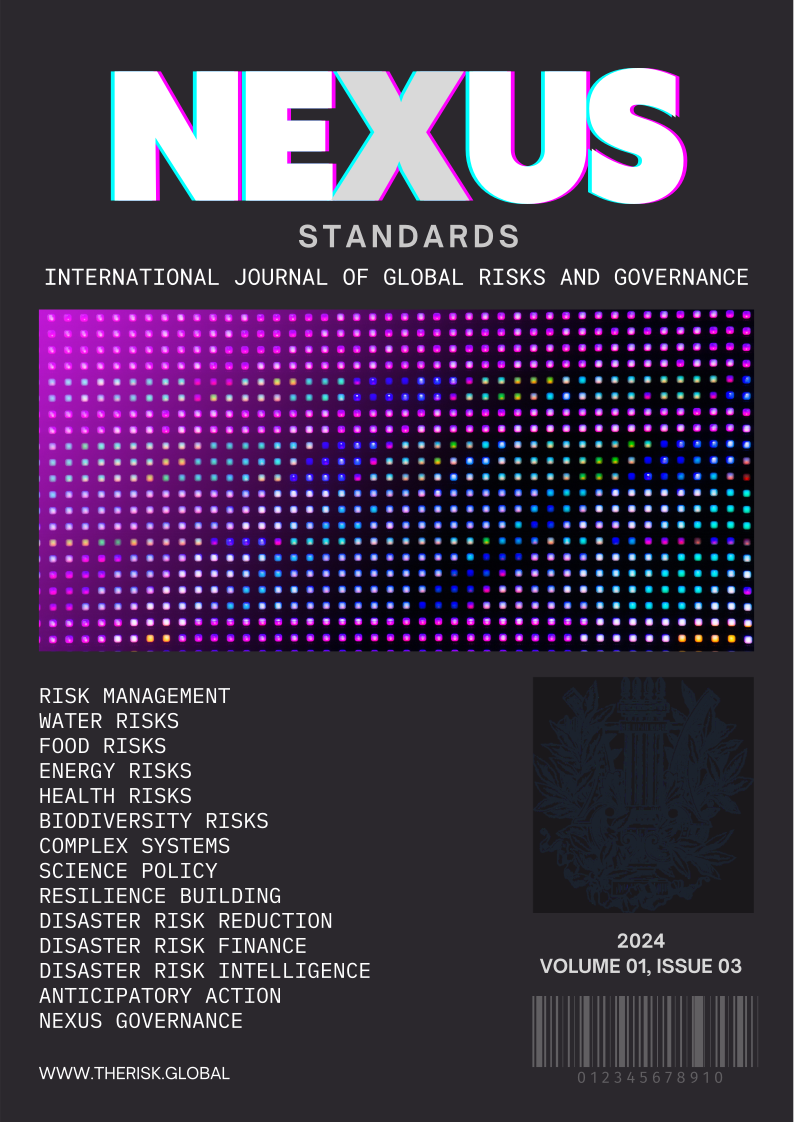
The International Journal of Global Risks and Governance (IJRG) is revolutionizing the understanding and management of global challenges with an integrated nexus approach. Aspiring to be the first decentralized scientific journal in global risks, IJRG leverages Web3 principles to foster an open, transparent, and collaborative ecosystem for researchers, policymakers, and practitioners

  • Continuity-by-Design & Clause Governance — Service continuity engineered into permits, contracts, and SLAs; fewer disputes, faster approvals.
  • Evidence Chain — Provenance from data → methods → outputs → decisions; reproducible, auditable, court-ready.
  • Resilience Blueprints — Measures pre-mapped to Sendai/SDGs/Paris/IHR and sector standards; ready for cabinet and licensing.
  • Scenario & Uncertainty Discipline — Base/adverse/severe paths with explicit confidence bands and sensitivity analysis.
  • NWG Testbeds — Country pilots convert guidance to SOPs before national rollout; lessons flow to regional/global positions.
  • Major Groups Participation — Structured inputs from workers, business, science, Indigenous Peoples, youth, women, NGOs.
  • Sovereign-Grade Privacy — Federated learning, TEEs, and lawful-basis controls enable collaboration without data exfiltration.
  • Open Interoperability — OGC/STAC/OpenAPI; OIDC/SAML—ministries, labs, CSOs, vendors onboard without lock-in.
  • Audit-Grade MRV — Single pipeline for resilience indicators and (where relevant) market disclosures—no double reporting.
  • Finance & Operations Hooks — Pre-arranged liquidity, parametric triggers, and mutual-aid protocols wired into delivery.
  • NWGs (National) — Convene utilities, agencies, academia, private sector, and civil society; define risks, evidence needs, and options.
  • Regional Stewardship Boards — Align methods, resolve cross-border dependencies (rivers, grids, supply corridors), set mutual-aid.
  • Global Secretariat — Curate baselines, manage assurance registry, coordinate submissions to UN/treaty bodies.
  • Consultation Windows — Managed portals for Major Groups with documented responses and revision history.
  • Resilience Docketing — Calendars aligned to parliamentary cycles and global milestones (COPs, GPDRR, WHA, HLPF).
  • Independent Review — Science/ethics/legal panels with public summaries—no black boxes.
  • Escalation Paths — Formal routes to resolve conflicts, data gaps, and urgent risks.
  • Localization — International resolutions translated into municipal SOPs, budgets, and training.
  • Feedback Loops — Monitoring and evaluations trigger clause updates and retabled measures.
  • Continuity Indicator Registry — SAIDI/SAIFI, MTTR, hospital surge capacity, water continuity, 911/112 uptime—formulas & cadence.
  • EO/Sensor/Admin Ingestion — Automated QA/QC, chain-of-custody logs, and gap flags.
  • Model Cards — Assumptions, validation, limits, and bias checks published with each model.
  • Uncertainty Controls — Confidence bands, sensitivity levers, EVPI reporting for decision-makers.
  • Distributional Analysis — Equity/rights impacts quantified (who benefits/loses, where, when).
  • Comparators & Benchmarks — Regional and international baselines inform targets.
  • Open Artefacts — Data dictionaries, code & notebooks where lawful.
  • Ethics & Safety — IRBs/DPIAs for sensitive data; harm-prevention protocols.
  • Public Dashboards — Accessible summaries; microdata access as permitted.
  • Assurance Portal — Read-only, provenance-rich views for auditors, SAIs, and courts.
  • Sendai Framework — Governance, EWS, preparedness, recovery integrated into programs.
  • SDGs — Strong links to 3, 6, 7, 9, 11, 12, 13, 16, 17.
  • Paris/UNFCCC — Adaptation & Loss-and-Damage interfaces with DRR and financing.
  • WHO IHR — Climate/air/water-linked health risk and surge capacity.
  • Human-Rights — FPIC, non-discrimination, remedy pathways built into clauses.
  • Financial Disclosure — ISSB/CSRD/GRI/TCFD/TNFD where resilience intersects markets.
  • Labor & Due Diligence — ILO, OECD, CSDDD embedded into permits/procurement.
  • Cyber/Data — GDPR/DPAs and NIS2-class security for critical infrastructure.
  • Sector Safety — ICAO/IMO/WMO/ITU interfaces for transport, maritime, meteorology, telecom.
  • ISO/IEC — 22301 (BCM) and 31000 (risk) aligned methods and evidence.
  • National Resilience Platform Act — Legal mandate for multi-hazard baselines, continuity dashboards, evidence rights.
  • EWS Modernization — Multi-hazard thresholds, last-mile comms, performance SLAs.
  • Anticipatory Action Protocol — Pre-agreed early actions with triggers, roles, and remedy routes.
  • Continuity-as-a-Service (CaaS) — Outcome-based contracts; vendors paid for verified uptime and time-to-restore.
  • Parametric Liquidity Rails — Forecast/impact triggers for O&M continuity and rapid repair.
  • Mutual Aid & Surge Logistics — Credentialed crews, shared inventories, reimbursement receipts.
  • Nature-Positive Resilience (NbS+) — Floodplains/wetlands/urban forests tied to service KPIs and O&M trusts.
  • Cyber-Physical Guardrails — OT/IT controls, comms fallback, identity federation—secure emergency mode.
  • Resilience of Social Protection — Targeted cash/vouchers/shelters triggered by verified shocks.
  • Resilience Disclosure Code — Standard indicators and uncertainty disclosures for agencies/SOEs.
  • KPI Registry — Jobs, continuity, emissions/nature co-benefits, safety, equity thresholds.
  • Taxonomy Tagging — Eligibility/alignment/DNSH per activity & capex.
  • Multi-Framework Compiles — Single pipeline for Sendai/SDG/UNFCCC/IHR and market disclosures.
  • Maker-Checker — Role-based approvals and immutable logs.
  • Lineage & Legal Hold — Jurisdiction-aware retention & discovery.
  • Public Reporting — Accessible summaries; machine-readable annexes.
  • Assurance Interfaces — Read-only evidence for SAIs, supervisors, rating agencies.
  • Breach Alerts — Automated detection, remediation playbooks, timestamped receipts.
  • After-Action Reviews — Lessons looped into clauses & SOPs.
  • Certification — Recognized conformance for labs, models, and processes.
  • Safeguard Matrices — FPIC, ILO labor, anti-corruption embedded in enforceable clauses.
  • Role-Based Approvals — Local → cabinet sign-offs; fixed escalation.
  • Transparency Registers — Lobbying, conflict, beneficial-ownership disclosures.
  • Sanctions/AML/CFT — Automated checks at grants, permits, and payments.
  • Grievance & Remedy — Time-bound SLAs; public case tracking to closure.
  • Benefit-Sharing Ledgers — Community entitlements traceable to recipients.
  • Field Audits — Randomized/risk-based verification with geotagged evidence.
  • Dispute Workflows — Cure/waiver/structured review captured for precedent.
  • Board/Regulator Cadence — Standard briefings and calendars; decisions archived.
  • Sunset & Refresh — Evidence thresholds trigger revision or retirement.
  • Lawful-Basis Catalog — Dataset-level legal grounds with renewal tracking.
  • Consent & Community Protocols — Respect ILK and local norms; auditable consent.
  • DPIAs — Mandatory for sensitive/cross-border pipelines.
  • Federated Analytics — Models move; data stays in-country.
  • TEEs & Attestation — Confidential compute with provable integrity.
  • Differential Privacy — Controlled noise budgets for safe statistics.
  • Attribute-Based Access — Field-level permissions tied to policy/role.
  • Residency Controls — Storage/processing pinned to national jurisdictions.
  • Standards Conformance — OGC/STAC/OpenAPI; OIDC/SAML/SCIM for identity.
  • Vendor Onboarding — Sandboxes, golden datasets, SLAs, and security attestations.
  • Resilience Control Room — One pane for milestones, risks, financing status, and SLAs.
  • Issue Intake & Scoping — Templates to turn problems into docket-ready notes.
  • Design & Contract Packs — Clause libraries, triggers, SOPs, dispute templates.
  • Consultation & Hearings — Moderated sessions with documented responses.
  • Capacity & Training — Role-based curricula with certification SLAs tied to live ops.
  • Independent Panels — Science/ethics/legal review with public summaries.
  • Change Management — Versioned clauses/datasets/KPIs; migration guides.
  • Risk Registry — Threats and mitigations tracked alongside policy.
  • Crisis Acceleration Mode — Fast-track procedures for urgent risks; audit preserved.
  • Knowledge & Reuse — Playbooks and datasets replicated across NWGs/regions.
  • Risk Reduction — Expected Annual Loss ↓; probability of cascading failure ↓.
  • Continuity — Uptime ↑; MTTR/outage duration ↓; hospital surge capacity ↑.
  • Reliability — SAIDI/SAIFI, water pressure/flow, 911/112 uptime improved.
  • Equity — Vulnerable households covered within SLA; grievance closure time ↓.
  • Nature & Co-Benefits — Peak-flow reduction; cooling degree improvements; air-quality days improved.
  • Capital & Speed — Time-to-financial-close ↓; parametric time-to-cash ≤ 72h; leverage ↑.
  • Pricing & Ratings — Spreads ↓; reinsurance cost ↓; outlook improved.
  • Assurance Quality — Audit exceptions ↓; provenance coverage ↑; uncertainty disclosure = 100%.
  • Adoption & Replication — RPS & runbooks adopted across sectors/regions.
  • Public Trust — Transparency metrics and FOI responsiveness ↑.
Get Access
Start a Resilience Lab
Build Resilience Masterplan
Design a Trigger
Launch a Data Commons
Train Your Model
Image Link
Learning
Quests
Leveraging WILPs for Twin Digital-Green Transition
Image Link
Impact
Bounties
Integration Process Pathways for Tackling ESG Issues
Image Link
Innovation
Builds
Crowdsourcing CCells for Integrated Research & Innovation

Building Tribes for Impact

Members can join working groups on the network platforms to operate as transition arenas, taking on specific challenges related to ESG issues. Each group works at national, regional, or local levels in a semi-autonomous mode with its own rules, logic, incentives, and assessment mechanisms. Working Groups leverage the full potential of the GCRI's multi-platform network to engage QH stakeholders, generate consensus, assemble CCells, create credit pools and manage teams across different disciplines. A competence cell is conceived as a small production unit which functions as a Digital Twin to simulate risks and innovation in large-scale projects. Competence Cells encourage various actors from QH to sponsor LLL programs and support micro-credentials through WILPs for upskilling, risk mitigation, and resilience building.

Have questions?