




The Global Centre for Risk and Innovation (GCRI)

Disaster Risk Reduction

Disaster Risk Reduction is not only about preparedness plans, emergency response, or post-crisis recovery. It is becoming a core capability for governments, cities, public authorities, humanitarian actors, insurers, funders, enterprises, universities, infrastructure operators, communities, and development institutions facing climate extremes, infrastructure fragility, ecosystem degradation, public health vulnerability, cyber disruption, food and water stress, displacement, supply-chain exposure, and cascading systemic risk. This area of activity helps institutions reduce risk before hazards become disasters. It connects disaster risk intelligence, exposure and vulnerability analysis, multi-hazard records, cascade modelling, resilience indicators, public authority learning, community safeguards, finance-readiness, national portfolios, public-safe reporting, and responsible handoff pathways so that risk reduction can move from fragmented planning to structured public-good capability

Image link
Hazard Intelligence
Hazard intelligence structures information about floods, storms, heat, drought, wildfire, earthquakes, landslides, epidemics, technological hazards, cyber disruptions, infrastructure failures, environmental degradation, and compound events into usable records. It helps technical, policy, finance, and public authority audiences understand the nature, frequency, intensity, geography, uncertainty, and limitations of hazard-related evidence without turning analysis into public warnings, official forecasts, or emergency commands
Vulnerability Analytics
Vulnerability analytics helps institutions understand why hazards become disasters by examining social, economic, physical, environmental, institutional, digital, and infrastructure conditions that increase harm. It supports records on poverty, housing, health, disability, access, governance capacity, ecosystem degradation, infrastructure fragility, cyber exposure, displacement, food and water insecurity, and community sensitivity while avoiding stigmatizing labels, community scoring, or social scoring
Cascade Modelling
Cascade modelling examines how shocks travel through interconnected systems. A flood may disrupt transport, health access, energy supply, food distribution, communications, insurance exposure, public finance needs, and community wellbeing. This area structures propagation pathways, dependency records, scenario assumptions, confidence labels, uncertainty labels, and public-safe summaries so cascading risk can be studied before losses multiply
Risk Financing Readiness
DRF Readiness Disaster Risk Finance readiness makes disaster risk reduction more readable to funders, insurers, donors, development actors, public finance institutions, and capital readers. It structures protection gaps, risk-layering questions, assumptions, dependencies, data gaps, model gaps, public authority dependencies, fiscal exposure, contingent liability questions, and insurance-readiness issues without providing underwriting, investment advice, donor allocation, public finance allocation, transaction activity, or financeability claims
Preparedness Systems
Preparedness systems connect risk intelligence to institutional learning, capability gaps, continuity questions, public authority dependencies, early-action pathways, training needs, public-safe reports, national portfolios, and handoff context. They help institutions understand what must be prepared before disaster impacts occur while preserving the difference between preparedness learning, official emergency command, public warning, public finance allocation, procurement, and implementation
Recovery Finance
A structuring desk designs Build-Back-Better facilities- program loans, reconstruction bonds, revolving reserves- with O&M covenants, milestone-linked disbursements, and step-down/step-up pricing tied to verified continuity and equity outcomes. Parametric tranches can bridge early cash needs, while transparency and assurance artifacts protect ratings and crowd in private capital. Funding flows when results are proven, not merely promised
Exposure Mapping
Exposure mapping identifies people, infrastructure, services, ecosystems, supply chains, assets, facilities, settlements, transport routes, digital systems, and public institutions that may be affected by hazards. It combines geospatial intelligence, data governance, public-safe mapping, infrastructure dependency records, and sensitivity controls so exposure can be understood without disclosing protected locations, enabling targeting misuse, creating insurance scores, or implying public authority decisions
Multi-Hazard Analysis
Multi-hazard analysis structures how multiple hazards interact across time, geography, sectors, and systems. It supports understanding of concurrent, compounding, sequential, and cascading risks across climate, infrastructure, health, ecosystems, food, water, energy, cyber, logistics, and public services. This makes disaster risk more legible for institutions without converting analysis into official risk ratings, procurement signals, public warnings, or implementation instructions
Resilience Metrics
Resilience metrics help institutions understand capacity, preparedness, redundancy, continuity, adaptive capability, recovery potential, public-service resilience, infrastructure readiness, community capacity, ecosystem buffering, and institutional learning. These metrics support improvement, not ranking. They help identify gaps, learning needs, investment questions, and preparedness priorities without becoming country scores, community scores, procurement signals, finance signals, or public authority approvals
Community Safeguards
Disaster risk reduction must protect the people and places it seeks to serve. This area supports community-sensitive data handling, lived-risk knowledge, accessibility, youth and disability inclusion, humanitarian sensitivity, Indigenous protocol-sensitive controls where applicable, protected knowledge restrictions, consent-boundary notices, public-safe summaries, and community-facing correction channels so DRR work remains non-extractive, safe, and accountable
Nexus Architecture
DRR handoff architecture transfers structured disaster risk context to competent actors that may reduce risk, finance resilience, procure systems, regulate, insure, design infrastructure, implement programs, or operate services separately. Handoff packages preserve hazard, exposure, vulnerability, cascade, safeguard, finance-readiness, public authority, procurement, technical, recipient responsibility, correction, and archive context without making the public-good layer the executor of downstream action
Compliance Vault
A read-only provenance vault provides SAIs and regulators the same immutable record—decisions, clauses, cures/waivers, inspections, and after-action updates to codes and SOPs. Evidence chains, versioned documentation, retention/legal-hold policies, and selective redaction ensure transparency without compromising privacy. Audits simplify, exceptions fall, and public trust strengthens
Image link

The Nexus Reports provide comprehensive evaluations of country-specific risks and opportunities, focusing on biodiversity, ecosystem services, climate change vulnerabilities, socio-economic risks, the food-water-energy nexus, and exponential technologies. Drawing on authoritative sources, these reports offer tailored policy recommendations, detailed analyses, and practical case studies, integrating global scientific research to manage risks and drive sustainable development

Image link

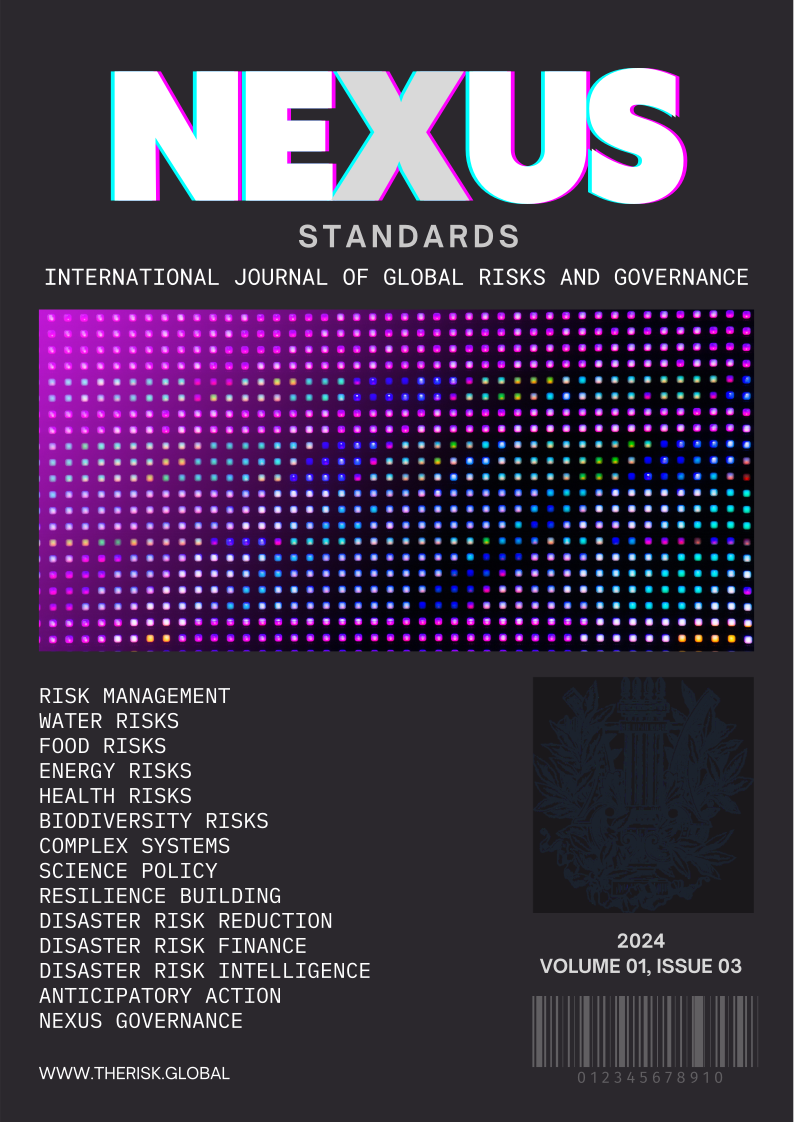
The International Journal of Global Risks and Governance (IJRG) is revolutionizing the understanding and management of global challenges with an integrated nexus approach. Aspiring to be the first decentralized scientific journal in global risks, IJRG leverages Web3 principles to foster an open, transparent, and collaborative ecosystem for researchers, policymakers, and practitioners

Get Access
Start a DRR Lab
Build Resilience Masterplan
Design a Trigger
Launch a Data Commons
Train Your Model

Building Tribes for Impact

Consortium Pathways
Consortium pathways provide the formal entry point for institutions seeking structured participation in anticipatory action, early risk intelligence, preparedness, disaster risk intelligence, humanitarian readiness, climate risk, finance-readiness, and national capability-building. They allow governments, enterprises, universities, funders, insurers, public authorities, civil society, humanitarian actors, technical partners, and communities to engage through global, regional, and national channels while keeping collaboration distinct from public warnings, finance, procurement, or implementation
Global Guilds
Anticipatory Action Working Groups turn expert knowledge and institutional experience into structured public-good outputs. They may focus on signals, indicators, trigger logic, forecast interpretation, scenario workflows, humanitarian sensitivity, community safeguards, public authority learning, finance-readiness, national portfolio inputs, technical notes, public-safe reports, and readiness questions that can be reviewed, corrected, archived, and routed for further use
Network Memory
Network memory preserves signal records, indicator histories, scenario outputs, trigger notes, public-safe summaries, learning materials, reports, datasets, technical objects, registry entries, listings, correction histories, archive records, and continuity pathways. It ensures that anticipatory action improves over time rather than resetting after each event, crisis, exercise, pilot, or annual cycle
Project Vehicles
National Consortium Companies and Project SPVs provide separate implementation-adjacent vehicles that may receive handoff context when anticipatory action work is mature enough for downstream consideration. These vehicles are distinct from the public-good layer and require their own legal, financial, public authority, humanitarian, procurement, operational, safeguard, liability, and governance conditions before any implementation activity occurs
National Councils
National Councils and Helix Councils organize country-level participation across public authorities, emergency institutions, academia, industry, technology, infrastructure, capital, insurance, donors, civil society, communities, media, humanitarian actors, and public-interest stakeholders. They translate anticipatory action priorities into national portfolios, preparedness learning agendas, working groups, capability needs, public-safe outputs, finance-readiness questions, and responsible handoff pathways
Competence Cells
Competence Cells provide focused expert capacity for anticipatory action challenges, including disaster risk intelligence, climate forecasting context, geospatial analysis, hazard modelling, trigger design, scenario simulation, humanitarian data governance, cyber risk signals, public health risk intelligence, food and water stress, finance-readiness questions, and public-safe reporting through bounded, reviewable, correctionable work
Annual Build
Nexus Universe provides the annual build and convergence cycle where anticipatory action work can be prepared, reviewed, demonstrated, routed, and advanced. It brings together national portfolios, risk signals, indicator sets, public authority learning rooms, finance-readiness rooms, working groups, competence cells, scenario workflows, public-safe reports, registry updates, and handoff pathways without becoming a warning center, emergency command body, investment platform, procurement forum, or execution event
Have questions?