
Global Risks Index (GRIx)
Public Risks
Public Risk Intelligence for Trust, Legitimacy, Service Continuity, and Civic Resilience
Public risks emerge when institutions lose the capacity to maintain trust, continuity, coordination, and legitimacy under pressure. Climate shocks, economic volatility, misinformation, cyber incidents, public health threats, migration pressures, disaster risk, technology disruption, political uncertainty, and service-delivery failures can combine to weaken confidence, fragment accountability, delay response, and intensify public harm
The Global Centre for Risk and Innovation (GCRI) provides public risk assessments, institutional resilience reviews, governance risk analysis, public trust diagnostics, crisis-readiness support, social cohesion intelligence, service-continuity reviews, public-safe communication briefs, policy-learning materials, scenario exercises, and handoff packages. This stream is designed for governments, public authorities, cities, international organizations, enterprises, universities, funders, civil society, and public-interest partners that need to understand public-facing risk before it becomes crisis

Public Risk Assessment
Public Risk Assessment evaluates risks to public trust, institutional legitimacy, service continuity, information integrity, public safety, governance capacity, and social cohesion under complex stress. It supports governments, cities, public authorities, enterprises, funders, civic institutions, and public-interest partners seeking public risk intelligence, institutional resilience, and crisis-readiness evidence
Institutional Resilience
Institutional Resilience Review examines whether public institutions can maintain coordination, accountability, service delivery, communication, and decision readiness under stress. It identifies mandate gaps, decision bottlenecks, public authority dependencies, accountability issues, crisis-governance weaknesses, and continuity risks, supporting governance resilience, public-sector readiness, and institutional capability-building
Service Continuity
Service Continuity Analysis evaluates essential public services under climate shocks, cyber incidents, public health threats, infrastructure disruption, workforce constraints, social stress, and governance fragmentation. It produces service dependency records, continuity briefs, degraded-mode questions, resilience priorities, and handoff-ready outputs for public service continuity planning and institutional preparedness
Public Trust Diagnostics
Public Trust Diagnostics assesses confidence, legitimacy, stakeholder trust, communication risk, credibility, misinformation exposure, and public perception under pressure. It helps institutions identify trust fragility before reputational, operational, political, or social risk escalates, supporting public trust strategy, crisis communication, public-safe reporting, and legitimacy-sensitive decision preparation
Crisis Readiness
Crisis Readiness Assessment prepares institutions for public-facing shocks that test communication, coordination, public safety, service continuity, and legitimacy. It combines scenario exercises, institutional stress testing, preparedness records, communication planning, and non-decision learning rooms to identify crisis-readiness gaps before emergency, public authority, or implementation action is required
Information Integrity
Information Integrity Review addresses misinformation, contested narratives, claims risk, communication breakdown, low-trust environments, and public confusion. It develops public-safe communication briefs, correction pathways, claims-discipline records, stakeholder-facing summaries, and institutional messaging controls for organizations managing sensitive public risk, social trust, and crisis communication environments
Social Cohesion Analysis
Social Cohesion Analysis examines polarization, exclusion, community tension, grievance, displacement pressure, access gaps, civic trust, vulnerability, and local legitimacy. It supports public-risk planning, community resilience, public-safe reporting, and institutional preparedness without stigmatizing communities, creating social scores, or turning analysis into enforcement signals
Public Dashboard Design
Public Dashboard Design creates controlled dashboards for service continuity, preparedness status, trust signals, institutional stress indicators, public-safe summaries, and correction records. These dashboards support transparency, public-risk monitoring, institutional learning, and situational awareness while remaining separate from official warnings, emergency commands, regulatory decisions, or public authority action
Public Risk Handoff
Public Risk Handoff packages governance dependencies, service-continuity risks, communication issues, stakeholder concerns, public authority dependencies, safeguard notes, correction routes, and recipient responsibilities. It prepares competent actors to assess public-risk actions separately, supporting responsible implementation pathways without substituting for official decisions, procurement, public finance, or program execution
Trusted By World Leaders
We support governments, multilaterals, regulators, DFIs, central banks, humanitarian agencies, utilities, insurers/reinsurers, critical-infrastructure operators, research networks, and national working groups (NWGs). Our leadership is earned through proactive, cutting-edge solutions and initiatives that tackle urgent challenges while balancing immediate impact with long-term sustainability. Strengthened by strategic partnerships with global powerhouses, GCRI sets a new standard for protection and progress in an era of unprecedented risks and opportunities
Engagement can begin through Nexus Consortiums, National Councils, Public Risks Working Groups, governance and public-interest Competence Cells, public authority learning rooms, civic participation pathways, institutional partnerships, sponsorship routes, and lawful handoff channels. The stream supports public-risk intelligence, learning, readiness, and communication; official decisions, legal determinations, public warnings, emergency command, public finance, procurement, and program execution remain separate
Our National Working Groups (NWGs) converge to shape a future defined by Resilience , Innovation , and Collaboration. By uniting cross-sector perspectives through a seamless hybrid model; from community to cabinet, and field to cloud—we translate collective insight into breakthrough innovations and durable partnerships that deliver measurable impact and a more sustainable future for all
[mapsvg id="1"]
Unlocking the Power of Spatial Finance 🌌 for Disaster Readiness 📡
Transforming risk management by integrating DRR, DRF, and DRI into a seamless, proactive system. Leveraging cutting-edge geospatial analytics and innovative financial triggers, NE enables real-time insights and rapid resource mobilization to build resilient communities and drive sustainable growth
Public Risk Data Foundation
A deployable foundation for public trust, service continuity, institutional stress, governance dependencies, public communication, crisis records, stakeholder context, accessibility, social vulnerability, and public-safe civic data. This layer establishes metadata, data-use rules, source records, sensitivity classes, consent boundaries, protected knowledge controls, correction status, and archive discipline
Public Trust Governance
A governance layer for trust-sensitive data, public-facing risk intelligence, stakeholder information, civic inputs, public authority records, public-safe summaries, and communication outputs. It includes claims discipline, review workflows, access control, correction pathways, non-surveillance controls, non-targeting safeguards, data minimization, and public-safe release rules
Governance Knowledge Graph
A knowledge graph connecting mandates, institutions, decision rights, accountability pathways, service responsibilities, public authority boundaries, escalation routes, stakeholder roles, delivery dependencies, and lawful handoff points. This supports governance resilience and public authority learning without replacing formal public authority decisions
Crisis Workflow
A workflow and simulation layer for scenario exercises, tabletop simulations, role mapping, preparedness checklists, communication review, after-action records, corrective actions, claims review, and public-safe reporting. It supports institutional readiness before emergency action, regulatory action, or public authority decision-making occurs
Public Risk Handoff
A handoff layer packaging governance dependencies, service-continuity gaps, communication risks, stakeholder concerns, public authority boundaries, safeguard notes, correction routes, archive records, and recipient responsibilities for competent actors that may act separately through their own authority
Public Systems Integration
An integration layer connecting public service systems, municipal platforms, emergency systems, institutional records, service-delivery data, communication channels, stakeholder inputs, public-safe reporting sources, and crisis-management tools. It supports secure APIs, event streaming, workflow integration, case-routing, role-based access, and controlled cross-agency collaboration
Service Continuity Graph
A dependency graph mapping essential services, delivery channels, workforce requirements, digital dependencies, infrastructure reliance, degraded-mode thresholds, escalation routes, recovery pathways, and public authority dependencies. This layer helps institutions identify where public service disruption may occur and where continuity capacity must be strengthened
Public Risk Analytics
An analytics layer for stakeholder concerns, grievance signals, public perception risk, service failure risk, communication gaps, legitimacy indicators, misinformation exposure, trust erosion patterns, civic vulnerability, and institutional stress. It is designed for contextual public-risk intelligence, not surveillance, social scoring, advertising, enforcement, or political targeting
Public Dashboard
A dashboard and reporting layer presenting service continuity, preparedness status, trust signals, institutional stress indicators, public-safe summaries, correction notices, learning records, and data freshness indicators. It includes role-based views, multilingual access, accessibility, interpretation notes, update cadence, non-warning status, and correction links
Public Risk Operating Model
An operating model layer for public-risk working groups, governance competence cells, civic data stewards, dashboard stewards, public authority learning rooms, communication reviewers, claims reviewers, correction routines, community feedback channels, archive rules, and continuous service-resilience improvement
Innovation Lab
Discover;
Learn;
Build;
We support innovation, collaboration and knowledge-sharing amongst our members, partners and the broader research, development, and education communities. Our WILPs streamline the identification, mitigation, and evaluation of Risks, followed by the optimal use of GRIx to tackle Issues and manage adverse impacts. They provide secure network platforms that enable citizens to participate in MPM and use iVRS to report risks and values anywhere. Risk Pathways deliver out-of-the-box CRS functionality to meet institutional requirements, including SCF taxonomies for digital-green skills, compliance frameworks and real-time validation systems. They help members and QH stakeholders with DICE to navigate essential resources and find the right levers across the public-private-planet landscape.
MPM
Integrated pathways for existing national portfolios on the right to inclusive education, skills development, and career mobility through LLL for all
CRS
Rewarding participation with utility value across the network to increase interoperability and career mobility
DICE
Next-generation of internet for risk and innovation in pluralistic societies
GRIx
Open source standard indexing system for linked open data set about global risk and humanitarian crisis.
iVRS
Stakeholder engagement and reporting mechanism for Environmental, Social and Governance (ESG) risks and impacts
SCF
Frameworks, skills taxonomies, competencies and policies for the twin digital-green transition
Research
0%
Design
0%
Innovation
0%
Acceleration
0%
Policy
0%
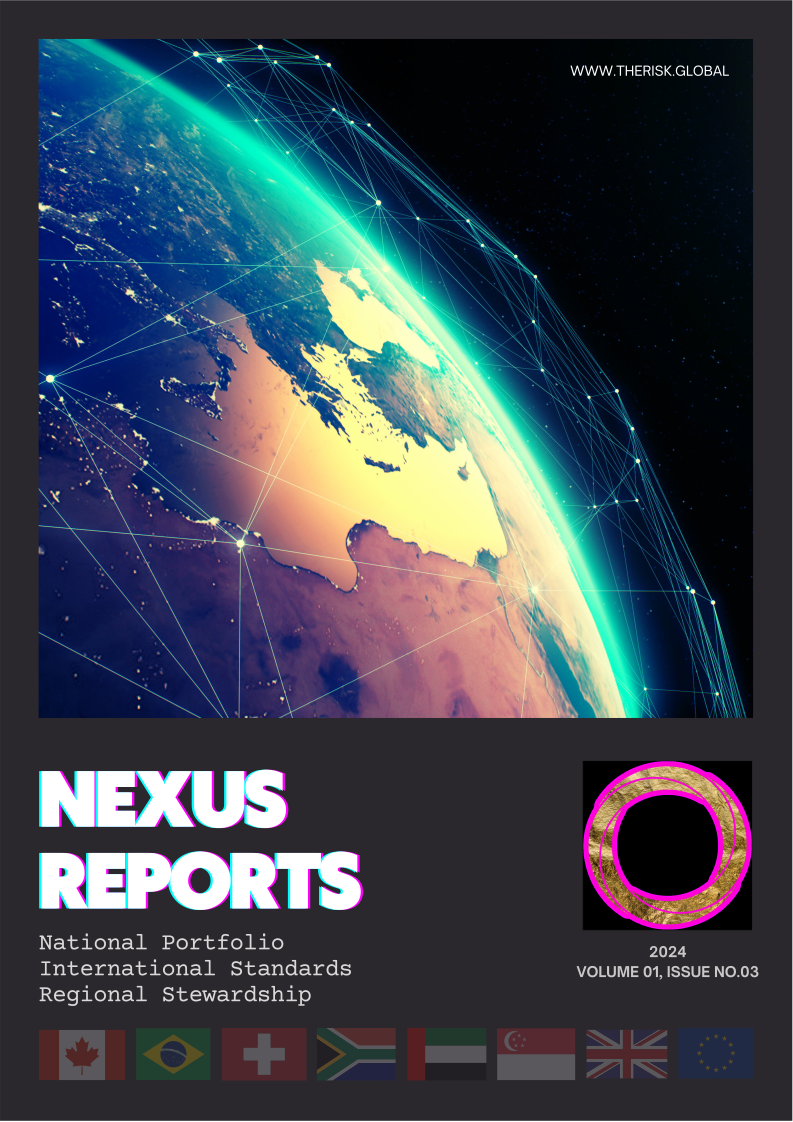
The Nexus Reports provide comprehensive evaluations of country-specific risks and opportunities, focusing on biodiversity, ecosystem services, climate change vulnerabilities, socio-economic risks, the food-water-energy nexus, and exponential technologies. Drawing on authoritative sources, these reports offer tailored policy recommendations, detailed analyses, and practical case studies, integrating global scientific research to manage risks and drive sustainable development