

Systemic risk work needs evidence that cannot be made public. This page explains how data rooms let qualified teams analyse it where it sits, under a recorded mandate, and what leaves the room.
Key takeaways
- In the Nexus Consortium, data rooms are controlled settings in which sensitive evidence is analysed under a recorded mandate, without being pooled into a central store; the evidence stays with its steward [1, 2].
- The Global Centre for Risk and Innovation (GCRI) designs the controls: mandates and policy decisions in NXS-NSF, lineage and quality in NXS-GRX, and three visibility classes, public, restricted and protected, set by the record owner within the law [3, 4, 2].
- The pressure is real: public administration was the target of 38.2% of 4,875 incidents ENISA analysed in the EU between July 2024 and June 2025, and phishing opened about 60% of observed intrusions [5].
- The design follows established practice rather than inventing it: the Five Safes used by the UK Office for National Statistics, the secure processing environments of the European Health Data Space, NIST zero trust and media-sanitization guidance, and the FAIR and CARE principles [6, 7, 8, 9, 10, 11].
- Nothing here is a deployed service: the programme is at service level R0, information and enquiries, as the claims and readiness register and programme status record, and no data room is open today [12].
What a data room is in the programme
A data room in the programme is a controlled setting in which named people, for a recorded purpose and for a limited time, analyse evidence that cannot be made public, and from which only reviewed outputs leave. It is a collaboration pattern of the Nexus Consortium, set out on therisk.global, the public-good programme through which The Global Centre for Risk and Innovation (GCRI), The Global Risks Forum (GRF) and The Global Risks Alliance (GRA) help countries examine interconnected risk with shared methods. The term describes a pattern of controls, not a product: in the current model it is carried by the Data room that each of the twenty Nexus systems contains, and, during the annual programme, by the secure data spaces of the temporary Core [13, 14].
Three properties define it. Access is bound to a mandate that names the grantor, the delegate, the purpose, the jurisdiction and the expiry, and that mandate is held by NXS-NSF (trust, authorization and assurance) [3]. The evidence keeps its origin: NXS-GRX (canonical data, provenance and risk) records each source release with its rights, temporal coverage and lineage, and distinguishes absent, stale, disputed and measured quality [4]. And what leaves the room is classed by its owner as public, restricted or protected, and recorded with a version [2].
A data room is therefore not a repository, a disclosure portal or a shared drive. It is not a substitute for a data-sharing agreement, a privacy assessment, a community consent or a regulator’s permission, all of which stay with the parties who hold them. GCRI designs and stewards the controls; it does not own the contents, and it never decides on behalf of the owner whether a record may be published [15].
Why sensitive evidence needs a controlled setting
The evidence that systemic risk work needs most is usually the evidence least able to travel. A city holds the condition of its drainage and the location of its most exposed residents; a utility holds the dependency map of its substations; a hospital holds its continuity constraints; an insurer holds claims patterns; a community holds knowledge that is its own. If none of it can be used, an analysis of cascading risk stays shallow. If all of it is pooled, the analysis creates a new and concentrated exposure.
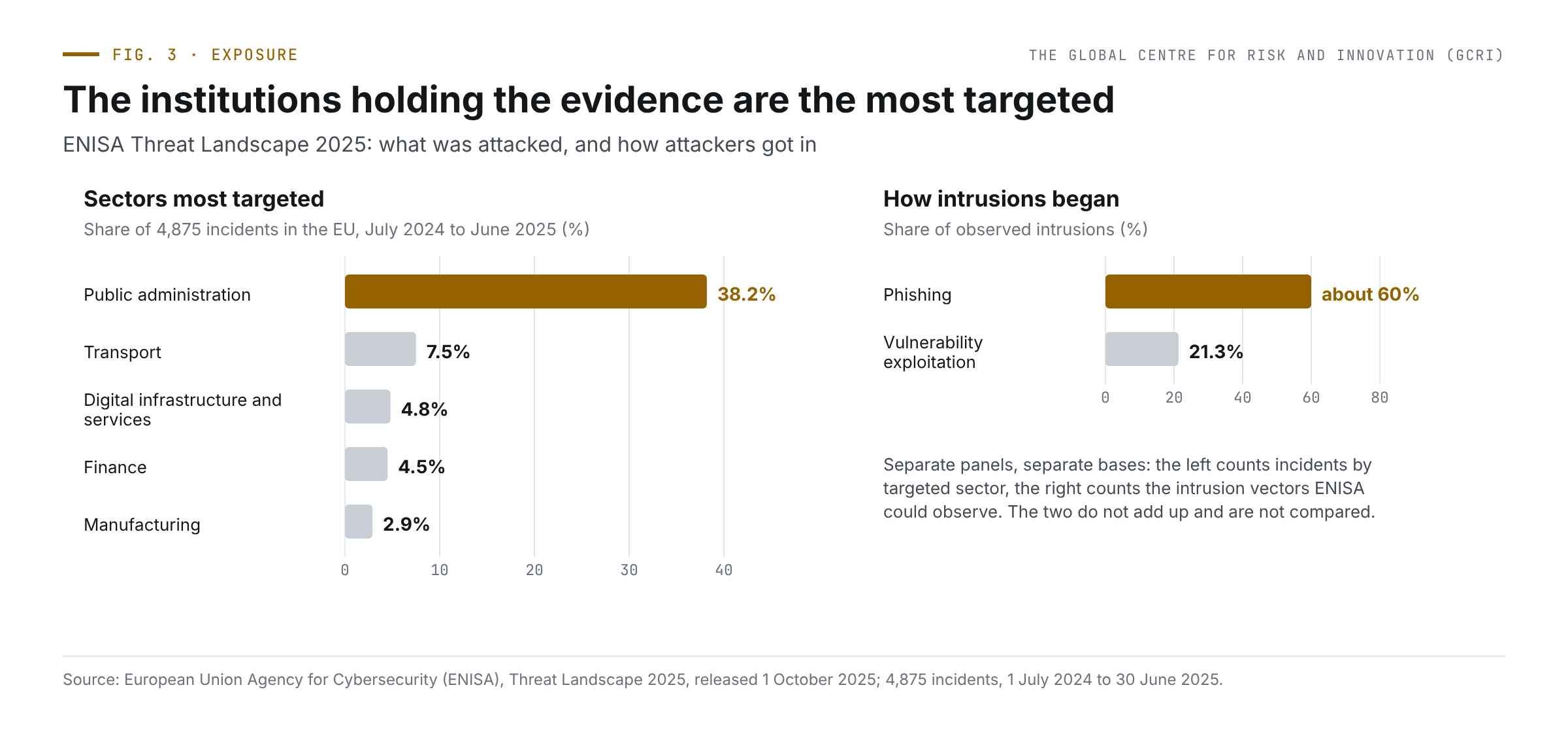
That exposure is not theoretical. The European Union Agency for Cybersecurity, in its Threat Landscape 2025, analysed 4,875 incidents in the EU between 1 July 2024 and 30 June 2025: public administration was the most targeted sector, with 38.2% of incidents, followed by transport at 7.5%, digital infrastructure and services at 4.8% and finance at 4.5% [5]. Phishing was the leading way in, at about 60% of observed intrusions, ahead of vulnerability exploitation at 21.3% [5]. The institutions whose evidence a national risk picture depends on are, in other words, the institutions most often attacked, and most often through the people who use their systems.
Controlled collaboration answers both halves of the problem. It lets a qualified team work on the evidence where it sits, under conditions the owner sets, and it limits what can be taken out to what has been reviewed. It is the same reasoning that led national statistical offices and health systems to build secure research environments, and the programme adopts it rather than reinventing it [6, 7].
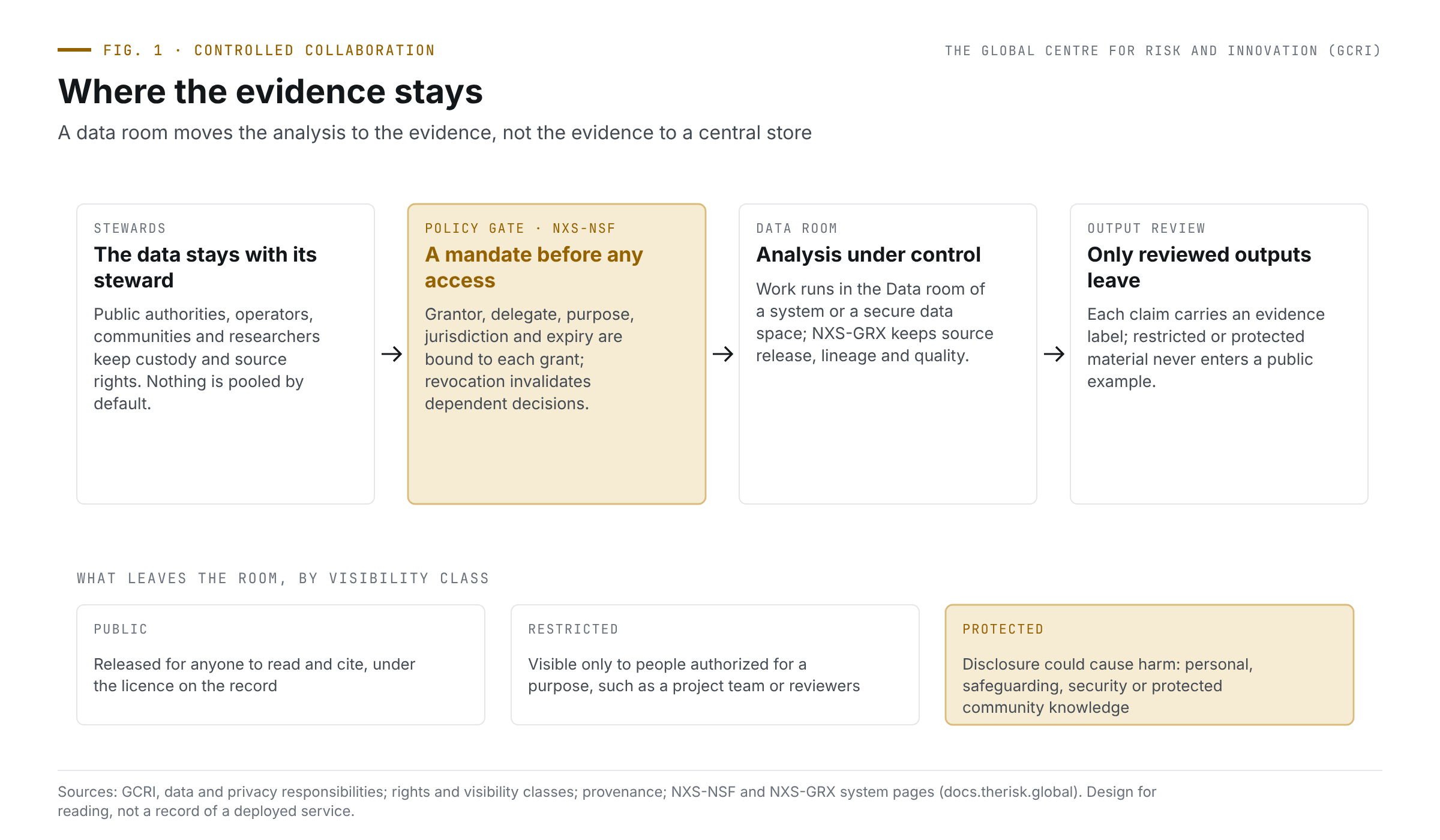
Compute to data: the evidence stays with its steward
The first rule is that nothing is pooled by default. Research data keeps its source rights and limitations, and the original source authority is retained; participation records are used only for the programme they relate to; enquiries are used to answer the enquiry and are never used for marketing [1]. Where a shared-system mission crosses a border, the work is designed to qualify each partner’s scope and data agreements, analyse locally where necessary and compare governed outputs, and federation creates no right to move data [16].
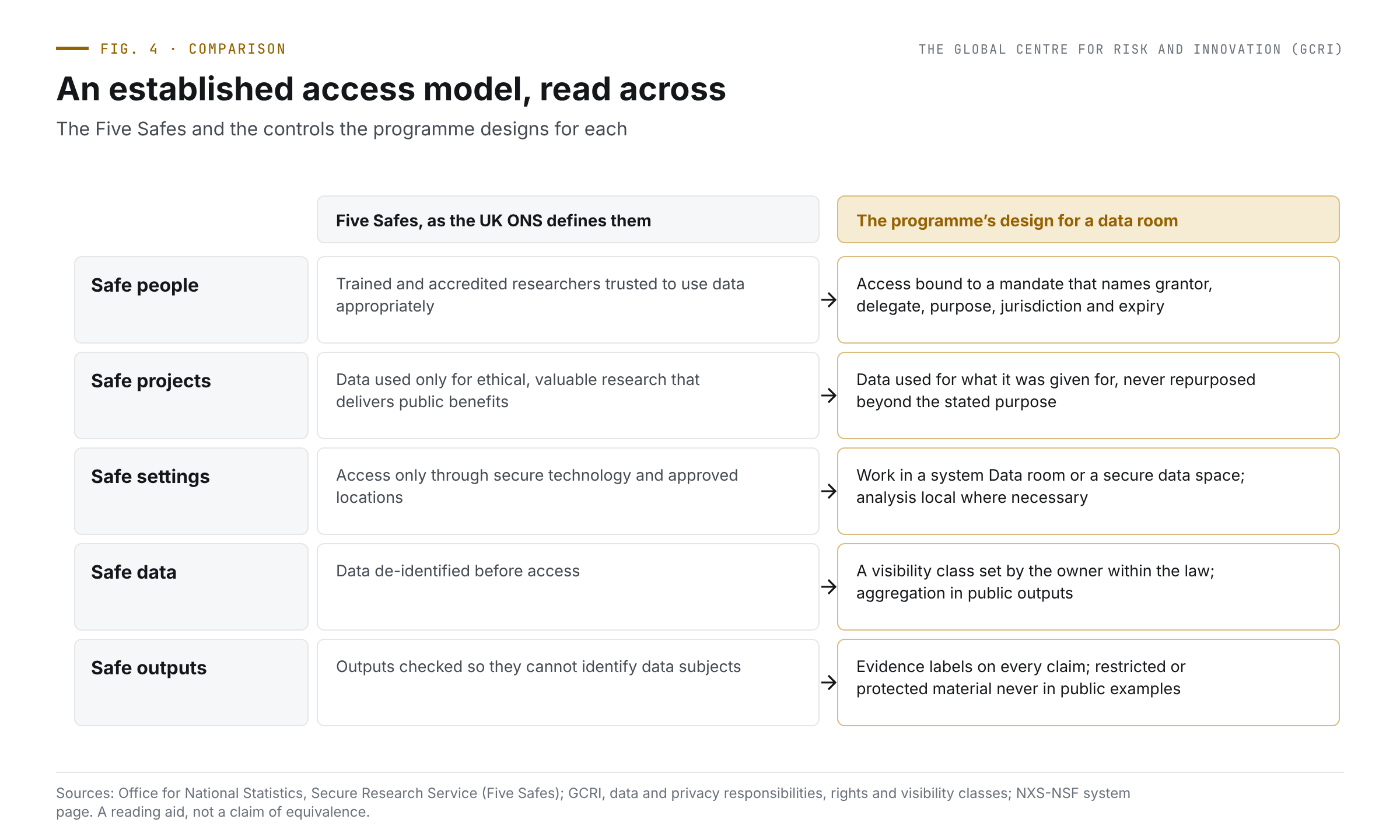
Moving the analysis to the evidence is an established pattern. The UK Office for National Statistics runs its Secure Research Service on the Five Safes: safe people, safe projects, safe settings, safe data and safe outputs, with access only through secure technology and approved locations; it recorded 868 current projects and 254 started in the previous twelve months in its July 2026 update [6]. The European Health Data Space Regulation, in force since 26 March 2025, requires that secondary use of health data take place only in secure processing environments, under a permit from a health data access body, and that no personal data be downloaded from them [7].
The programme reads these models as comparators, not as claims of equivalence. Its own design binds each grant to a mandate in NXS-NSF, keeps every transformation in a lineage graph designed to follow the W3C PROV ontology, and lets the owner, not the platform, decide whether anything becomes public [3, 17, 18, 2].
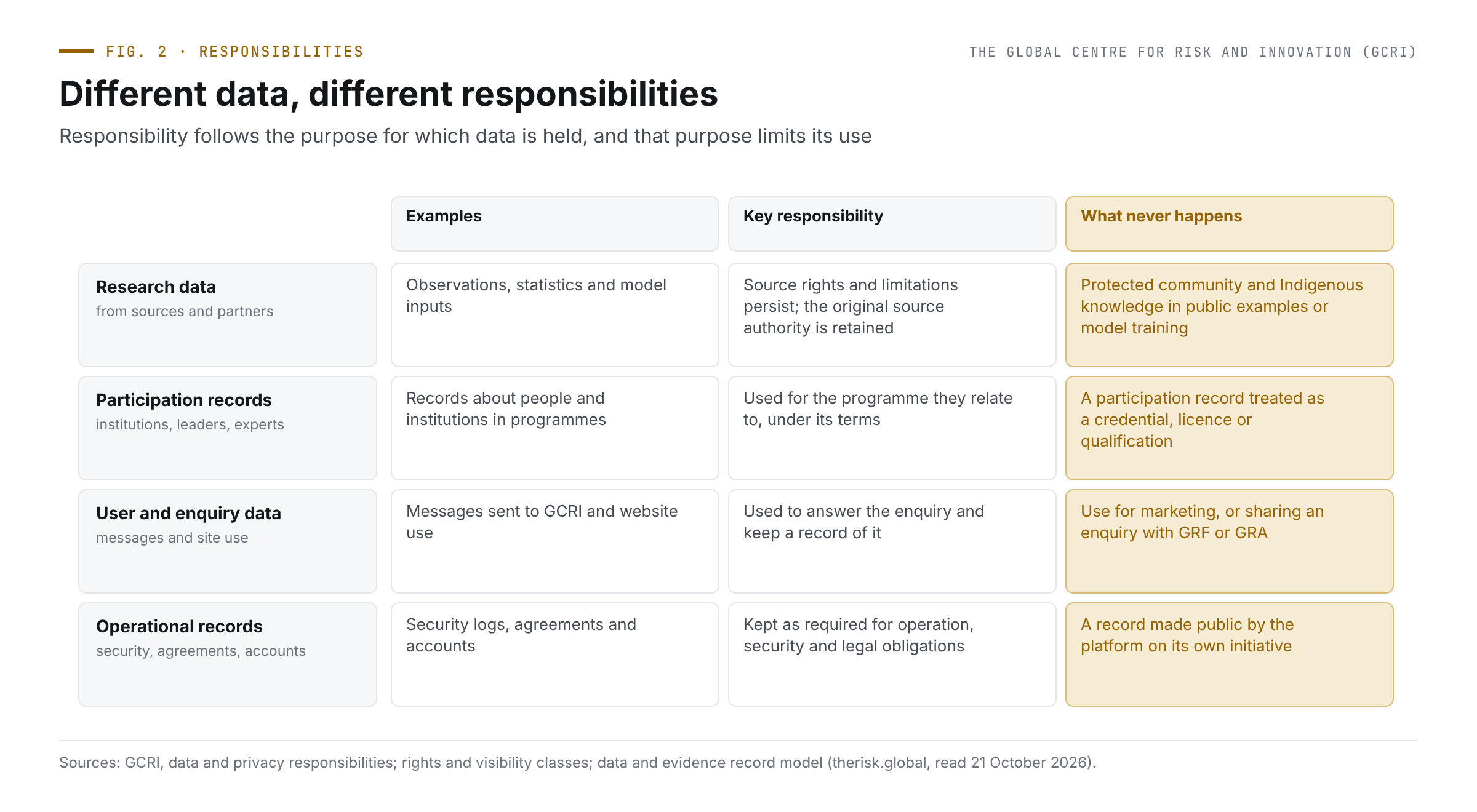
Four kinds of data, three visibility classes
GCRI, in its statement of data and privacy responsibilities, distinguishes four kinds of data, each with its own responsibility: research data from sources and partners, participation records about institutions, leaders and experts, user and enquiry data from people who write to GCRI or use its sites, and operational records such as security logs, agreements and accounts [1]. GCRI, GRF and GRA each have their own privacy notice and controller, and enquiries are not shared across institutions; if a matter belongs to another institution, the enquirer is told where to write [1].
Every record in the programme’s participation records is placed in one of three visibility classes [2]. A public record is released for anyone to read and cite under the licence stated on it. A restricted record is visible only to people authorized for a purpose, such as a project team or reviewers. A protected record is one whose disclosure could cause harm, such as personal, safeguarding, security or protected community knowledge. The owner decides the class within the law; people named in a record can exercise their privacy rights; and protected and Indigenous knowledge is never published or used in public examples or model training without its holders’ consent [2, 1].
Withdrawal is designed to be visible rather than silent. An owner can withdraw a record from public view; its identifier stays and resolves to a notice that says it was withdrawn, when, and whether a replacement exists, and the change is kept in the version history [2]. The record model of the programme’s participation records sets out the common fields every record carries: a permanent identifier, the schema version, the issuer and authority, the origin with an evidence label, the status and validity period, the visibility class and the version chain [15].
| Kind of data | Examples | Key responsibility |
|---|---|---|
| Research data | Observations, statistics, model inputs from sources and partners | Source rights and limitations persist; original source authority is retained [1] |
| Participation records | Records about institutions, leaders and experts in programmes | Used for the programme they relate to, under its terms [1] |
| User and enquiry data | Messages sent to GCRI and website use | Used to answer the enquiry and keep a record of it; never used for marketing [1] |
| Operational records | Security logs, agreements, accounts | Kept as required for operation, security and legal obligations [1] |
How the twenty systems carry the controls
No single system is the data room; the controls are divided so that no room worker can quietly become the authority for something it does not own. NXS-NSF is the single writer of consent, delegation, mandate, sovereignty, disclosure and decision-receipt records; it separates classification, residency, consent and disclosure conditions in each data-handling record, and a revocation invalidates dependent decisions and cached grants [3]. Every other system asks it for a policy decision and reads the answer; none writes it.
NXS-GRX keeps the evidence honest once it is inside. It records the rights and lineage of each source release, validates mappings and units against one ontology release, preserves conflicts and dependence assumptions when sources are fused, and propagates a source correction to dependent products without rewriting old results [4]. Its method boundary forbids flattening observation, inference, prediction and simulation into a single unqualified truth value [4]. NXS-HUB (knowledge, records and learning) applies the same discipline to institutional records: it respects confidentiality, source access lists and publication conditions, and keeps community participation separate from project and data authorization [14].
Each system has ten rooms, eight of them shared, and one of the shared rooms is the Data room, where the system’s datasets, sources and lineage live as NXS-GRX products or system-owned records [14]. A controlled collaboration is therefore always a collaboration in a named room of a named system, under a named mandate, which is what makes it auditable after the fact.
Controls by stage, from purpose to purge
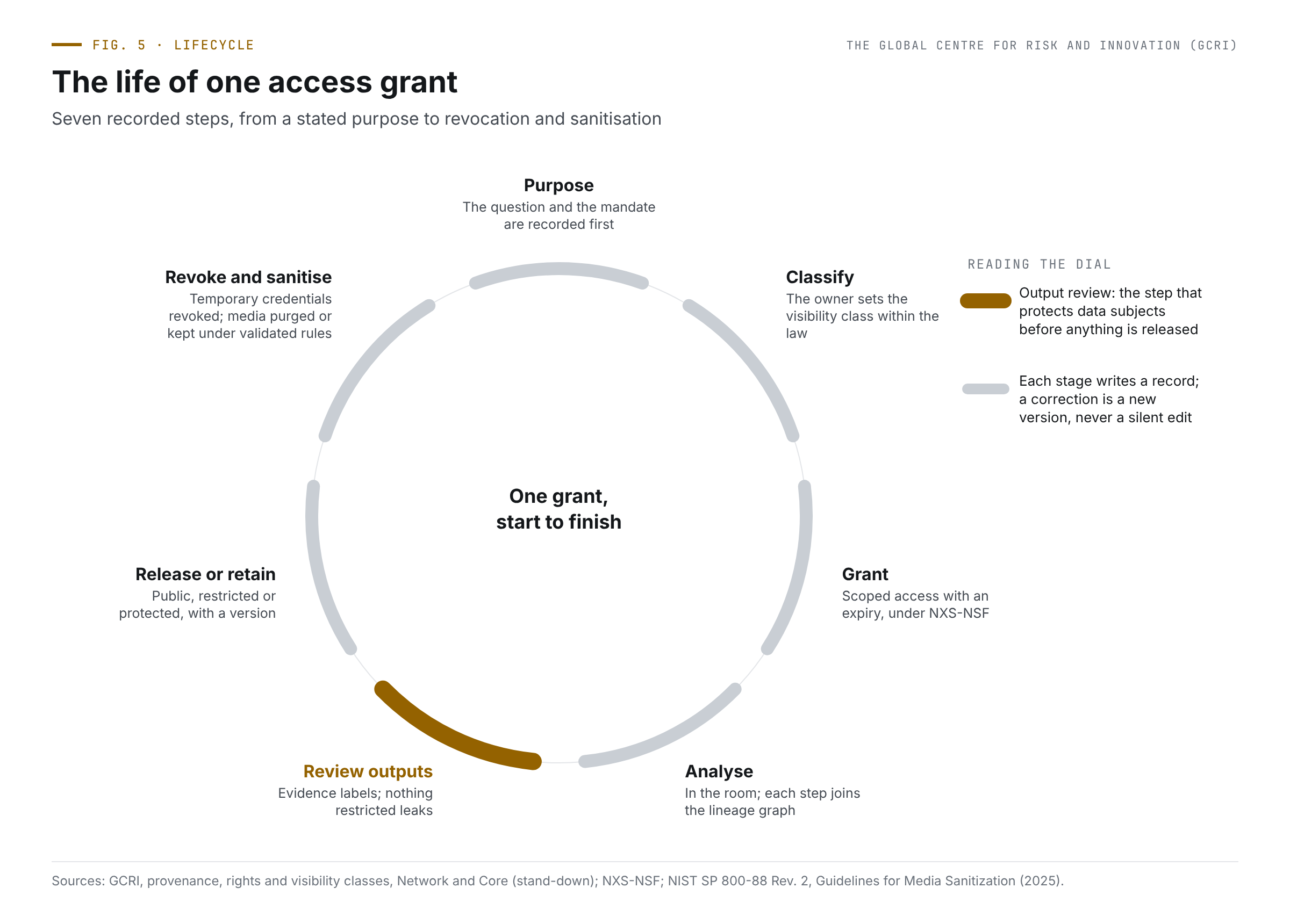
A grant has a life, and each stage writes a record. It begins with a purpose: the question and the mandate are recorded before any access. The owner sets the visibility class. Access is granted for a scope and an expiry. Analysis runs inside the room, and each transformation, model run and review is recorded as a step in the lineage graph [17]. Outputs are reviewed before they leave: every claim carries one of the programme’s evidence labels, Observed, Published statistics, Institution-reported, Estimated, Modelled, Forecast, Scenario, Expert judgement or Unknown, and Nexus estimates stay labelled as estimates and never replace published figures [17].
The end of a grant matters as much as its start. In the programme year, the proposed one-day stand-down of the temporary Core closes new submissions, checkpoints authorized jobs, freezes the evidence manifest, revokes temporary credentials and records open exceptions [13, 19]. No promise is made that data is deleted within a day; media are purged or retained under approved, validated rules, and review continues after stand-down [13]. That is the posture of NIST SP 800-88 Revision 2, published in September 2025, which treats sanitization as a programme matched to the sensitivity of the information rather than a single wipe [9].
Where an AI agent or model contributed to an output, the record names it, its configuration and the person who reviewed and accepted the result; an unreviewed agent output is not recorded as evidence [17]. Where a source cannot be shown, the record says that a restricted source was used, who holds it and why it cannot be shown, without revealing the protected content [17].
How exposure and use are measured
Two kinds of measurement bear on a data room: the threat to the evidence, and the use made of it. The first is best read from public authorities that publish their method and period. ENISA’s Threat Landscape 2025 counts incidents by targeted sector and observed intrusions by vector, on two different bases that should not be added or compared; Figure 3 keeps them in separate panels for that reason [5]. The second is best read from operators of established secure environments, which publish counts of approved projects rather than of datasets or users: the ONS reports current projects and projects started in the last twelve months [6].
The programme applies the same rules to its own claims. A resource offer, a data permission and a completed analysis are different states, and one never implies the next [12]. Published capability is described with its conditions; an evidence label tells the reader whether a figure was observed, reported, modelled or estimated; and a restricted result stays restricted when the rest of an exercise is published [17, 20]. No data-room usage figures are given on this page, because none exist: no data room has opened.
| Measure | Category | Share |
|---|---|---|
| Targeted sector | Public administration | 38.2% [5] |
| Targeted sector | Transport | 7.5% [5] |
| Targeted sector | Digital infrastructure and services | 4.8% [5] |
| Targeted sector | Finance | 4.5% [5] |
| Targeted sector | Manufacturing | 2.9% [5] |
| Intrusion vector | Phishing | About 60% of observed intrusions [5] |
| Intrusion vector | Vulnerability exploitation | 21.3% of observed intrusions [5] |
Established instruments the design draws on
The controls follow instruments that already govern secure access, and the programme cites them as references, not as claims of conformance. The comparison in Figure 4 sets the Five Safes beside the programme’s design for each.
| Year | Instrument | What it contributes |
|---|---|---|
| 2013 | W3C PROV-O, the PROV Ontology | A standard vocabulary for lineage; the provenance graph is designed to follow it [18, 17] |
| 2016 | FAIR Guiding Principles | Findable, accessible, interoperable and reusable data; metadata stay accessible even when the data are no longer available [10] |
| 2020 | NIST SP 800-207, Zero Trust Architecture | No implicit trust from network location; every access decided per request [8] |
| 2020 | CARE Principles for Indigenous Data Governance | Collective benefit, authority to control, responsibility and ethics for Indigenous data [11] |
| 2025 | European Health Data Space Regulation | Secondary use only in secure processing environments, under a permit; in force 26 March 2025 [7] |
| 2025 | NIST SP 800-88 Rev. 2, Guidelines for Media Sanitization | Sanitization as a programme matched to data sensitivity [9] |
| Continuing | Five Safes (ONS Secure Research Service) | Safe people, projects, settings, data and outputs [6] |
Standards the programme proposes
The programme’s own standards are proposed, not adopted, and each country decides through its National Standards Council whether and how to use them. Three bear directly on data rooms. NS-1, the UNI and the artifact catalog, gives every dataset, record and output one resolvable identifier, so that a restricted record can be cited without being shown. NS-10, policies and clauses, expresses obligations such as purpose, residency and retention in a machine-readable form that a policy gate can evaluate. NS-11, verification and monitoring, covers the evidence and attestations that show a control was applied.
The NXS-NSF system profile, NRS-S13 in the Nexus Risk Standards, is open for drafting, as are the profiles of NXS-GRX and NXS-HUB [3, 4, 14]. Statuses such as open or proposed describe the drafting stage only; none records adoption or certification.
What is changing
- Health data spaces set the pace. Key secondary-use rules of the European Health Data Space apply from March 2029, with remaining data categories from March 2031, which will make secure processing environments a routine expectation of public-sector research [7].
- Agents inside controlled settings. As AI agents enter analytical work, the decisive control is the record of who reviewed and accepted an agent’s output, not the agent itself [17].
- Zero trust beyond the perimeter. With phishing behind about 60% of observed intrusions in the EU, access decided per request rather than by network location, as NIST SP 800-207 describes it, becomes the baseline for shared evidence [5, 8].
- Indigenous data sovereignty. The CARE principles add collective rights to the FAIR principles‘ focus on reuse, and both are needed when community knowledge enters a risk picture [10, 11].
Three faces of controlled collaboration
The same data room looks different to a scientist, a convenor and a financier, and each is bounded. GCRI leads on science, methods and evidence: it designs the controls, qualifies data and methods for the annual programme and captures evidence, without owning the contents [15]. GRF governs Nexus Universe, whose evidence and outcomes are published only as agreed for each mission, and restricted results stay restricted [20]. GRA, through its Consortium finance interface, reads evidence for the questions competent financial institutions ask, and asks enquirers to describe the decision ahead and the evidence they hold without attaching confidential data [21].
Boundaries. What this page does not claim: no data room is open, and the programme is at service level R0, information and enquiries. A data room is a design of controls, not a hosting service, a repository or a disclosure portal; it replaces no data-sharing agreement, privacy assessment, community consent or regulatory permission. GCRI does not regulate or certify, GRF does not regulate, finance or procure, and GRA does not lend, underwrite, rate or invest. Naming an agency, instrument or standard is not a claim of partnership, conformance or endorsement.
Questions and answers
Can my institution put data into a Nexus data room today?
No. The programme is at service level R0, information and enquiries, and no data room, computing allocation or application route is open. You can send an enquiry describing the question and the kind of evidence involved, without attaching any confidential data; the acknowledgement gives a reference and names the next step.
Does GCRI take ownership of data analysed in a data room?
No. The owner, the institution or person with authority over the content, decides its visibility class and its licence. GCRI designs and stewards the controls, checks that records are complete and consistent, and keeps their history; it cannot make a record public on its own initiative.
How is Indigenous and community knowledge protected?
Protected and Indigenous knowledge is never published or used in public examples or model training without its holders’ consent. Where disclosure could expose a community to harm, a record can be restricted or protected and its public view, if any, generalized. The design draws on the CARE Principles for Indigenous Data Governance.
Is data deleted as soon as an exercise ends?
No such promise is made. At the proposed stand-down, temporary credentials are revoked and the evidence manifest is frozen; media are then purged or retained under approved, validated rules, and review, reconciliation and corrections continue afterwards. That follows the programme-level approach of NIST SP 800-88 Revision 2.
Can AI tools be used on restricted data?
Only inside the controls. Where an agent or model contributed to an output, the record names it, its configuration and the person who reviewed and accepted the result, and an unreviewed agent output is not recorded as evidence. Protected knowledge never enters model training without its holders’ consent.
Glossary
- Data room: A controlled setting in which named people analyse non-public evidence for a recorded purpose and a limited time, and from which only reviewed outputs leave.
- Mandate: A record in NXS-NSF that binds grantor, delegate, purpose, jurisdiction and expiry to an access grant.
- Visibility class: Public, restricted or protected: the class the owner sets for a record within the law.
- Evidence label: The source type of a claim, from Observed to Unknown, carried by every record so that an estimate is never read as an observation.
- Five Safes: The access model of the UK Office for National Statistics: safe people, projects, settings, data and outputs.
- Secure processing environment: Under the European Health Data Space Regulation, the only setting in which health data may be processed for secondary use.
Further reading across the network
- Data and privacy responsibilities
- The programme’s participation records
- Provenance and attribution
- Evidence records and archive
- GRA data and research standards
- Universe evidence and outcomes at GRF
- Identifiers and records
- Nexus Universe application
References
- The Global Centre for Risk and Innovation (2026). Data and privacy responsibilities. Accessed 2026-10-21.
- The Global Centre for Risk and Innovation (2026). Rights and visibility. Accessed 2026-10-21.
- Nexus documentation (docs.therisk.global) (2026). NXS-NSF: trust, authorization, mandate, policy and assurance. Accessed 2026-10-21.
- Nexus documentation (docs.therisk.global) (2026). NXS-GRX: canonical data, provenance, risk and federation. Accessed 2026-10-21.
- European Union Agency for Cybersecurity (ENISA) (2025). ENISA Threat Landscape 2025: EU consistently targeted by diverse yet convergent threat groups. Accessed 2026-10-21.
- Office for National Statistics (United Kingdom) (2026). About the Secure Research Service (the Five Safes). Accessed 2026-10-21.
- European Commission (2025). European Health Data Space Regulation (EHDS). Accessed 2026-10-21.
- U.S. National Institute of Standards and Technology (NIST) (2020). SP 800-207, Zero Trust Architecture. Accessed 2026-10-21.
- U.S. National Institute of Standards and Technology (NIST) (2025). SP 800-88 Rev. 2, Guidelines for Media Sanitization. Accessed 2026-10-21.
- Scientific Data (Nature Portfolio) (2016). Wilkinson et al., The FAIR Guiding Principles for scientific data management and stewardship, Scientific Data 3, 160018. Accessed 2026-10-21.
- Data Science Journal (CODATA) (2020). Carroll et al., The CARE Principles for Indigenous Data Governance, Data Science Journal 19, 43. Accessed 2026-10-21.
- The Global Centre for Risk and Innovation (2026). Claims and readiness register. Accessed 2026-10-21.
- The Global Centre for Risk and Innovation (2026). Network and Core. Accessed 2026-10-21.
- Nexus documentation (docs.therisk.global) (2026). NXS-HUB: institutional knowledge, records and learning. Accessed 2026-10-21.
- The Global Centre for Risk and Innovation (2026). Data and evidence record model. Accessed 2026-10-21.
- Nexus documentation (docs.therisk.global) (2026). Cross-Border and Shared-System Missions (offering O06), Nexus Consortium model. Accessed 2026-10-21.
- The Global Centre for Risk and Innovation (2026). Provenance and attribution. Accessed 2026-10-21.
- World Wide Web Consortium (W3C) (2013). PROV-O: The PROV Ontology, W3C Recommendation. Accessed 2026-10-21.
- Nexus documentation (docs.therisk.global) (2026). The programme year. Accessed 2026-10-21.
- The Global Risks Forum (2026). Nexus Universe: evidence and outcomes. Accessed 2026-10-21.
- The Global Risks Alliance (2026). Consortium finance interface. Accessed 2026-10-21.
Editorial record
Facts and programme states are given as of 21 October 2026. This page is reviewed at least every 180 days and whenever a programme state, a service level or a cited figure changes. It replaces an earlier version of the same post, which described a stand-alone “Nexus Data Rooms” offering and connected it to platforms under names that are now retired; no such offering is on record, and the controls are described here as the current model carries them, in the systems and the annual programme.
Published by the GCRI editorial desk under the scientific and editorial integrity policy. To report an error or request a correction, use the corrections and concerns route; every accepted correction is recorded as a new version, never a silent edit.