




The Global Centre for Risk and Innovation (GCRI)

Disaster Risk Reduction

Disaster Risk Reduction is not only about preparedness plans, emergency response, or post-crisis recovery. It is becoming a core capability for governments, cities, public authorities, humanitarian actors, insurers, funders, enterprises, universities, infrastructure operators, communities, and development institutions facing climate extremes, infrastructure fragility, ecosystem degradation, public health vulnerability, cyber disruption, food and water stress, displacement, supply-chain exposure, and cascading systemic risk. This area of activity helps institutions reduce risk before hazards become disasters. It connects disaster risk intelligence, exposure and vulnerability analysis, multi-hazard records, cascade modelling, resilience indicators, public authority learning, community safeguards, finance-readiness, national portfolios, public-safe reporting, and responsible handoff pathways so that risk reduction can move from fragmented planning to structured public-good capability

Image link
Hazard Intelligence
Hazard intelligence structures information about floods, storms, heat, drought, wildfire, earthquakes, landslides, epidemics, technological hazards, cyber disruptions, infrastructure failures, environmental degradation, and compound events into usable records. It helps technical, policy, finance, and public authority audiences understand the nature, frequency, intensity, geography, uncertainty, and limitations of hazard-related evidence without turning analysis into public warnings, official forecasts, or emergency commands
Vulnerability Analytics
Vulnerability analytics helps institutions understand why hazards become disasters by examining social, economic, physical, environmental, institutional, digital, and infrastructure conditions that increase harm. It supports records on poverty, housing, health, disability, access, governance capacity, ecosystem degradation, infrastructure fragility, cyber exposure, displacement, food and water insecurity, and community sensitivity while avoiding stigmatizing labels, community scoring, or social scoring
Cascade Modelling
Cascade modelling examines how shocks travel through interconnected systems. A flood may disrupt transport, health access, energy supply, food distribution, communications, insurance exposure, public finance needs, and community wellbeing. This area structures propagation pathways, dependency records, scenario assumptions, confidence labels, uncertainty labels, and public-safe summaries so cascading risk can be studied before losses multiply
Risk Financing Readiness
DRF Readiness Disaster Risk Finance readiness makes disaster risk reduction more readable to funders, insurers, donors, development actors, public finance institutions, and capital readers. It structures protection gaps, risk-layering questions, assumptions, dependencies, data gaps, model gaps, public authority dependencies, fiscal exposure, contingent liability questions, and insurance-readiness issues without providing underwriting, investment advice, donor allocation, public finance allocation, transaction activity, or financeability claims
Preparedness Systems
Preparedness systems connect risk intelligence to institutional learning, capability gaps, continuity questions, public authority dependencies, early-action pathways, training needs, public-safe reports, national portfolios, and handoff context. They help institutions understand what must be prepared before disaster impacts occur while preserving the difference between preparedness learning, official emergency command, public warning, public finance allocation, procurement, and implementation
Recovery Finance
A structuring desk designs Build-Back-Better facilities- program loans, reconstruction bonds, revolving reserves- with O&M covenants, milestone-linked disbursements, and step-down/step-up pricing tied to verified continuity and equity outcomes. Parametric tranches can bridge early cash needs, while transparency and assurance artifacts protect ratings and crowd in private capital. Funding flows when results are proven, not merely promised
Exposure Mapping
Exposure mapping identifies people, infrastructure, services, ecosystems, supply chains, assets, facilities, settlements, transport routes, digital systems, and public institutions that may be affected by hazards. It combines geospatial intelligence, data governance, public-safe mapping, infrastructure dependency records, and sensitivity controls so exposure can be understood without disclosing protected locations, enabling targeting misuse, creating insurance scores, or implying public authority decisions
Multi-Hazard Analysis
Multi-hazard analysis structures how multiple hazards interact across time, geography, sectors, and systems. It supports understanding of concurrent, compounding, sequential, and cascading risks across climate, infrastructure, health, ecosystems, food, water, energy, cyber, logistics, and public services. This makes disaster risk more legible for institutions without converting analysis into official risk ratings, procurement signals, public warnings, or implementation instructions
Resilience Metrics
Resilience metrics help institutions understand capacity, preparedness, redundancy, continuity, adaptive capability, recovery potential, public-service resilience, infrastructure readiness, community capacity, ecosystem buffering, and institutional learning. These metrics support improvement, not ranking. They help identify gaps, learning needs, investment questions, and preparedness priorities without becoming country scores, community scores, procurement signals, finance signals, or public authority approvals
Community Safeguards
Disaster risk reduction must protect the people and places it seeks to serve. This area supports community-sensitive data handling, lived-risk knowledge, accessibility, youth and disability inclusion, humanitarian sensitivity, Indigenous protocol-sensitive controls where applicable, protected knowledge restrictions, consent-boundary notices, public-safe summaries, and community-facing correction channels so DRR work remains non-extractive, safe, and accountable
Nexus Architecture
DRR handoff architecture transfers structured disaster risk context to competent actors that may reduce risk, finance resilience, procure systems, regulate, insure, design infrastructure, implement programs, or operate services separately. Handoff packages preserve hazard, exposure, vulnerability, cascade, safeguard, finance-readiness, public authority, procurement, technical, recipient responsibility, correction, and archive context without making the public-good layer the executor of downstream action
Compliance Vault
A read-only provenance vault provides SAIs and regulators the same immutable record—decisions, clauses, cures/waivers, inspections, and after-action updates to codes and SOPs. Evidence chains, versioned documentation, retention/legal-hold policies, and selective redaction ensure transparency without compromising privacy. Audits simplify, exceptions fall, and public trust strengthens
Image link

The Nexus Reports provide comprehensive evaluations of country-specific risks and opportunities, focusing on biodiversity, ecosystem services, climate change vulnerabilities, socio-economic risks, the food-water-energy nexus, and exponential technologies. Drawing on authoritative sources, these reports offer tailored policy recommendations, detailed analyses, and practical case studies, integrating global scientific research to manage risks and drive sustainable development

Image link

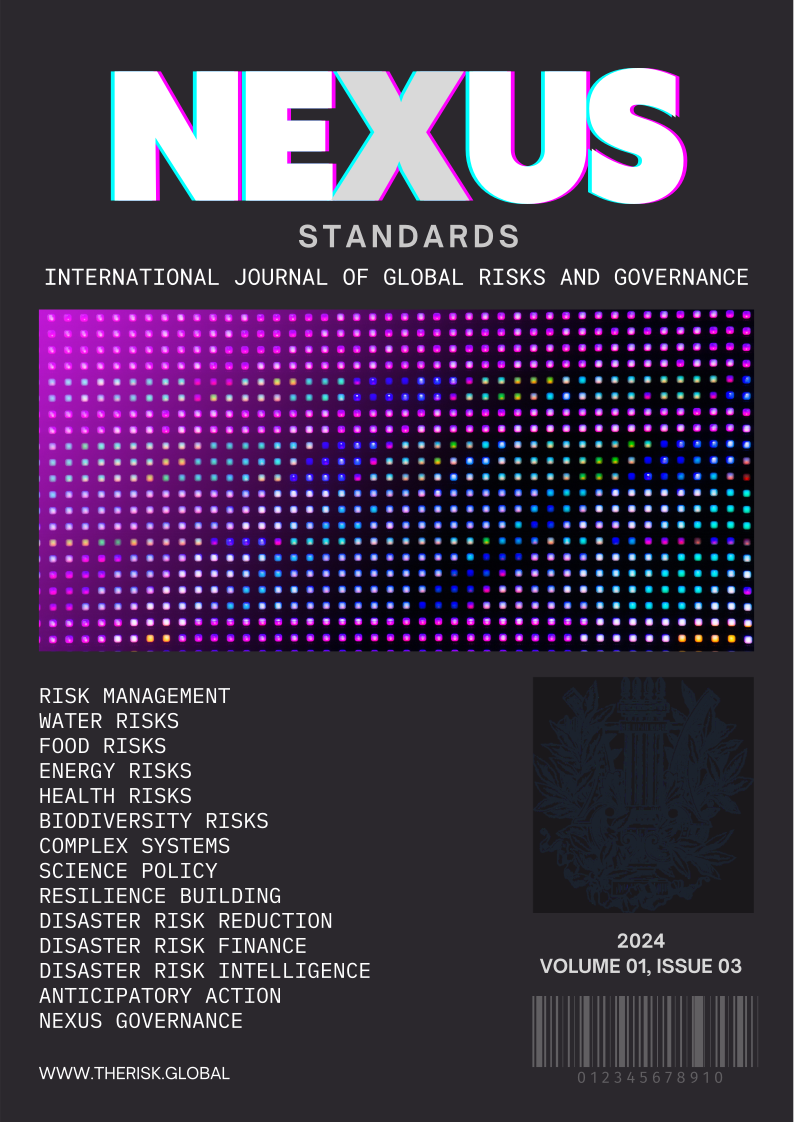
The International Journal of Global Risks and Governance (IJRG) is revolutionizing the understanding and management of global challenges with an integrated nexus approach. Aspiring to be the first decentralized scientific journal in global risks, IJRG leverages Web3 principles to foster an open, transparent, and collaborative ecosystem for researchers, policymakers, and practitioners

  • Risk Architecture - National DRR master architecture linking hazards, exposure, vulnerability, and interdependencies to programs, budgets, and permits.
  • Code Governance - Resilience performance standards (RPS) embedded in building, infrastructure, and land-use codes with test methods and equity thresholds.
  • Program Bankability - Standard project cards (capex/opex, EAL reduction, uncertainty bands) that make prevention and retrofit pipelines financeable.
  • Clause Execution — Policy-as-code that binds approvals, safeguards, and SLAs to verifiable evidence—fewer disputes, faster execution.
  • Portfolio Prioritization — Cost-per-EAL avoided, service-continuity uplift, and distributional impacts drive cabinet-level choices.
  • Finance Stack — Blended DRF: parametric covers, contingency lines, reconstruction bonds, and results-based contracts wired for rapid disbursement.
  • Operational Readiness — Runbooks, mutual-aid, surge logistics, and comms redundancy tuned to lead-time targets.
  • Open Assurance — One evidence chain for supervisors, SAIs, ratings, and courts; no black boxes.
  • Sovereign Privacy — Federated analytics, TEEs, and residency controls—collaborate without exporting sensitive data.
  • Replication Kits — Playbooks, clause libraries, data schemas, and training packs for rapid scale-out across sectors and regions.
  • NWG Mandate — Cross-ministerial, utility, private sector, academia, and civil society cells define national DRR dockets and evidence needs.
  • Regional Stewardship — Harmonize methods; manage cross-border rivers, grids, corridors, and shared risk pools.
  • Global Alignment — Curate baselines; synchronize with Sendai/SDG/UNFCCC reporting and multilateral finance windows.
  • Consultation Windows — Structured inputs from Major Groups (workers, business, science, Indigenous Peoples, youth, women, NGOs) with traceable responses.
  • Docket Discipline — Calendars aligned to seasons, legislative cycles, and global milestones (GPDRR, COPs, HLPF).
  • Independent Panels — Science/ethics/legal reviewers publish public summaries and recommendations.
  • Escalation Paths — Formal routes to resolve data gaps, modeling divergence, and urgent risks.
  • Localization Rails — Translate national measures into municipal SOPs, budgets, and drills.
  • Knowledge Commons — Reusable clauses, datasets, model cards, and lessons learned across NWGs.
  • Capability Exchange — Credentialed teams, shared labs, and regional surge rosters for fast mutual support.
  • Hazard Atlas — Site-class micro-zonation and peril layers (hydromet, seismic, landslide, wildfire) with exceedance curves and secondary-hazard overlays.
  • Interdependency Graphs — System-of-systems models mapping asset→service→population dependencies to reveal cascade paths and critical hubs.
  • Fragility Libraries — Sectoral fragility and vulnerability functions with model cards, validation sets, and bias checks.
  • Scenario Bench — Base/adverse/severe suites linking hazard intensities to PD/LGD, outage profiles, and time-to-restore.
  • Uncertainty Controls — Confidence bands, EVPI, and sensitivity levers on every metric and decision point.
  • Distributional Lens — Equity and rights impacts quantified (who benefits/loses, where, when) with grievance channels.
  • Data Fusion — EO, in-situ, admin, and crowd sources with automated QA/QC and chain-of-custody logs.
  • Public Dashboards — Accessible summaries; machine-readable annexes; lawful microdata access.
  • Assurance Portal — Read-only provenance for auditors, SAIs, ratings, and courts—same dataset, different views.
  • After-Action Science — Counterfactuals and causal attribution convert events into parameter updates and code refinements.
  • Sendai Integration — Priorities 1–4 operationalized: risk understanding, governance, investment, preparedness/BBB.
  • SDGs Linkage — Explicit ties to Goals 3, 6, 7, 9, 11, 12, 13, 16, 17 with indicator maps.
  • Paris Interfaces — Adaptation and Loss-and-Damage linkages to DRR and forecast-based finance.
  • WHO IHR — Heat, air, water, and infectious risk capacities with surge and continuity.
  • Human Rights — FPIC, non-discrimination, remedy embedded in approvals and contracts.
  • Disclosure Ready — ISSB/CSRD/GRI/TCFD/TNFD where DRR intersects markets and supervision.
  • Labor & Due Diligence — ILO, OECD, CSDDD integrated into permits, procurement, and vendor due diligence.
  • Cyber/Data — GDPR/DPAs and NIS2-class security for lifeline sectors.
  • Sector Safety — ICAO/IMO/WMO/ITU interfaces for transport, maritime, meteorology, and telecom.
  • ISO/IEC — 22301 (BCM), 31000 (risk), 14090 (adaptation), 37123 (resilient cities) aligned evidence packs.
  • Urban Flood Defense — Blue-green corridors, detention, pump staging, and backflow control with equity targeting.
  • Seismic Retrofit Portfolios — Schools, hospitals, and critical bridges prioritized by EAL avoided and continuity uplift.
  • Wildfire Urban Interface — Fuel breaks, fire-resistant retrofits, evacuation zoning, and smoke-health advisories.
  • Heat Risk Management — Cooling centers, grid demand response, occupational safety shifts, and urban albedo upgrades.
  • Critical Lifelines — Substation hardening, islanding microgrids, water redundancy, and telecom failover.
  • Landslide Stability — Slope drainage, anchors, retaining works, and hazard-aware land-use controls.
  • Coastal Resilience — Dunes, reefs, surge barriers, and managed retreat with SEEA-EA and TNFD co-benefits.
  • Industrial Safety — Flood/quake-safe design, secondary containment, and emergency shutdown protocols.
  • Social Protection Continuity — Targeted cash/vouchers/shelters triggered by verified impact and forecast.
  • Recovery Acceleration — Debris management, expedited permitting, and BBB design standards.
  • KPI Registry — Uptime, MTTR, EAL reduction, equity coverage, safety, reliability.
  • Taxonomy Tagging — Eligibility/DNSH mapping across jurisdictions; label once, defend everywhere.
  • One-Build Reports — Single pipeline for Sendai/SDG/UNFCCC/IHR plus market disclosures where relevant.
  • Maker–Checker — Role-based approvals, immutable logs, and attested oracles.
  • Lineage & Legal Hold — Jurisdiction-aware retention and discovery for all artifacts.
  • Public Reporting — Machine-readable annexes; accessible summaries for citizens and media.
  • Assurance Interfaces — Read-only access for SAIs, supervisors, donors, ratings—same source of truth.
  • Breach Alerts — Automated detection, timestamped receipts, and remediation playbooks.
  • Counterfactual Reviews — Verified avoided loss and time-to-restore deltas feed pricing and policy.
  • Certification Tracks — Conformance pathways for labs, models, contractors, and processes.
  • Safeguard Matrices — FPIC, labor, anti-corruption enforced as binding clauses.
  • Approval Chains — Local → cabinet authority with fixed escalation and segregation of duties.
  • Transparency Registers — Lobbying, conflicts, and beneficial-ownership disclosures.
  • Sanctions/AML/CFT — Automated partner checks at grant, permit, and payout.
  • Grievance & Remedy — Time-bound SLAs; public case tracking to closure.
  • Benefit Ledgers — Community payments and entitlements traceable to recipients.
  • Field Audits — Randomized/risk-based inspections with geotagged evidence.
  • Dispute Workflows — Cure/waiver/restructure documented for precedent and learning.
  • Board/Regulator Cadence — Standard briefings and reporting calendars.
  • Sunset & Refresh — Evidence thresholds auto-trigger measure revision or retirement.
  • Lawful-Basis Catalog — Dataset-level legal grounds with renewal tracking and constraints.
  • Consent Protocols — ILK and community norms respected with auditable consent trails.
  • DPIAs by Default — Mandatory for sensitive/cross-border analytics.
  • Federated Analytics — Models travel; data stays in-country; outputs verifiable.
  • Confidential Compute — TEEs with remote attestation for sensitive pipelines.
  • Differential Privacy — Noise budgets for safe statistics and public dashboards.
  • Attribute Access — Policy-driven field-level permissions and redaction.
  • Residency Controls — Storage/processing pinned to national jurisdictions.
  • Standards First — OGC/STAC/OpenAPI; OIDC/SAML/SCIM for identity and provisioning.
  • Onboarding Sandboxes — Golden datasets, SLAs, and security attestations for rapid vendor/agency integration.
  • DRR Control Room — One pane for hazards, works, logistics, finance, and evidence.
  • Issue Intake — Templates convert risks into docket-ready measures with owners and budgets.
  • Design & Contract Packs — Clause libraries, SOPs, dispute and remedy kits.
  • Consultation & Hearings — Moderated sessions with documented responses and revisions.
  • Capacity & Drills — Role-based curricula and certification SLAs tied to operations.
  • Independent Review — External science/ethics/legal panels with public summaries.
  • Change Management — Versioned datasets/models/KPIs; migration guides for agencies and vendors.
  • Risk Registry — Threats, mitigations, and residual risk tracked to SLA and budget.
  • Crisis Acceleration — Fast-track procedures for urgent risks; audit preserved.
  • Knowledge & Reuse — Playbooks and datasets replicated across NWGs and sectors.
  • EAL Reduction — Expected Annual Loss down vs. baseline, by sector and region.
  • Continuity Uptime — Power, water, health, communications SLAs achieved during events.
  • Time-to-Restore — MTTR and outage duration reduced across lifeline systems.
  • Equity Coverage — Vulnerable households/SMEs served within SLA; grievance closure time down.
  • Safety Outcomes — Injury/fatality reductions; surge capacity attainment for hospitals and EMS.
  • Reliability Metrics — SAIDI/SAIFI, pressure/flow, 911/112 uptime improved.
  • Capital Efficiency — Time-to-financial-close down; leverage of public to private capital up.
  • Pricing Advantage — Spreads, reinsurance costs, and reserve requirements reduced.
  • Assurance Quality — Audit exceptions down; provenance coverage up; 100% uncertainty disclosure.
  • Adoption & Scale — Codes and runbooks replicated; mutual-aid activations executed per plan.
Get Access
Start a DRR Lab
Build Resilience Masterplan
Design a Trigger
Launch a Data Commons
Train Your Model
Image link
Learning
Quests
Work-integrated learning paths for Systemic Transition
Image link
Impact
Bounties
Integration Process Pathways for Tackling Complex Issues
Image link
Innovation
Builds
Crowdsourcing CCells for Integrated Research & Innovation

Building Tribes for Impact

Have questions?