

Japan, China, the Republic of Korea, Mongolia and the Democratic People’s Republic of Korea share seismic hazards, production networks and fast-ageing populations. This page explains what the planned Japan hub would coordinate, where the East Asia Nexus Consortium stands, and what the evidence shows.
Key takeaways
- The Japan hub is one of three planned coordination roles in the Asia and the Pacific programme of the Nexus Consortium; it would coordinate shared-system work for Japan, China, the Republic of Korea, Mongolia and the Democratic People’s Republic of Korea, and no hub host decision is on record [1, 2].
- The East Asia Nexus Consortium is a named programme in formation, with a public programme page published by The Global Risks Alliance (GRA); no Tokyo hub office is on record, and earlier descriptions of one are withdrawn [1, 3].
- The seismic stakes are national in scale: the 2011 earthquake left 19,765 dead and 2,553 missing, and a Nankai Trough megaquake, given a 30-year probability of about 60% to 90% or higher, could kill up to 298,000 people [4, 5, 6].
- The region is ageing fast: people aged 65 and over were about 30% of Japan’s population in 2025, against 17.4% in 2000, and the Republic of Korea’s fertility rate was 0.75 births per woman in 2024 [7, 8].
- The programme is at service level R0: an institution starts with an enquiry to asiapacific@therisk.global and receives a reference [1].
What the Japan hub is
The Japan hub is a planned regional coordination role in the Asia and the Pacific programme region of the Nexus Consortium, the public-good programme through which The Global Centre for Risk and Innovation (GCRI), The Global Risks Forum (GRF) and The Global Risks Alliance (GRA) help countries examine interconnected risk with shared methods. It is one of three planned hubs in the region, beside India and Singapore, and its recorded group is Japan, China, the Republic of Korea, Mongolia and the Democratic People’s Republic of Korea [1]. Its recorded focus is seismic and tsunami resilience, manufacturing, robotics, ageing, energy and supply chains [1].
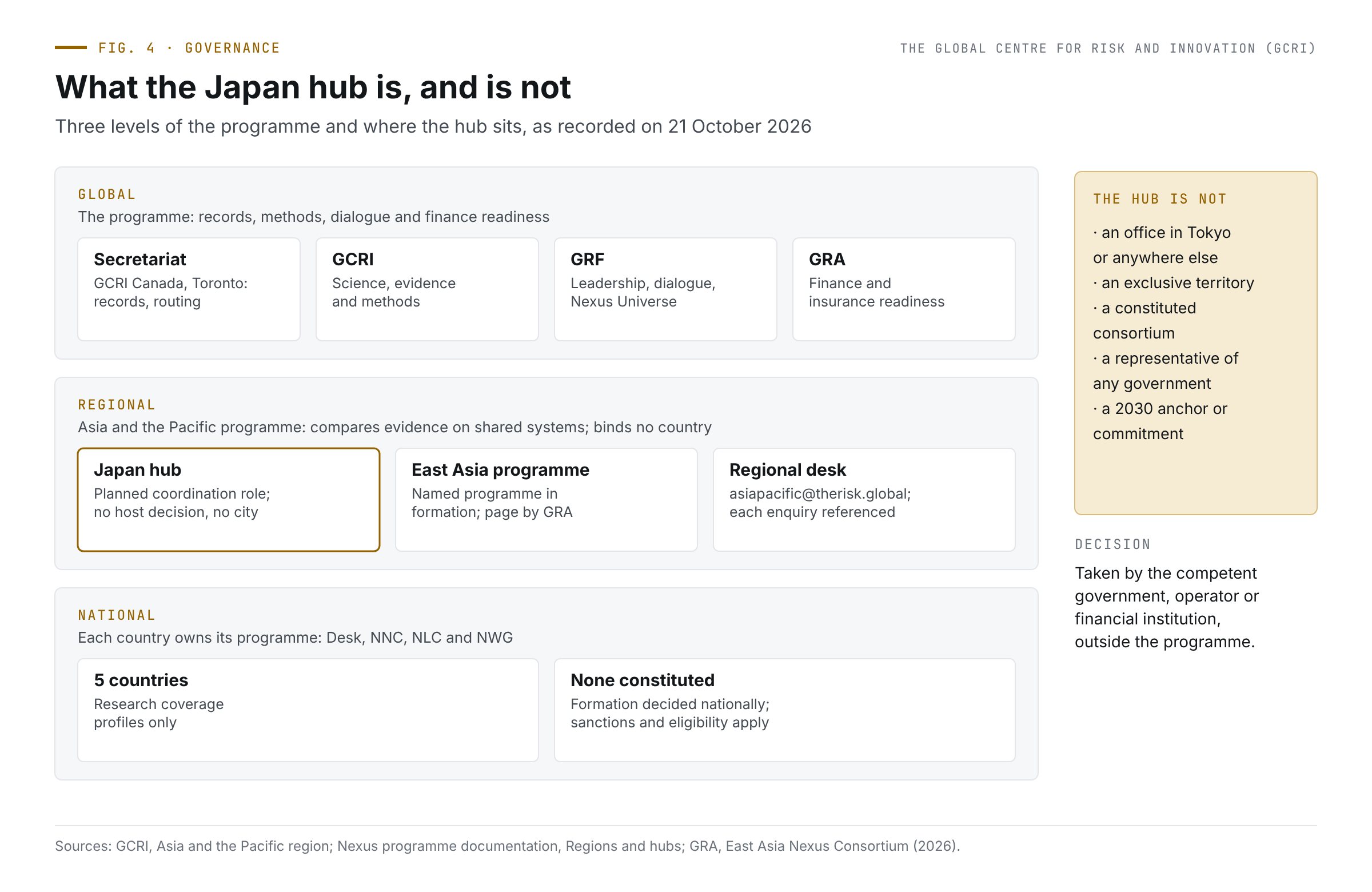
A planned hub coordinates shared-system work for a group of countries; it is not an office, an operational site or an exclusive territory, and it operates only once its host decision is on record [1, 2]. The hub is named for a country, not a city, and no host institution or city has been decided. Separately, the East Asia Nexus Consortium is one of three named programmes in formation across the six regions; GRA publishes its programme page, and the Secretariat confirms formation records and participating structures before they are listed [1, 2, 3]. A named programme in formation is not a constituted consortium.
Why East Asia needs shared risk evidence
East Asia concentrates three kinds of systemic exposure in one place: some of the world’s largest seismic and tsunami hazards, dense manufacturing and logistics networks on which global supply depends, and the fastest population ageing on record. Each interacts with the others. A great earthquake damages factories, ports and power at once; an ageing population changes who can evacuate and who staffs recovery; and supply chains carry the shock far beyond the region.
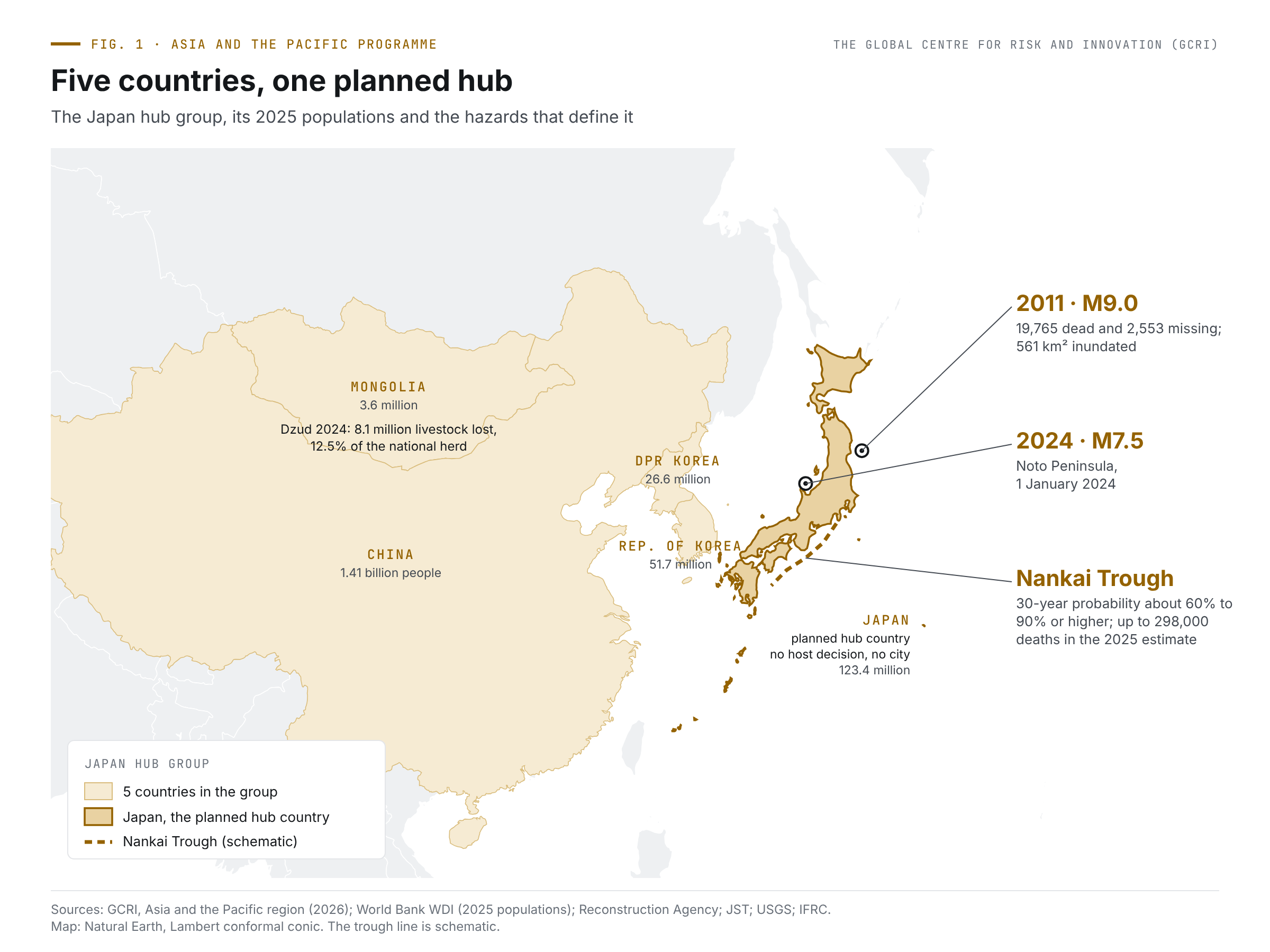
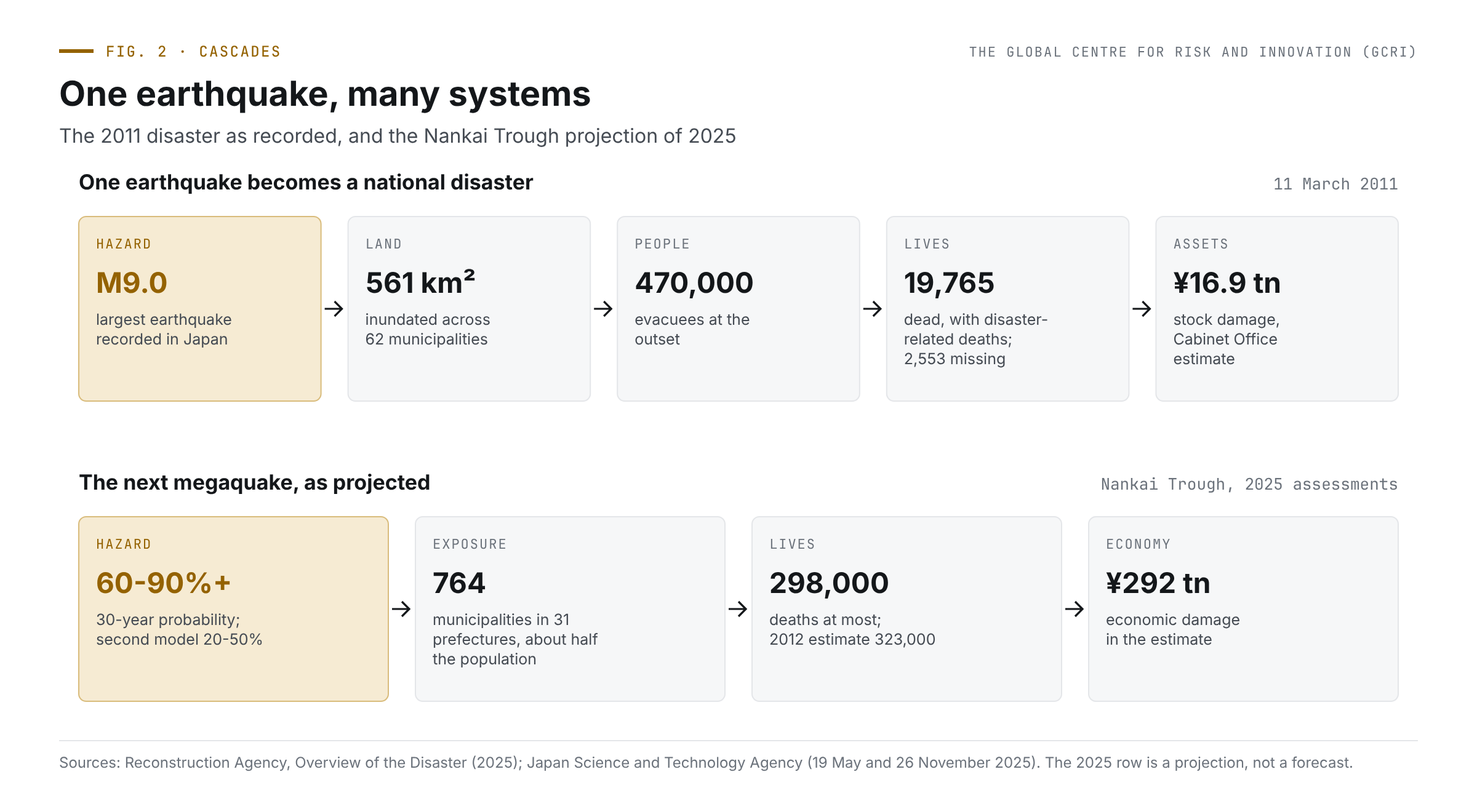
The record of 2011 shows the scale. The Tohoku earthquake of 11 March 2011, magnitude 9.0, was the largest ever recorded in Japan; with the tsunami and the Fukushima Daiichi accident it left 19,765 people dead, including disaster-related deaths, and 2,553 missing, inundated 561 km² across 62 municipalities, and displaced 470,000 people at the outset, with a Cabinet Office stock-damage estimate of about ¥16.9 trillion (Reconstruction Agency) [4]. The government designated the combined earthquake, tsunami and nuclear disaster as one event precisely because its parts could not be managed separately [4].
The coupling also runs through networks. Interdependent infrastructures are more fragile than isolated ones: a failure in one can trigger failures in another, and beyond a threshold the joint system collapses abruptly rather than degrading gradually (Buldyrev et al.) [9]. For a region whose grids, ports and production lines are tightly linked, national assessments see only the part of a cascade that falls inside their own borders.
The countries the hub would serve
The five countries of the Japan hub group held about 1.61 billion people in 2025, of whom China accounted for about 1.41 billion, Japan 123.4 million, the Republic of Korea 51.7 million, the Democratic People’s Republic of Korea 26.6 million and Mongolia 3.6 million (World Bank) [12]. Listing a country in a hub group records research coverage and the scope for formation enquiries; it does not by that fact give the country a constituted programme [1]. Engagement follows the programme’s sanctions and eligibility policy, and where engagement is not available no desk or call to action appears [1].
The region is organised by subregion so that national programmes can compare semiconductor, port, energy and hazard dependencies without merging their data or authority [1]. Southeast Asia and the Pacific island states are covered by the planned Singapore hub, and South Asia by the planned India hub [1]. An earlier version of this page described country nodes, special-status interfaces and a 2030 Tokyo anchor beyond the recorded group; those descriptions are withdrawn.
Five shared systems, five questions
The Asia and the Pacific programme names five shared systems, each with the question it examines. The cross-border risk systems page sets the rule for all of them: shared-system work compares governed outputs and preserves dissent; it creates no treaty, no transfer of sovereignty and no right to move data [1].
| Shared system | The question it examines | Relevance to the Japan hub group |
|---|---|---|
| Glacier-fed and monsoon basins | How will snowmelt, monsoon timing and groundwater use alter water, power and food security across the Indus, Ganges-Brahmaputra and Mekong systems? [1] | Chiefly the India and Singapore groups; China shares the upper basins |
| Semiconductor and electronics networks | Which fabrication, materials and logistics nodes are single points of failure for regional and global production? [1] | A core focus of the Japan hub: manufacturing, robotics and supply chains [1] |
| Maritime chokepoints and ports | How would disruption at a strait or hub port propagate through energy imports, food and manufacturing? [1] | Recorded as a regional question; no figure is cited here |
| Typhoon, cyclone and seismic hazards | Where do compound hazards meet dense exposure and limited restoration capacity? [1] | Nankai Trough: up to 298,000 deaths in the 2025 estimate [6] |
| Island connectivity | How many Pacific states depend on a single subsea cable or satellite path? [1] | Chiefly the Singapore group |
Seismic and tsunami risk: the Nankai Trough
The largest single risk in the group is a megathrust earthquake along the Nankai Trough, which runs from Suruga Bay to the Hyuganada Sea off Kyushu. At least nine such earthquakes have occurred since 684 CE, at intervals of generally 100 to 150 years, and about 80 years have passed since the last [5]. In 2025 the government’s Earthquake Research Committee revised the 30-year probability from “approximately 80%” to “approximately 60-90% or higher”, and listed a second figure of 20% to 50% from a different model; both fall in the highest rank of its three-tier classification, and the committee stresses that the danger level has not changed (JST, November 2025) [5]. Publishing two numbers for one earthquake is itself a lesson in how uncertainty should be communicated to decision makers.
The consequences have been estimated in detail. On 31 March 2025 a government working group projected up to 298,000 deaths and about ¥292 trillion in economic damage; 764 municipalities in 31 prefectures, where about half the population lives, could face shaking of seismic intensity 6-lower or above or tsunamis higher than three metres (JST, May 2025) [6]. The previous estimate, from 2012, was 323,000 deaths, so more than a decade of measures had reduced the projected toll by less than 10% [6]. The 1 January 2024 Noto Peninsula earthquake, magnitude 7.5, showed again how ageing, peninsular communities with few access roads face long recoveries (USGS) [11].
Ageing societies and the people who respond
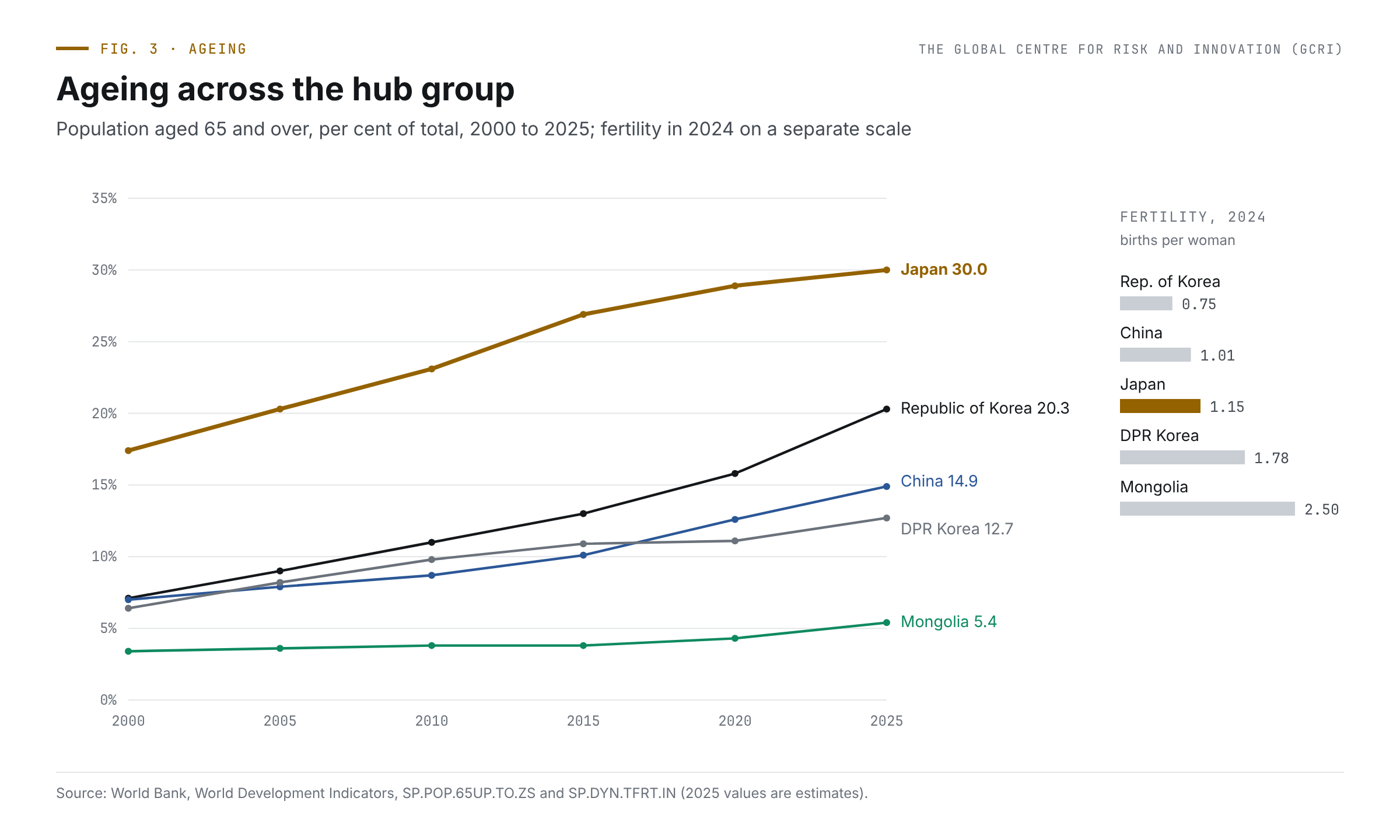
Population ageing changes every part of the risk chain: who is exposed, who can move, who cares for whom, and who is left to staff utilities, hospitals and recovery. In Japan, people aged 65 and over were 17.4% of the population in 2000 and about 30.0% in 2025; in the Republic of Korea the share rose from 7.1% to 20.3%, and in China from 7.0% to 14.9% (World Bank) [7]. Fertility shows where the trend is heading: in 2024 the total fertility rate was 0.75 births per woman in the Republic of Korea, 1.01 in China and 1.15 in Japan, against 2.5 in Mongolia (World Bank) [8].
For disaster risk, the implication is concrete. Evacuation plans built for a younger population fail when a larger share of residents need assistance to move, care homes and dialysis centres depend on continuous power and water, and the workforce that restores infrastructure shrinks. Comparing how countries with different ageing paths prepare for the same hazard class is one of the most useful things a regional programme can do.
| Country | 2000 | 2005 | 2010 | 2015 | 2020 | 2025 |
|---|---|---|---|---|---|---|
| Japan | 17.4 | 20.3 | 23.1 | 26.9 | 28.9 | 30.0 [7] |
| Republic of Korea | 7.1 | 9.0 | 11.0 | 13.0 | 15.8 | 20.3 [7] |
| China | 7.0 | 7.9 | 8.7 | 10.1 | 12.6 | 14.9 [7] |
| Dem. People’s Rep. of Korea | 6.4 | 8.2 | 9.8 | 10.9 | 11.1 | 12.7 [7] |
| Mongolia | 3.4 | 3.6 | 3.8 | 3.8 | 4.3 | 5.4 [7] |
Cold extremes and pastoral systems: Mongolia
Mongolia’s risk profile is different and equally systemic. About 27.4% of its households, some 246,302, are pastoral nomads who rely on livestock for their livelihoods, according to the 2021 national statistics cited by the IFRC [10]. In the 2023 to 2024 dzud, a combination of summer drought and extreme winter cold and snow, 8.1 million livestock had perished by July 2024, 12.5% of the national herd, according to the Ministry of Food, Agriculture and Light Industry as reported by the IFRC (IFRC) [10]. Nearly 5,000 herder households lost more than 70% of their animals [10]. Herd losses of this size pass directly into household income, rural-to-urban migration and food prices, and they are a candidate for anticipatory action before the winter peaks.
Three levels of cooperation, one rule of subsidiarity
At the national level, a National Nexus programme belongs to its country, with a National Desk that collects material questions, the National Nexus Consortium (NNC) as its institutional pillar, a National Leadership Council (NLC) and National Working Groups (NWG), whose experts work in Competence Cell units at institution, community or agency level [2]. No country in the group has a constituted programme today [1].
At the regional level, the East Asia Nexus Consortium programme, in formation, and a Regional Nexus Consortium for the wider region would compare compatible evidence on shared systems and support regional profiles of Nexus Reports that never override a country’s own findings; the Japan hub is a coordination role at this level [2]. At the global level, the Consortium Secretariat, held by GCRI through GCRI Canada in Toronto, keeps the programme’s records and routes each enquiry [2]. Decisions stay with the competent government, operator or financial institution, outside the programme.
The instruments that already govern shared risk
The global frame for disaster risk was itself adopted in the region: the Sendai Framework for Disaster Risk Reduction 2015 to 2030 was agreed by 187 UN Member States in Sendai on 18 March 2015, four years after the 2011 disaster, with seven targets and four priorities (UN News) [13]. The programme aligns its evidence to national instruments such as Japan’s long-term earthquake evaluations and damage estimates rather than substituting for them [5, 6]. Nexus Standards propose geophysical hazard standards and a Sendai Framework alignment; adoption is decided by each jurisdiction.
| Year | Instrument or record | Status and relevance |
|---|---|---|
| 2015 | Sendai Framework for Disaster Risk Reduction 2015-2030 | In force to 2030; adopted in Sendai with seven targets and four priorities [13] |
| 2025 | Nankai Trough damage estimate (Cabinet Office working group) | Released 31 March 2025: up to 298,000 deaths, about ¥292 trillion [6] |
| 2025 | Nankai Trough long-term evaluation (Earthquake Research Committee) | Revised to about 60-90% or higher over 30 years, with a second figure of 20-50% [5] |
| Continuing | Nexus Standards (proposed) | Geophysical hazard standards and Sendai alignment; adoption decided nationally |
How the region’s risks are measured
The evidence base in the group is unusually deep but held in national forms. Earthquake probabilities and damage estimates come from Japan’s Earthquake Research Committee and Cabinet Office [5, 6]; recovery records from the Reconstruction Agency [4]; event parameters from seismological agencies including the USGS [11]; demographic series from national statistics compiled by the World Bank [7, 8]; and pastoral losses from Mongolia’s ministry, reported by the IFRC [10]. Each figure on this page carries its own date and scope.
In the programme’s shared evidence environment, this work would run through NXS-GRX (canonical data, provenance and risk), NXS-DSS (decision cases and deliberation), NXS-COR (compute, nodes and runtimes), NXS-NET (network topology and continuity), NXS-EOP (earth observation and digital twins) and NXS-EWS (multi-hazard monitoring and warning), the systems the region’s missions use most [1]. Verification under the Nexus Standards means each figure can be traced to its issuer; participation states are kept in the programme’s participation records.
What is changing
- Probability is being communicated as a range. Two published figures for the Nankai Trough make uncertainty explicit, a model for how risk evidence should reach the public [5].
- Ageing outpaces preparedness. With nearly a third of Japan’s population aged 65 or over, evacuation, care continuity and response staffing are risk questions in their own right [7].
- Fertility is falling across the group. A rate of 0.75 in the Republic of Korea and about 1 in China signal shrinking workforces for recovery [8].
- Cold extremes hit pastoral economies. The 2024 dzud killed one in eight Mongolian livestock, making winter a hazard season for anticipatory finance [10].
- Measures have moved projections only slightly. A decade of work cut the Nankai death estimate by less than 10%, so the gap is in implementation, not knowledge [6].
Three faces of regional cooperation
GCRI leads on science, methods and evidence and keeps the regional desk. GRF leads leadership, institutional dialogue and the governance of Nexus Universe, with its regional view on regional cooperation in Asia and the Pacific and its own account of the hub on GRF’s page for the Japan hub [14]. GRA reads the region’s evidence for finance, on catastrophe and protection-gap questions for typhoon, flood and earthquake exposure and on supply-chain concentration in electronics, on its Asia and the Pacific programme and its pages on insurance and public pools; it never lends, underwrites, rates or invests [1, 15]. Risk Academy teaches the same systems for the region.
What institutions in the region can do now
At service level R0, participation begins with a question. Applications, payments, computing allocations and registrations open only when their team, terms and review capacity exist [1].
- Ministries, prefectures and cities: send a material question on a shared system to asiapacific@therisk.global or through the enquiry form; the reply gives a reference and the next step [1].
- Governments considering a country programme: begin with a country programme enquiry; formation is decided nationally.
- Manufacturers, ports and utilities: propose a dependency to examine through infrastructure and industry; operators keep full responsibility for their systems.
- Universities and research institutes: contribute a method, dataset or case to Nexus Reports, credited to the contributor.
- Insurers, reinsurers and supervisors: read the region’s finance questions with GRA on its Asia and the Pacific programme [15].
Boundaries. What this page does not claim: the Japan hub is a planned coordination role with no host decision on record; it is not an office in Tokyo or anywhere else, a public authority or a representative of any government or institution. The East Asia Nexus Consortium is a named programme in formation, not a constituted consortium. No country in the group has a constituted programme, and the current service level is R0. Engagement follows the programme’s sanctions and eligibility policy. GCRI does not regulate or certify, GRF does not regulate, finance or procure, and GRA does not lend, underwrite, rate or invest. Naming an agency, instrument or organization is not a claim of partnership or endorsement.
Questions and answers
Is there a GCRI office or hub in Tokyo?
No. The Japan hub is a planned coordination role with no host decision on record, and it is named for a country, not a city. The Consortium Secretariat sits with GCRI Canada in Toronto.
What is the East Asia Nexus Consortium?
A named programme in formation in the Asia and the Pacific region, with a public programme page published by GRA. Its formation records and participating structures are confirmed by the Secretariat before they are listed.
Which countries does the Japan hub cover?
Japan, China, the Republic of Korea, Mongolia and the Democratic People’s Republic of Korea. Listing records research coverage only, and engagement follows the programme’s sanctions and eligibility policy.
Does the programme forecast the Nankai Trough earthquake?
No. Probabilities and damage estimates are published by Japan’s Earthquake Research Committee and Cabinet Office. The programme compares and teaches from such evidence; it never issues forecasts or warnings.
How does an institution in the region start?
Write to the regional desk at asiapacific@therisk.global or use the enquiry form at therisk.global. You receive a reference and the name of the next step; today the programme offers information and enquiries only.
Glossary
- Planned hub: A regional coordination role for a group of countries; it operates only once a host decision is on record, and is never an office or an exclusive territory.
- Named programme in formation: A programme with a formation dossier under way; not yet a constituted consortium.
- Megathrust earthquake: A great earthquake on the interface where one tectonic plate slides beneath another, as along the Nankai Trough.
- Dzud: A Mongolian winter disaster in which drought, deep snow or extreme cold cause mass livestock deaths.
- Total fertility rate: The average number of children a woman would have at current age-specific birth rates.
- Service level R0: The programme’s current state: information and enquiries, with a reference for each enquiry.
Further reading across the network
- Asia and the Pacific region at GCRI
- Six programme regions
- Regional cooperation in Asia and the Pacific at GRF
- Asia and the Pacific at GRA
- East Asia Nexus Consortium programme page at GRA
- Asia and the Pacific at Risk Academy
- Regions and hubs (documentation)
- Programme status
References
- The Global Centre for Risk and Innovation (2026). Asia and the Pacific region. Accessed 2026-10-21.
- Nexus programme documentation (GCRI) (2026). Regions and hubs. Accessed 2026-10-21.
- The Global Risks Alliance (2026). East Asia Nexus Consortium (programme page). Accessed 2026-10-21.
- Reconstruction Agency, Government of Japan (2025). Overview of the Disaster: the Great East Japan Earthquake (Progress to date, chapter 1 section 1). Accessed 2026-10-21.
- Japan Science and Technology Agency (reporting the Earthquake Research Committee) (2025). Nankai Trough megaquake: two occurrence probabilities listed side by side. Accessed 2026-10-21.
- Japan Science and Technology Agency (reporting the Cabinet Office working group) (2025). New projection for Nankai Trough megaquake: over 290,000 deaths and 292 trillion yen in economic damage. Accessed 2026-10-21.
- World Bank, World Development Indicators (2026). Population ages 65 and above (% of total population), SP.POP.65UP.TO.ZS. Accessed 2026-10-21.
- World Bank, World Development Indicators (2026). Fertility rate, total (births per woman), SP.DYN.TFRT.IN, 2024. Accessed 2026-10-21.
- Buldyrev, Parshani, Paul, Stanley and Havlin, Nature 464 (2010). Catastrophic cascade of failures in interdependent networks. Accessed 2026-10-21.
- International Federation of Red Cross and Red Crescent Societies (2024). Mongolia: dzud, operational update (MDRMN020). Accessed 2026-10-21.
- U.S. Geological Survey (2024). M 7.5, 2024 Noto Peninsula, Japan Earthquake (us6000m0xl). Accessed 2026-10-21.
- World Bank, World Development Indicators (population series) (2026). Population, total, SP.POP.TOTL, 2025. Accessed 2026-10-21.
- United Nations (UN News) (2015). Sendai: UN conference adopts new, people-centred disaster risk reduction strategy. Accessed 2026-10-21.
- The Global Risks Forum (2026). Asia and the Pacific region (regional cooperation). Accessed 2026-10-21.
- GRA, regional programmes (2026). Asia and the Pacific region (finance-readiness view). Accessed 2026-10-21.
Editorial record
Facts and programme states are given as of 21 October 2026. This page is reviewed at least every 180 days and whenever a hub host decision, a programme state or a cited figure changes. It replaces an earlier version of this post, published in 2026, which described a Tokyo cluster hub anchored by 2030, country nodes and interface pathways beyond the recorded hub group, and records and outputs that are not on the programme’s records; those descriptions are withdrawn.
Published by the GCRI editorial desk under the editorial integrity policy. To report an error or request a correction, use the corrections route; corrections are dated and listed with the page.