




The Global Centre for Risk and Innovation (GCRI)

Science Policy

Science policy is becoming one of the defining capabilities of the twenty-first century. Climate disruption, artificial intelligence, cyber risk, infrastructure fragility, disaster risk, biodiversity loss, public health vulnerability, geospatial intelligence, sovereign compute, advanced data systems, and economic transition are no longer separate policy challenges. They are connected conditions shaping national resilience, public trust, enterprise strategy, finance-readiness, and global stability. Our area of activity in this context helps institutions turn science into usable evidence, technology into responsible governance questions, and complex risk into shared capability. It is designed for governments, public authorities, universities, enterprises, funders, insurers, development actors, technical communities, and public-interest partners that need more than isolated research, fragmented dashboards, vendor claims, or one-off reports

Image link
Evidence Systems
Evidence systems turn research, datasets, models, observations, simulations, expert input, and field intelligence into trusted institutional records. Each record can carry source context, method, assumptions, limitations, confidence, uncertainty, public-safe status, correction history, and archive status, allowing technical, policy, and finance audiences to understand what the evidence supports, what remains unresolved, and what should not yet be claimed
Compute Infrastructure
Compute infrastructure covers the cloud, edge, high-performance computing, sovereign compute, secure enclaves, confidential computing, compute-to-data, and verifiable compute environments required for modern science-policy work. It helps institutions govern sensitive analytics, simulations, AI workflows, digital twins, data rooms, and national capability-building without confusing compute access with data rights, security approval, provider validation, or deployment authorization
Digital Commons
Digital commons provide reusable public-good infrastructure for software, datasets, metadata, APIs, schemas, dashboards, ontologies, model documentation, learning objects, reports, registries, listings, and handoff packages. This area makes public-good assets discoverable, reviewable, localizable, correctionable, archivable, and responsibly reusable while preventing open release, marketplace visibility, or technical contribution from becoming procurement preference, endorsement, or execution authority
Policy Simulation
Policy simulation gives institutions controlled environments to explore possible futures before formal decisions are made. Dashboards, simulations, digital twins, AI-assisted analysis, secure rooms, data rooms, and compute-to-data workflows allow users to test assumptions, compare options, examine dependencies, and understand consequences while keeping simulation separate from policy adoption, procurement, finance, deployment, emergency command, or implementation
Finance Readiness
Finance readiness makes science-policy priorities more legible to funders, donors, insurers, development actors, public finance institutions, and capital readers. It structures assumptions, dependencies, evidence gaps, technical risks, cost questions, protection gaps, public authority dependencies, safeguard conditions, and implementation uncertainties without providing investment advice, underwriting, donor allocation, public finance allocation, solicitation, transaction activity, or financeability claims
AI Governance
AI governance supports responsible institutional learning around artificial intelligence, agentic systems, automated decision-support, AI-enabled infrastructure, model workflows, and human-AI collaboration. This area advances model cards, system cards, agent workflow records, AI-use labels, oversight patterns, red-team records, public-safe output controls, and review environments before AI systems are treated as ready for procurement, deployment, regulation, public use, or operational reliance
Risk Intelligence
Risk intelligence structures how institutions read hazards, exposure, vulnerability, resilience, infrastructure dependencies, ecosystem stress, health risks, cyber threats, disaster signals, and cascading impacts. It converts indicators, signals, multi-hazard analysis, hotspot records, scenario outputs, and public-safe summaries into a usable intelligence layer for technical teams, public authorities, funders, insurers, and national platforms without turning analysis into public warnings, official statistics, or risk scores
Geospatial Intelligence
Geospatial intelligence brings together Earth observation, remote sensing, sensors, drones, digital twins, infrastructure mapping, environmental monitoring, protected-location controls, and place-based risk analysis. It enables institutions to use location intelligence for resilience, disaster risk, biodiversity, infrastructure, and national planning while protecting sensitive sites, community knowledge, data sovereignty, public authority boundaries, and public-safe reporting standards
Standards Interface
Standards interface work organizes taxonomies, schemas, controlled vocabularies, maturity context, readiness evidence, assurance records, interoperability requirements, and technical documentation. It helps institutions coordinate around shared language and technical meaning without implying certification, standards authority, regulatory substitution, supplier validation, procurement approval, or public authority endorsement
Nexus Architecture
Handoff architecture creates the disciplined pathway from public-good knowledge to responsible downstream action. Handoff packages carry evidence, data, methods, technical dependencies, safeguards, public authority dependencies, finance and insurance questions, procurement boundaries, provider-neutrality notes, recipient responsibilities, correction routes, and archive status to competent actors that may decide, finance, procure, regulate, insure, implement, or operate separately
Image link

The Nexus Reports provide comprehensive evaluations of country-specific risks and opportunities, focusing on biodiversity, ecosystem services, climate change vulnerabilities, socio-economic risks, the food-water-energy nexus, and exponential technologies. Drawing on authoritative sources, these reports offer tailored policy recommendations, detailed analyses, and practical case studies, integrating global scientific research to manage risks and drive sustainable development

Image link

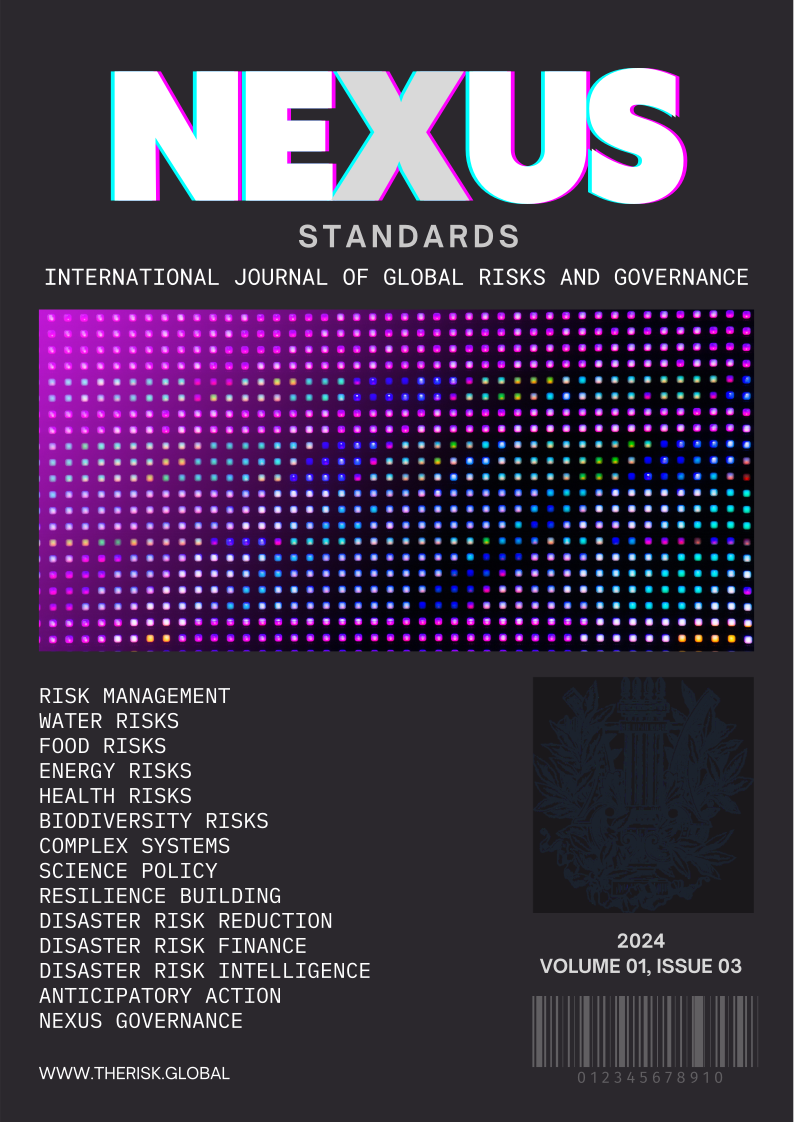
The International Journal of Global Risks and Governance (IJRG) is revolutionizing the understanding and management of global challenges with an integrated nexus approach. Aspiring to be the first decentralized scientific journal in global risks, IJRG leverages Web3 principles to foster an open, transparent, and collaborative ecosystem for researchers, policymakers, and practitioners

Get Access
Start a Policy Lab
Build Resilience Masterplan
Design a Trigger
Launch a Data Commons
Train Your Model

Building Tribes for Impact

Consortium Pathways
Consortium pathways provide the formal entry point for institutions seeking structured participation in anticipatory action, early risk intelligence, preparedness, disaster risk intelligence, humanitarian readiness, climate risk, finance-readiness, and national capability-building. They allow governments, enterprises, universities, funders, insurers, public authorities, civil society, humanitarian actors, technical partners, and communities to engage through global, regional, and national channels while keeping collaboration distinct from public warnings, finance, procurement, or implementation
Global Guilds
Anticipatory Action Working Groups turn expert knowledge and institutional experience into structured public-good outputs. They may focus on signals, indicators, trigger logic, forecast interpretation, scenario workflows, humanitarian sensitivity, community safeguards, public authority learning, finance-readiness, national portfolio inputs, technical notes, public-safe reports, and readiness questions that can be reviewed, corrected, archived, and routed for further use
Network Memory
Network memory preserves signal records, indicator histories, scenario outputs, trigger notes, public-safe summaries, learning materials, reports, datasets, technical objects, registry entries, listings, correction histories, archive records, and continuity pathways. It ensures that anticipatory action improves over time rather than resetting after each event, crisis, exercise, pilot, or annual cycle
Project Vehicles
National Consortium Companies and Project SPVs provide separate implementation-adjacent vehicles that may receive handoff context when anticipatory action work is mature enough for downstream consideration. These vehicles are distinct from the public-good layer and require their own legal, financial, public authority, humanitarian, procurement, operational, safeguard, liability, and governance conditions before any implementation activity occurs
National Councils
National Councils and Helix Councils organize country-level participation across public authorities, emergency institutions, academia, industry, technology, infrastructure, capital, insurance, donors, civil society, communities, media, humanitarian actors, and public-interest stakeholders. They translate anticipatory action priorities into national portfolios, preparedness learning agendas, working groups, capability needs, public-safe outputs, finance-readiness questions, and responsible handoff pathways
Competence Cells
Competence Cells provide focused expert capacity for anticipatory action challenges, including disaster risk intelligence, climate forecasting context, geospatial analysis, hazard modelling, trigger design, scenario simulation, humanitarian data governance, cyber risk signals, public health risk intelligence, food and water stress, finance-readiness questions, and public-safe reporting through bounded, reviewable, correctionable work
Annual Build
Nexus Universe provides the annual build and convergence cycle where anticipatory action work can be prepared, reviewed, demonstrated, routed, and advanced. It brings together national portfolios, risk signals, indicator sets, public authority learning rooms, finance-readiness rooms, working groups, competence cells, scenario workflows, public-safe reports, registry updates, and handoff pathways without becoming a warning center, emergency command body, investment platform, procurement forum, or execution event
Have questions?