Global Risks Index (GRIx)

Technology Risks

Technology Risk Governance for AI, Cyber, Digital Trust, Critical Infrastructure, and Frontier Systems

Technology risk has become a central institutional risk category because digital systems now shape public trust, infrastructure continuity, enterprise operations, public services, finance, security, education, health, and national capability. Artificial intelligence, agentic systems, cyber-physical infrastructure, cloud and edge compute, sovereign data systems, telecom networks, digital identity, geospatial intelligence, robotics, DLT, Web3, DePIN, quantum-relevant systems, semiconductors, advanced manufacturing, and biosecurity-sensitive innovation create operational dependencies, governance uncertainty, procurement complexity, cyber exposure, public-safe communication risks, and implementation responsibilities

The Global Centre for Risk and Innovation (GCRI) provides technology risk assessments, AI governance records, model and system cards, cyber resilience reviews, data governance frameworks, digital infrastructure dependency maps, geospatial risk notes, public-good software documentation, responsible innovation briefs, assurance-readiness records, and handoff packages. This stream supports governments, enterprises, universities, funders, infrastructure operators, technology providers, public authorities, and technical communities that need to govern frontier technology responsibly

Engagement can begin through Nexus Consortiums, Technology Helix Councils, AI and Cyber Working Groups, technical Competence Cells, Nexus Foundry, Nexus Universe technical tracks, provider contribution pathways, National Portfolio routes, institutional partnerships, sponsorship pathways, and lawful handoff channels. The stream supports technology learning, assurance readiness, R&D, governance, and handoff; certification, compliance approval, vendor validation, procurement, deployment, operation, and implementation remain separate.


Image Link

Technology Risk Assessment

Technology Risk Assessment evaluates how AI, cyber systems, cloud, edge, telecom, data infrastructure, digital identity, geospatial systems, robotics, autonomous systems, DLT, quantum-relevant systems, semiconductors, and advanced manufacturing create operational, governance, procurement, security, public trust, and implementation risk for institutions

AI Governance Review

AI Governance Review supports responsible institutional use of AI, agentic systems, automated decision-support, AI-enabled infrastructure, and human-AI collaboration. It produces model cards, system cards, AI-use labels, oversight patterns, red-team records, risk documentation, public-safe controls, and deployment-boundary reviews before procurement or operational reliance

Cyber Resilience

Cyber Resilience Assessment reviews cyber exposure across public-good software, identity systems, OT/IoT environments, cloud platforms, critical services, data systems, digital infrastructure, and technology-dependent operations. It supports cyber resilience planning through dependency maps, incident pathways, vulnerability disclosure objects, and public-safe cyber summaries

Data Governance Review

Data Governance Review structures sensitive, sovereign, public authority, health, infrastructure, community, protected-knowledge, and AI-relevant data through data-use labels, access classes, privacy controls, compute-to-data models, residency context, retention rules, public-safe outputs, and correction pathways for responsible institutional use

Digital Infrastructure

Digital Infrastructure Review examines cloud, edge, HPC, sovereign compute, secure enclaves, APIs, telecom, private wireless, digital identity, interoperability, provider dependency, continuity, and national digital capability. It identifies operational dependencies, resilience gaps, architecture risks, and governance questions without validating providers or authorizing deployment

Model Risk Review

Model Risk Review prepares AI models, statistical models, digital twins, simulation models, disaster risk models, financial risk models, and decision-support tools for institutional review. It documents assumptions, uncertainty, limits, evaluation context, oversight patterns, appropriate-use conditions, correction pathways, and model governance requirements

Geospatial Technology

Geospatial Technology Review governs Earth observation, remote sensing, sensors, drones, digital twins, robotics, protected-location data, infrastructure mapping, and public-safe geospatial outputs. It integrates advanced spatial intelligence with data sovereignty, community safeguards, protected knowledge controls, public authority boundaries, and responsible reporting

Frontier Technology

Frontier Technology Review examines DLT, Web3, DePIN, quantum-relevant systems, semiconductors, advanced manufacturing, cyber-physical systems, autonomous systems, dual-use technology, and biosecurity-sensitive innovation. It helps institutions understand technical risk, standards dependencies, export-control sensitivity, governance requirements, and implementation constraints

Nexus Handoff

Technology Handoff Package transfers architecture context, technical evidence, data limits, cyber questions, AI governance records, public authority dependencies, procurement boundaries, provider-neutrality notes, recipient responsibilities, correction pathways, and archive status to competent actors assessing procurement, deployment, operation, regulation, finance, or implementation.
Trusted By World Leaders

We support governments, multilaterals, regulators, DFIs, central banks, humanitarian agencies, utilities, insurers/reinsurers, critical-infrastructure operators, research networks, and national working groups (NWGs). Our leadership is earned through proactive, cutting-edge solutions and initiatives that tackle urgent challenges while balancing immediate impact with long-term sustainability. Strengthened by strategic partnerships with global powerhouses, GCRI sets a new standard for protection and progress in an era of unprecedented risks and opportunities

A Statue With A Medical Protective Mask Concept Of The Coronavirus Pandemic
Purple Background
Yellow Background
Our National Working Groups (NWGs) converge to shape a future defined by Resilience , Innovation , and Collaboration. By uniting cross-sector perspectives through a seamless hybrid model; from community to cabinet, and field to cloud—we translate collective insight into breakthrough innovations and durable partnerships that deliver measurable impact and a more sustainable future for all

Unlocking the Power of Spatial Finance 🌌 for Disaster Readiness 📡

Transforming risk management by integrating DRR, DRF, and DRI into a seamless, proactive system. Leveraging cutting-edge geospatial analytics and innovative financial triggers, NE enables real-time insights and rapid resource mobilization to build resilient communities and drive sustainable growth

Hybrid Cloud Landing Zone
A deployable hybrid-cloud landing zone across public cloud, private cloud, on-prem, sovereign environments, Kubernetes, Red Hat OpenShift, secure enclaves, and edge environments. It includes identity, network segmentation, platform policies, workload classification, logging, observability, cost visibility, infrastructure-as-code, and deployment separation for regulated and mission-critical workloads
AI Governance
An AI governance layer managing model cards, system cards, agent workflow records, AI-use labels, evaluation records, red-team outputs, human oversight, prompt logs, output review, model monitoring, incident records, approved-use boundaries, and lifecycle controls across enterprise AI, public-good AI, and mission-critical AI workflows
Cyber Resilience
A cyber resilience layer integrating zero trust, identity and access management, vulnerability disclosure, SBOMs, dependency scanning, secrets management, secure repositories, incident records, SIEM/SOAR integration, continuity planning, threat context, secure CI/CD, and public-safe cyber reporting across enterprise, public-sector, and public-good systems
Geospatial Technology
A geospatial layer integrating Earth observation, STAC catalogues, PostGIS, GIS services, remote-sensing pipelines, sensor feeds, drones where lawful, digital twins, map services, protected-location controls, and public-safe atlas outputs for risk, resilience, infrastructure, environmental, and disaster intelligence
Edge AI Nodes
An edge AI layer supporting distributed inference, sensor analytics, private wireless, AI-RAN/O-RAN contexts, local compute, field environments, disconnected operations, industrial edge, sovereign-sensitive workloads, and human oversight. It enables governed AI-enabled intelligence closer to where data is produced
Data Governance
A governed data layer managing catalogues, metadata, lineage, access classes, consent context, data-use labels, residency, retention, compute-to-data workflows, privacy controls, protected knowledge restrictions, cross-border transfer notes, and public-safe output review across clouds, national repositories, data rooms, and controlled analytics environments
Model Risk
A model risk layer governing AI models, statistical models, digital twins, simulation models, disaster risk models, financial models, geospatial models, and decision-support systems. It records assumptions, uncertainty, lineage, performance limits, data dependencies, evaluation context, monitoring status, approvals, corrections, and appropriate-use conditions
Digital Infrastructure Mesh
An infrastructure mesh mapping cloud, edge, HPC, sovereign compute, secure enclaves, APIs, telecom, private wireless, digital identity, interoperability, provider dependencies, event streams, workload dependencies, network paths, and resilience gaps. It supports national digital capability while reducing vendor lock-in and operational opacity
Software Supply Chain
A software supply chain layer managing repositories, dependency scanning, SBOMs, artifact signing, provenance, vulnerability tracking, release classes, support status, container registries, CI/CD workflows, open-source license context, and correction pathways. It makes public-good and mission-critical software trustworthy, maintainable, auditable, and handoff-ready
Technology Handoff
A handoff layer packaging architecture records, cyber questions, AI governance notes, model risk records, data limits, provider-neutrality records, public authority dependencies, procurement boundaries, recipient responsibilities, correction records, and archive status for downstream procurement, deployment, regulation, finance, insurance, or operations

Future Innovation Labs

Innovation Lab
Discover;
Learn;
Build;

We support innovation, collaboration and knowledge-sharing amongst our members, partners and the broader research, development, and education communities. Our WILPs streamline the identification, mitigation, and evaluation of Risks, followed by the optimal use of GRIx to tackle Issues and manage adverse impacts. They provide secure network platforms that enable citizens to participate in MPM and use iVRS to report risks and values anywhere. Risk Pathways deliver out-of-the-box CRS functionality to meet institutional requirements, including SCF taxonomies for digital-green skills, compliance frameworks and real-time validation systems. They help members and QH stakeholders with DICE to navigate essential resources and find the right levers across the public-private-planet landscape. 

MPM
Integrated pathways for existing national portfolios on the right to inclusive education, skills development, and career mobility through LLL for all
CRS
Rewarding participation with utility value across the network to increase interoperability and career mobility
DICE
Next-generation of internet for risk and innovation in pluralistic societies
GRIx
Open source standard indexing system for linked open data set about global risk and humanitarian crisis.
iVRS
Stakeholder engagement and reporting mechanism for Environmental, Social and Governance (ESG) risks and impacts
SCF
Frameworks, skills taxonomies, competencies and policies for the twin digital-green transition
Research
0%
Design
0%
Innovation
0%
Acceleration
0%
Policy
0%
Image Link

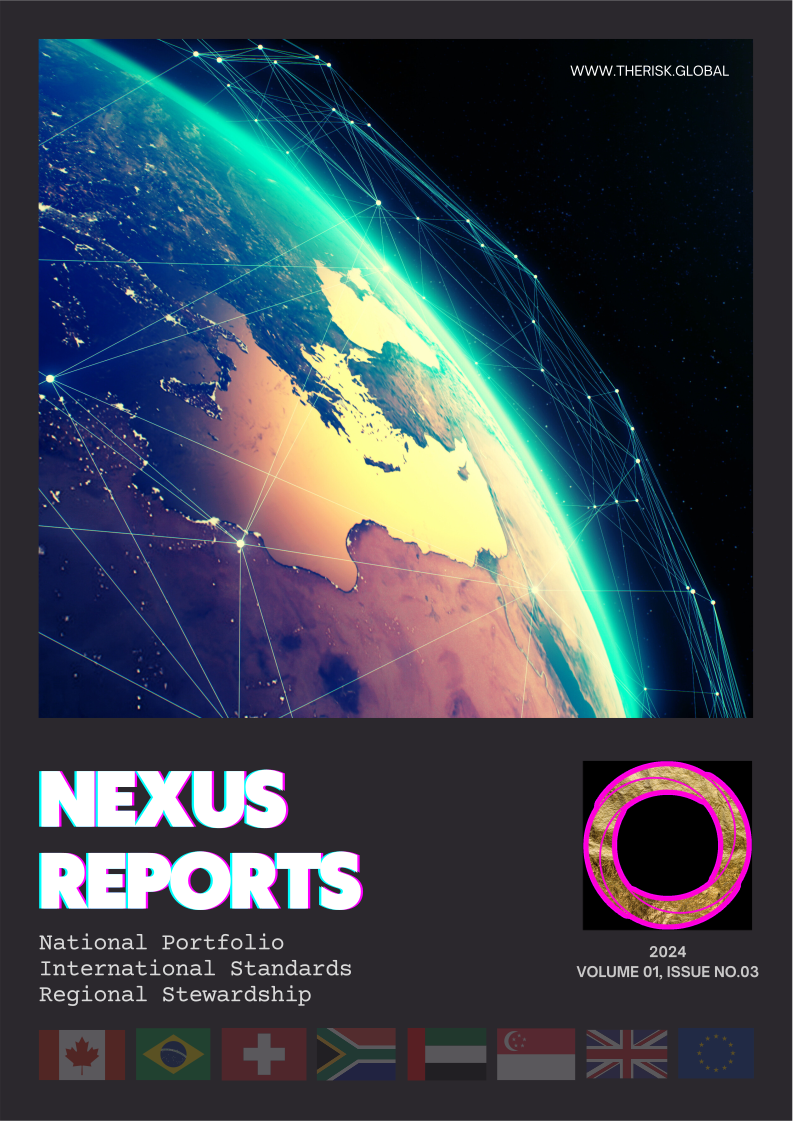
The Nexus Reports provide comprehensive evaluations of country-specific risks and opportunities, focusing on biodiversity, ecosystem services, climate change vulnerabilities, socio-economic risks, the food-water-energy nexus, and exponential technologies. Drawing on authoritative sources, these reports offer tailored policy recommendations, detailed analyses, and practical case studies, integrating global scientific research to manage risks and drive sustainable development

Have questions?