

An institution that claims to decide everything can be held to account for nothing. This essay sets out the principle of authority by boundary, the evidence on durable institutions behind it, and how the Nexus programme keeps one decider for every decision on the record.
Key takeaways
- Authority by boundary is the principle that an institution earns trust for what it does by recording, as precisely, what it will not do and who decides instead [1, 2].
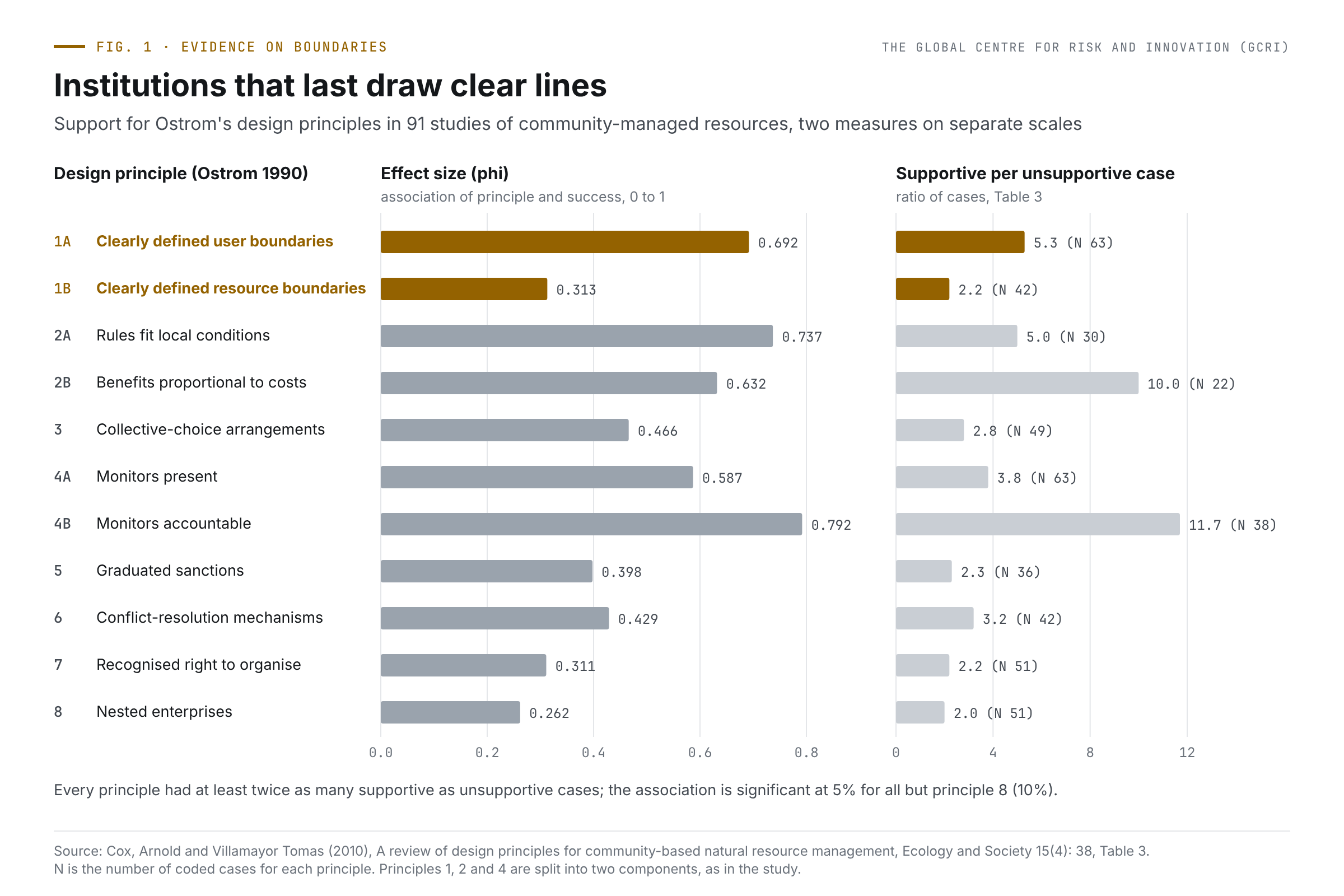
- The evidence from durable institutions supports it: in a review of 91 studies, clearly defined user boundaries had an effect size of 0.692 and 5.3 supportive cases for each unsupportive one [3].
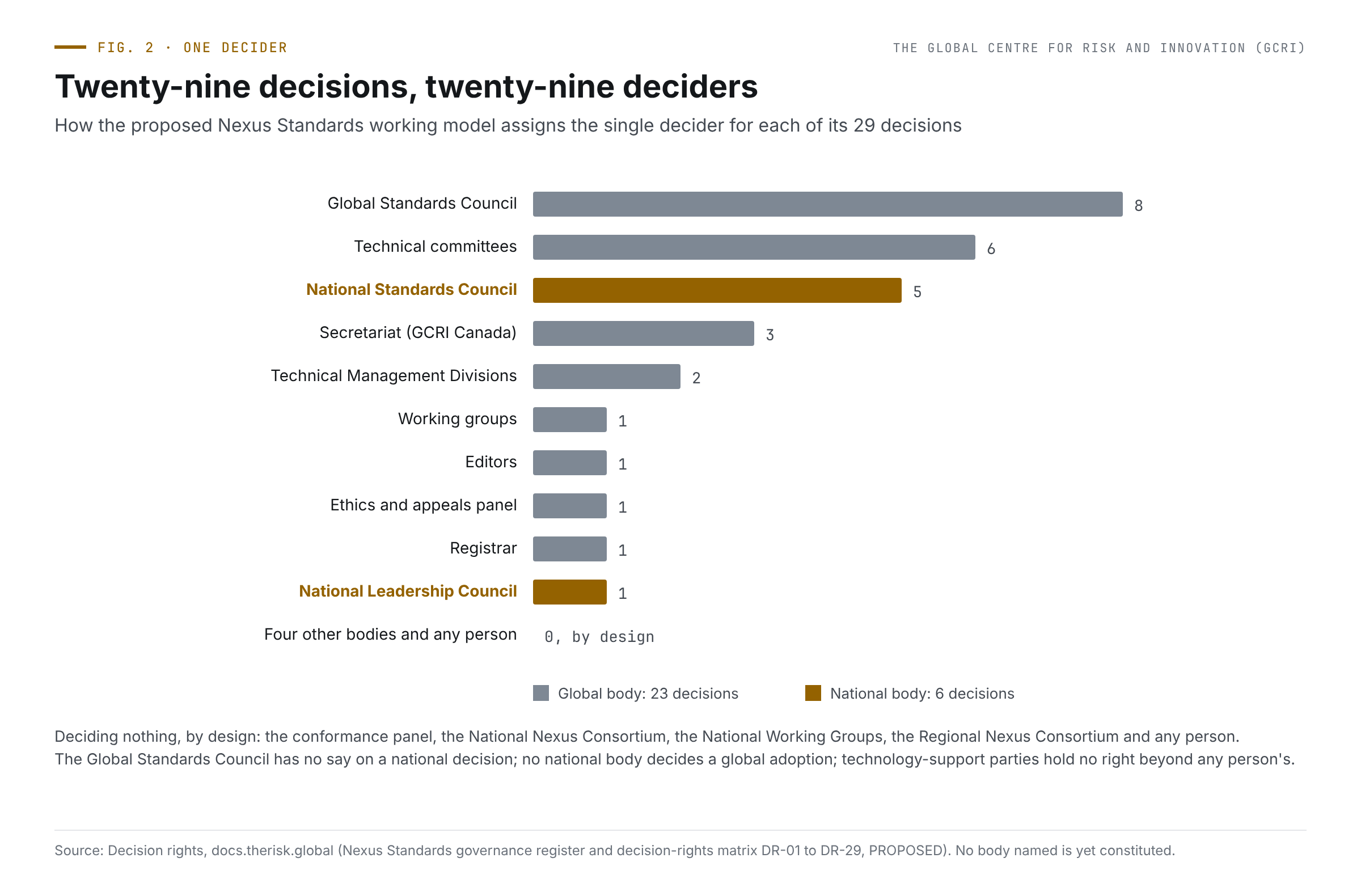
- In the Nexus programme each decision has exactly one decider: of the 29 decisions in the proposed standards working model, 23 sit with global bodies and 6 with national ones, and neither decides for the other [1].
- Public authority stays where international law places it: the Sendai Framework gives each State the primary responsibility to prevent and reduce disaster risk, and the programme informs that authority without replacing it [4, 1].
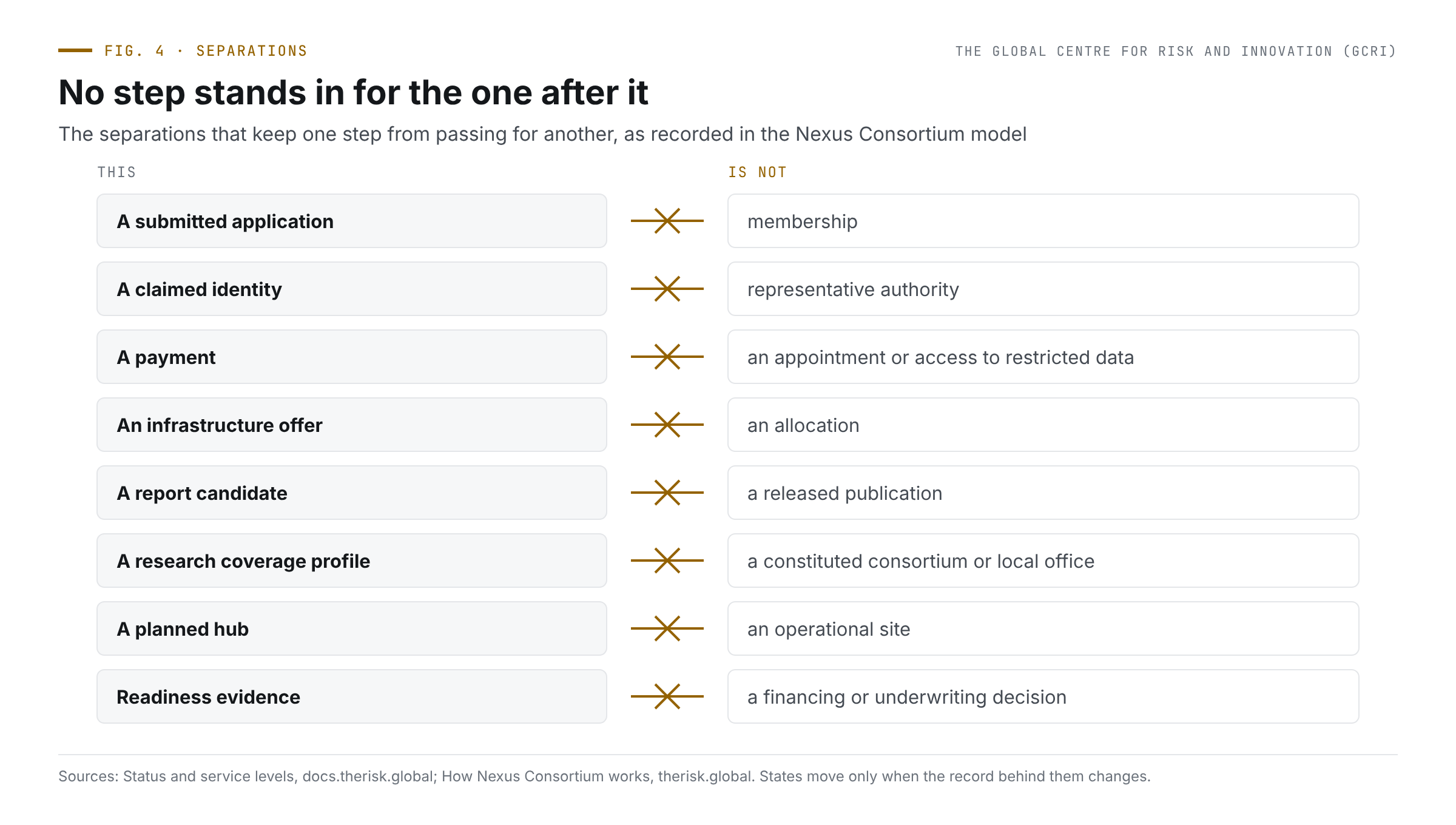
- Boundaries are kept on the record: eight separations stop one state passing for the next, and every programme is in formation at service level R0 [5].
What authority by boundary means
Authority by boundary is the principle that a shared institution gains usable authority not by extending its reach but by defining it: each function has one accountable party, each decision one decider, and each limit is written down where anyone can read it. The Nexus Consortium model states the consequence in five words: “The authority decides; the programme informs” [1].
The principle has a companion in GCRI’s essay on the non-execution doctrine, which explains why public, regulatory, fiduciary and operational decisions are never taken inside the programme. This essay asks the prior question: why boundaries create authority at all, what the evidence on durable institutions says, and how the programme turns that evidence into rules on the record.
The Global Centre for Risk and Innovation (GCRI) is a research, development and policy institution; it does not regulate, certify, license or approve, and its findings carry their methods and uncertainty [6]. The Global Risks Forum (GRF) does not regulate, finance, procure or certify, and The Global Risks Alliance (GRA) does not lend, underwrite, rate, invest, advise on or arrange transactions [7]. These are not disclaimers added at the end. They are the shape of the institutions.
Why limits create trust
Systemic risk crosses ministries, operators, markets and borders, and the institutions that study it are tempted to follow it everywhere. An institution that claims to decide on flood defences, grid investment, insurance cover and public warnings at once becomes impossible to hold to account for any of them. Its findings start to read as instructions, its convenings as negotiations, and its partners as clients. The more it claims, the less each claim is worth.
A boundary reverses that dynamic. When an evidence body states that it will never take the decision its evidence informs, the evidence can be read on its merits; when a convening body states that it does not finance, a minister can speak in its forum without that speech becoming a commitment; when a finance-readiness body states that it does not underwrite, an insurer can examine its analysis without a conflict of interest. Each limit lowers the cost of trusting what lies inside it.
This is also how international practice is organised. The Sendai Framework for Disaster Risk Reduction, adopted by the United Nations General Assembly in June 2015, sets as its first guiding principle that each State has the primary responsibility to prevent and reduce disaster risk, and as its second that responsibilities be shared by central governments, national authorities, sectors and stakeholders [4]. A programme that respects that order can work with every State; one that blurred it could work with none.
What the evidence on durable institutions shows
The most careful test of this idea comes from the study of commons. In 1990 Elinor Ostrom, awarded the 2009 economics prize in memory of Alfred Nobel for her analysis of economic governance, especially the commons, proposed eight design principles that characterise robust institutions for managing shared resources such as forests, fisheries and irrigation systems [8, 3]. Twenty years later, Cox, Arnold and Villamayor Tomas analysed 91 studies, coding 77 cases, and found the principles well supported empirically [3].
The first principle is clearly defined boundaries. Split into its two components, the boundary around the community of users had an effect size (phi) of 0.692, with 5.3 supportive cases for each unsupportive one across 63 cases; the boundary around the resource itself had 0.313 and 2.2 across 42 cases [3]. The strongest single association in the review was for monitors who are accountable to those they monitor, at 0.792 and a ratio of 11.7 [3]. Every principle had at least twice as many supportive as unsupportive cases, and the association was significant at the 5% level for all but the eighth, nested enterprises, which was significant at 10% [3].
Shared risk infrastructure is not a fishery, and the authors themselves warn against generalising the principles to large-scale systems without care [3]. But the mechanism carries: boundaries make costs and benefits attributable, so participants can see who answers for what. That is the property a programme spanning three institutions and many countries needs most.
One decider for every decision
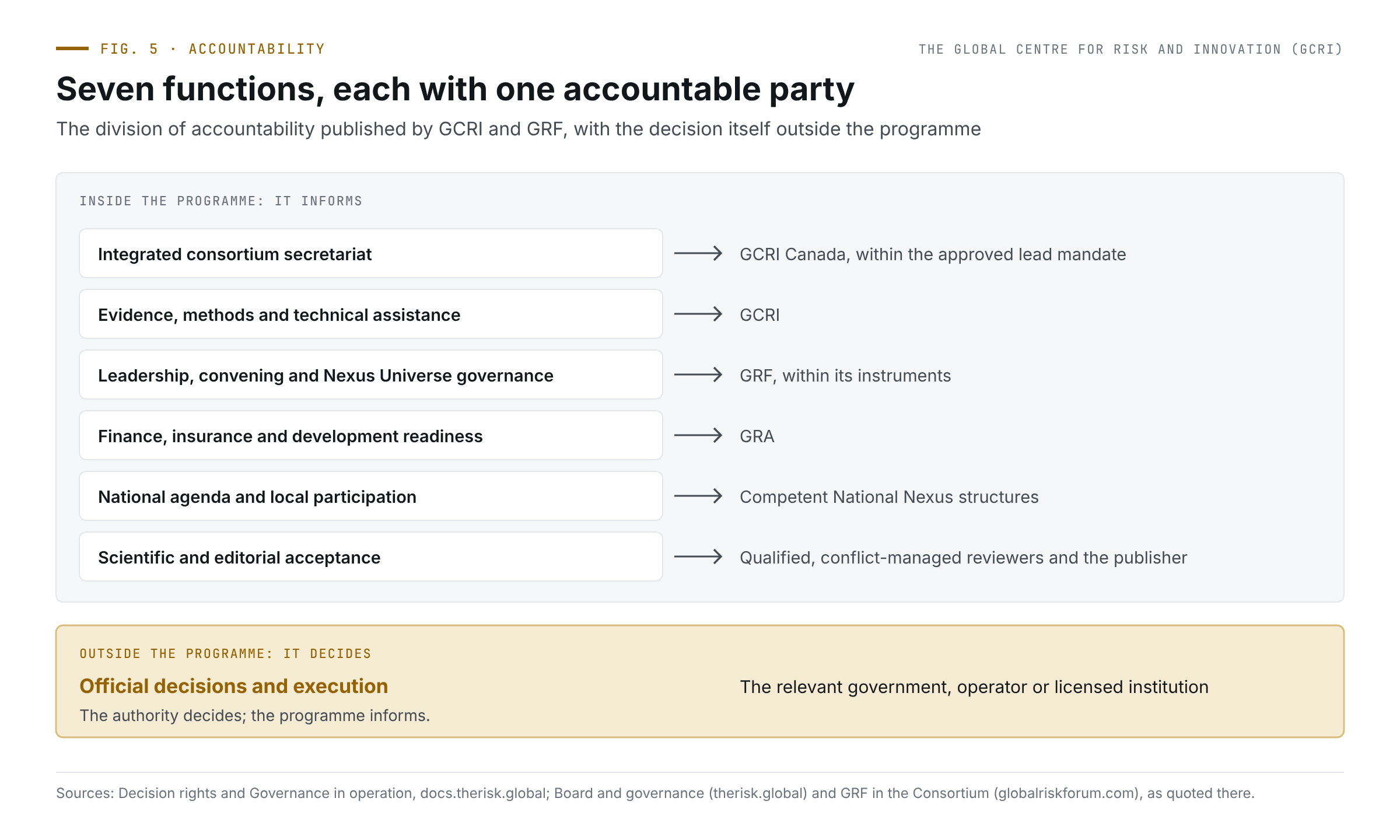
The programme writes its boundaries as decision rights. Seven functions each have one accountable party: the integrated consortium secretariat sits with GCRI Canada within the approved lead mandate; evidence, methods and technical assistance with GCRI; leadership, convening and Nexus Universe governance with GRF; finance, insurance and development readiness with GRA; the national agenda and local participation with competent National Nexus structures; scientific and editorial acceptance with qualified, conflict-managed reviewers and the publisher; and official decisions and execution with the relevant government, operator or licensed institution [1, 2].
The proposed working model of the Nexus Standards goes further. Its matrix gives each of 29 decisions exactly one decider, recorded separately from those who propose, are consulted, perform the work or are informed [1]. Twenty-three decisions sit with global bodies, led by the Global Standards Council with eight and the technical committees with six; six sit with national bodies, the National Standards Council with five and the National Leadership Council with one [1]. Four bodies, and any member of the public, decide nothing at all, by design, though anyone may comment, propose and appeal [1].
Five invariants hold across the matrix: one decider per decision; no say for the global council on a national decision; no national body deciding a global adoption; no adoption, technical content or conformance decisions for the National Leadership Council; and no right for technology-support parties beyond any person’s [1]. Decision rights sets them out in full, and GRF explains the same logic in its pages on decision rights and responsibilities.
Eight principles, read as programme rules
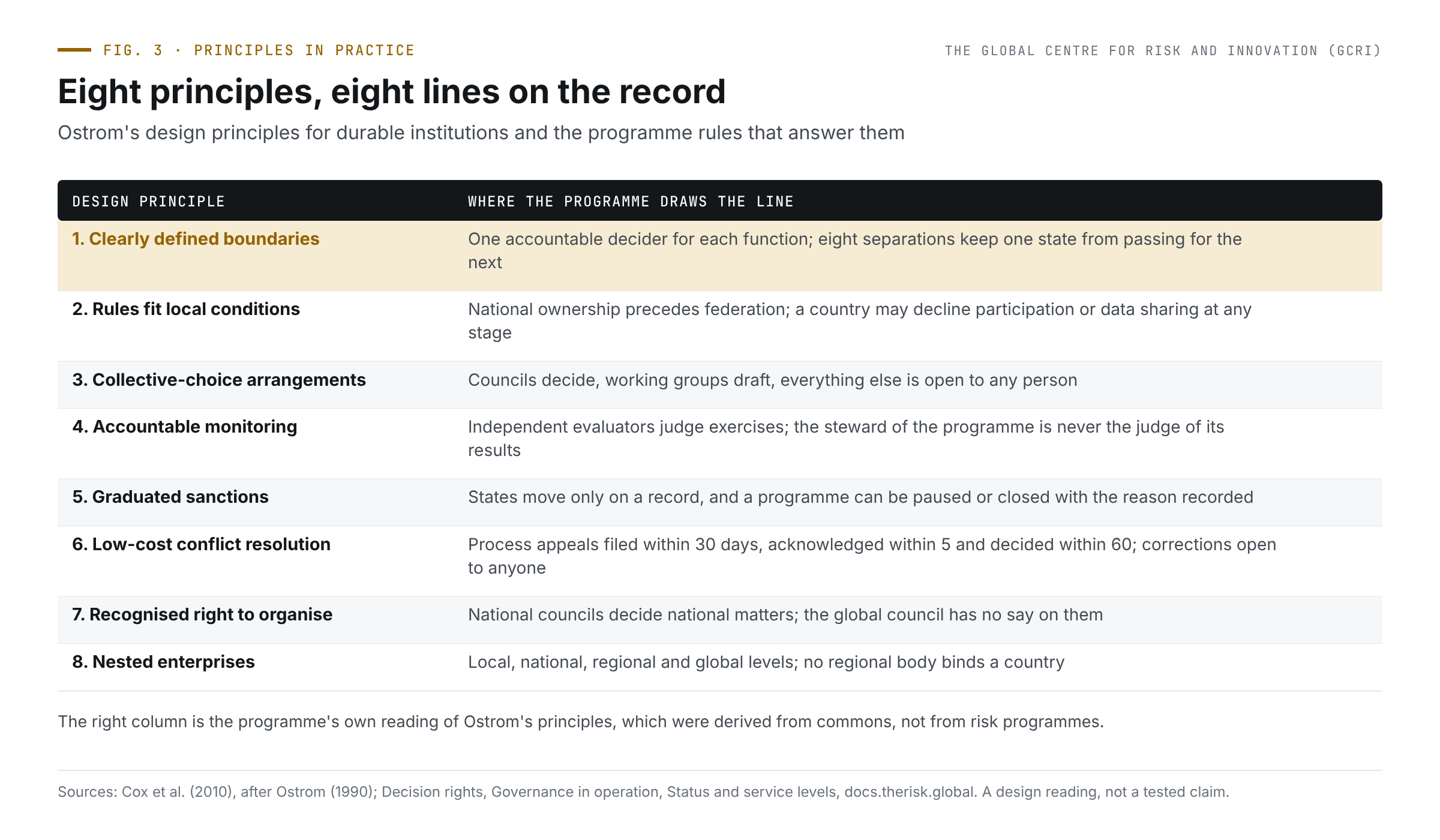
Read against Ostrom’s principles, the programme’s rules form a recognisable pattern. Clear boundaries become decision rights and separations. Rules that fit local conditions become national ownership: competent National Nexus structures hold the national agenda, and a country may decline participation or data sharing at any stage [2]. Collective choice becomes the formula “councils decide; working groups draft; everything else is open” [1].
Accountable monitoring becomes the separation of exercise direction from control and evaluation: GRF holds the programme gates in the manner of exercise direction, and independent evaluators judge results, so the steward of the programme is never the judge of its results [1, 9]. The separation follows established exercise practice, which the WHO Simulation Exercise Manual sets out for planning, conducting and evaluating exercises [10]. Graduated sanctions become explicit states that can move backwards, so a programme can be paused or closed with the reason recorded [5]. Low-cost conflict resolution becomes an appeal route with time limits: a process appeal is filed within thirty days, acknowledged within five and decided within sixty [1].
The last two principles concern scale. A recognised right to organise appears as the rule that national councils decide national matters; nested enterprises appear as four levels, local, national, regional and global, in which no regional body binds a country and a planned hub is never an office or an exclusive territory [2, 11]. Figure 3 sets out the reading, which is the programme’s own and not a finding of the review.
Boundaries kept on the record
A boundary that lives only in a mission statement is not a boundary. The programme keeps its limits as states on a record: “every programme carries one explicit state, taken from a record, never from ambition”, and states move only when the record behind them changes [5]. Eight separations stop one step passing for the next: an application is not membership, a claimed identity is not representative authority, a payment is not an appointment or access to restricted data, an infrastructure offer is not an allocation, a report candidate is not a publication, a research coverage profile is not a constituted consortium, a planned hub is not an operational site, and readiness evidence is not a financing or underwriting decision [5].
The programme year applies the same discipline to time. Gates G0 to G7 are programme decisions, recorded by GRF; a gate “is not a public-authority approval, a certification or a deployment authorisation” [9]. GCRI’s claims and readiness register and its essay on governance and claims discipline show how each public statement is matched to the record that supports it, and its principle of validity by record explains why a claim without a record carries no weight.
Money is bounded as firmly as authority. No payment buys office, selection comes before any contribution, institutional membership does not create a council seat, and ordinary participation in a working group has no fee [2]. GRA states the same rule for financial institutions on membership and authority.
Where the decision lives
The final boundary is the one that matters most to governments. Official decisions and execution remain with the relevant government, operator or licensed institution, and the programme works with them only through bounded interfaces where agreed [1]. GCRI’s essay on public authority interfaces describes how it supports government and regulatory learning without replacing authority; finance vehicles that competent actors may form are outside the programme, as the documentation on lawful handoffs explains.
Today the boundary is also a matter of fact. All six programme regions are in formation, the fifteen planned hubs are coordination roles and none is operating, no national programme is recorded as constituted or active, and the service level is R0, information and enquiries [5, 12]. A boundary that describes what does not yet exist is as important as one that limits what does.
Instruments and evidence the principle rests on
The principle draws on public instruments and peer-reviewed evidence. Naming them records where they are read; it claims no endorsement.
| Instrument or record | Issuer and status | What it contributes |
|---|---|---|
| Sendai Framework for Disaster Risk Reduction 2015-2030 | UN General Assembly, A/RES/69/283, June 2015 | Primary responsibility of the State; shared responsibilities [4] |
| WHO Simulation Exercise Manual | World Health Organization, February 2017 | Direction, control and evaluation kept apart [10] |
| Review of Ostrom’s design principles | Cox, Arnold and Villamayor Tomas, Ecology and Society, 2010 | Empirical support for clear boundaries and accountable monitoring [3] |
| Division of accountability | GCRI and GRF, published on their sites | One accountable party for each of seven functions [1, 2] |
| Decision-rights matrix DR-01 to DR-29 | Nexus Standards, proposed | One decider for each of 29 decisions [1] |
| Programme states, service levels and separations | Nexus Consortium model | States taken from a record, never from ambition [5] |
What is changing
- From disclaimers to decision rights. Boundaries are moving out of footnotes into matrices that name one decider for each decision, as the proposed standards model does for 29 of them [1].
- From membership to records. Participation is evidenced by records with explicit states rather than by lists of members, so a state can move backwards when the record changes [5].
- From global design to national ownership. National councils decide national matters, and a country may decline participation or data sharing at any stage [1, 2].
- From promises to service levels. Each service opens only when its team, terms and review capacity are in place; today the level is R0 [5].
Three institutions, three boundaries
GCRI states its boundary on Board and governance and on what GCRI does and does not do, and publishes its independence and conflicts policy and its public accountability record. GRF sets out its role in GRF in the Consortium, its council rules and what GRF does not do. GRA explains its non-execution boundary for financial institutions and its place in GRA in the Consortium.
The canonical texts are Governance in operation, National Nexus, the National Standards Council and the councils. The annual programme has its home at universe.nexus, and participation is recorded in the programme’s participation records. GCRI’s STEM page on policy, institutional and decision science covers the research behind institutional design.
Boundaries. What this page does not claim: the reading of Ostrom’s principles as programme rules is the programme’s own interpretation, not a finding of the review it cites. The decision-rights matrix of the Nexus Standards is proposed and no body named in it is yet constituted. All six regions are in formation and the service level is R0. GCRI does not regulate, certify, license or approve; GRF does not regulate, finance, procure or certify; GRA does not lend, underwrite, rate, invest, advise on or arrange transactions; decisions rest with the competent authority, outside the programme.
Questions and answers
Is authority by boundary the same as the non-execution doctrine?
They are two sides of one design. Non-execution says the programme never takes public, regulatory, fiduciary or operational decisions; authority by boundary explains why defining such limits is what makes the programme’s evidence and convening trustworthy.
Who decides when two institutions disagree?
Each function has one accountable party, so a disagreement is routed to the owner of the decision rather than settled by negotiation. Process appeals go to a panel not responsible for the contested decision, within published time limits.
Can a national council be overruled by a global one?
Not on national matters. In the proposed standards working model the Global Standards Council has no say on a national decision, and no national body decides a global adoption. Each level decides only its own matters.
Does a contribution or membership buy a role in decisions?
No. No payment buys office, selection comes before any contribution, membership does not create a council seat, and technology-support parties hold no right beyond any person’s.
Why rely on research about forests and fisheries?
Because it is the largest body of evidence on what makes shared institutions last. The review of 91 studies found clear boundaries and accountable monitoring strongly associated with success, a mechanism that applies wherever many parties share a resource or a risk.
Glossary
- Authority by boundary: The principle that recorded limits and single deciders make an institution’s authority usable and trusted.
- Decision right: The recorded assignment of one decider to one decision, separate from proposing, consulting and performing.
- Separation: A recorded rule that one state, such as an application, is never the next, such as membership.
- Design principle: One of eight conditions Ostrom identified in institutions that manage shared resources durably.
- Effect size (phi): A measure from 0 to 1 of the association between two yes-or-no variables.
- Competent authority: The government, operator or licensed institution that holds the decision outside the programme.
Further reading across the network
- Decision rights
- Governance in operation
- Status and service levels
- Non-execution doctrine
- GCRI, GRF and GRA
- Decision rights and responsibilities at GRF
- Non-execution boundary at GRA
- Governance of the Nexus Standards
- Risk governance courses, Risk Academy
References
- The Global Centre for Risk and Innovation (documentation) (2026). Decision rights. Accessed 2026-10-21.
- The Global Centre for Risk and Innovation (documentation) (2026). Governance in operation. Accessed 2026-10-21.
- Cox, Arnold and Villamayor Tomas, Ecology and Society (2010). A Review of Design Principles for Community-based Natural Resource Management (Ecology and Society 15(4): 38). Accessed 2026-10-21.
- United Nations General Assembly (2015). Sendai Framework for Disaster Risk Reduction 2015-2030 (A/RES/69/283). Accessed 2026-10-21.
- The Global Centre for Risk and Innovation (documentation) (2026). Status and service levels. Accessed 2026-10-21.
- The Global Centre for Risk and Innovation (documentation) (2026). GCRI (institution reference). Accessed 2026-10-21.
- The Global Centre for Risk and Innovation (2026). GCRI, GRF and GRA. Accessed 2026-10-21.
- The Nobel Prize (Nobel Prize Outreach) (2009). Elinor Ostrom: Facts. Accessed 2026-10-21.
- The Global Centre for Risk and Innovation (documentation) (2026). The programme year. Accessed 2026-10-21.
- World Health Organization (2017). WHO Simulation Exercise Manual (WHO/WHE/CPI/2017.10). Accessed 2026-10-21.
- The Global Centre for Risk and Innovation (documentation) (2026). Regions and hubs. Accessed 2026-10-21.
- The Global Centre for Risk and Innovation (2026). Programme status. Accessed 2026-10-21.
Editorial record
Facts and programme states are given as of 21 October 2026. This page is reviewed at least every 180 days and whenever a programme state, a service level, the decision-rights matrix or a cited figure changes. It replaces an earlier version of the same page, which restated the non-execution doctrine with references to structures and names no longer on record, including retired platform and pillar names; those have been dropped. The page now takes a distinct angle, the evidence and principle behind institutional boundaries, and links the non-execution essay for the doctrine itself.
Published by the GCRI editorial desk under the editorial integrity policy. To report an error or request a correction, use the GCRI corrections route; corrections are open to anyone, without membership, and each accepted correction is dated and listed with the page.