

In coupled systems an error travels like a risk, so an institution that publishes risk evidence must be designed to find and fix its own mistakes. This page explains what it means to be built to correct at The Global Centre for Risk and Innovation (GCRI), with the evidence from science and the routes now on record.
Key takeaways
- An institution that works on systemic risk is built to correct when its errors are expected, findable, reported by anyone and fixed in public, with every earlier version kept on record [1, 2].
- Corrections change conclusions: once spreadsheet, exclusion and weighting errors were fixed, average growth in high-debt economies was 2.2% a year, not the -0.1% first published [3].
- Error is a large share of the problem: 21.3% of 2,047 retracted biomedical articles were withdrawn for error, and more than 10,000 papers were retracted in 2023 [4, 5].
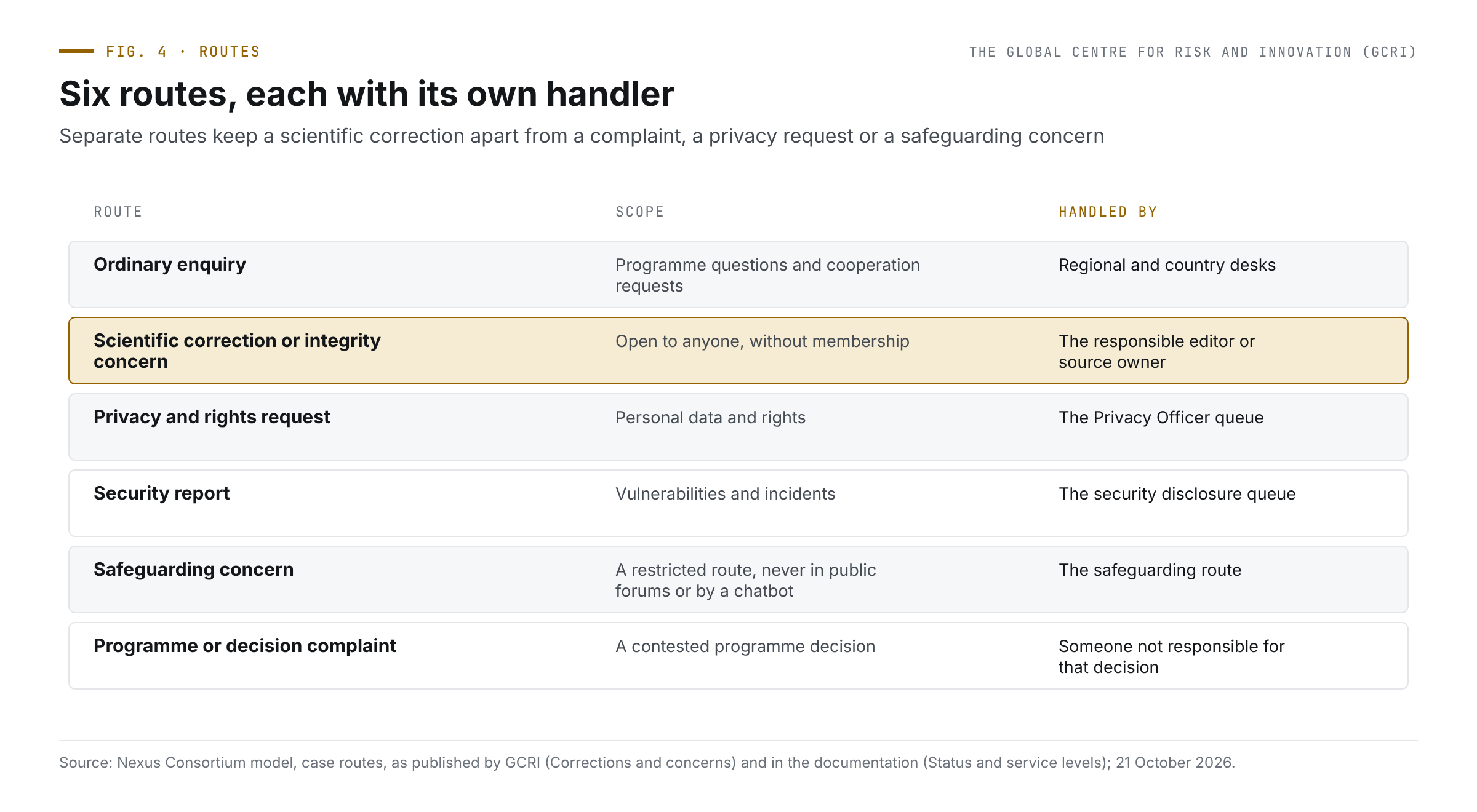
- The Nexus Consortium keeps six separate case routes, opens scientific corrections to anyone without membership and records every accepted correction as a new version [2].
- Correction feeds the next cycle: method and correction findings become change proposals to the Nexus Standards, and Renew is a step of every cycle [6, 7].
What it means to be built to correct
An institution is built to correct when finding and fixing its own errors is part of its design rather than an exception to it: errors are expected, anyone can report one, a named owner reviews it on method, the outcome is recorded, and an accepted correction produces a new version while the earlier one stays visible. At The Global Centre for Risk and Innovation (GCRI) this is the rule for data, models, reports, programme states and public claims across the Nexus Consortium, which GCRI runs with The Global Risks Forum (GRF) and The Global Risks Alliance (GRA) [1, 2].
The phrase names a stance as much as a procedure. A risk institution’s authority comes from the reliability of its record, and a record is reliable only if it can be shown to have been corrected when it was wrong. GCRI’s corrections page states the principle in four words: visible histories, never silent edits [1].
Why correctability matters most in coupled systems
Errors in risk work propagate the way risks do. Interdependent networks are more fragile than isolated ones, and a failure in one can cascade into the other [8]. A wrong input to a coupled model does the same: an error in one dataset shifts every downstream estimate that depends on it, and a decision built on those estimates carries the error into budgets and infrastructure. The defence is not infallibility, which no institution has, but the speed and visibility with which an error is found and fixed.
Public cases show the stakes. NASA’s Mars Climate Orbiter, launched on 11 December 1998, was lost on 23 September 1999 after a navigation error caused by a failure to translate English units to metric between ground and onboard software [9]. In economics, an influential study reported that countries with public debt above 90% of GDP grew on average by -0.1% a year; a replication by Herndon, Ash and Pollin found coding errors, selective exclusion of available data and unconventional weighting, and with those corrected the average was 2.2% [3]. The errors barely moved the lower debt categories but changed the conclusion in the one that mattered for policy.
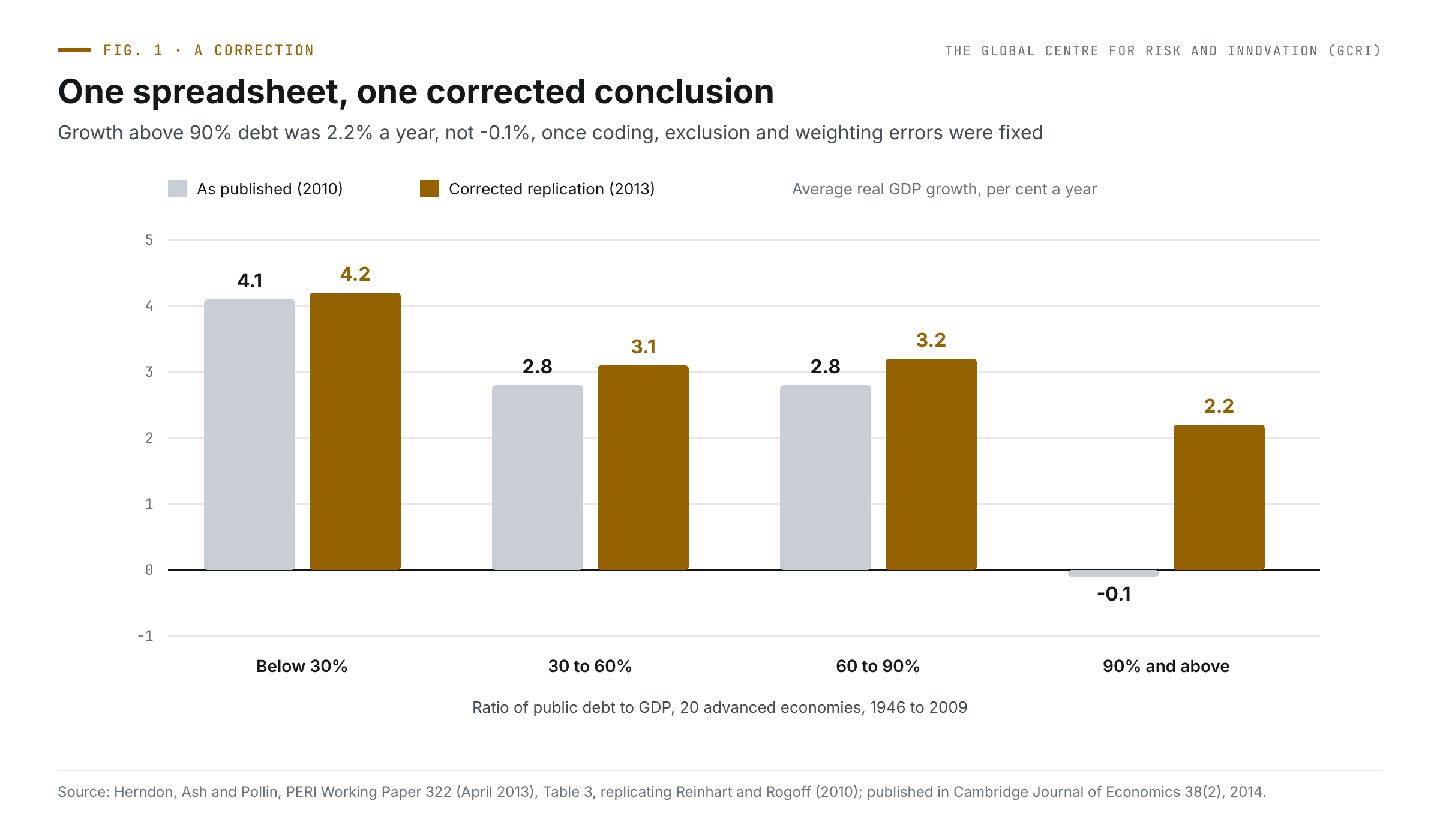
| Public debt to GDP | As published (per cent a year) | Corrected (per cent a year) |
|---|---|---|
| Below 30% [3] | 4.1 [3] | 4.2 [3] |
| 30 to 60% [3] | 2.8 [3] | 3.1 [3] |
| 60 to 90% [3] | 2.8 [3] | 3.2 [3] |
| 90% and above [3] | -0.1 [3] | 2.2 [3] |
What the record of retractions shows
Science has the longest experience of correcting a public record, and its data are sobering. An analysis of 2,047 retracted biomedical and life-science articles found that 67.4% were attributable to misconduct, fraud or suspected fraud accounting for 43.4%, duplicate publication for 14.2% and plagiarism for 9.8%, while 21.3% were retracted for error; retractions for fraud had risen about tenfold since 1975 [4]. Nature reported that more than 10,000 research papers were retracted in 2023, a record [5].
Two lessons follow for any institution that publishes evidence. First, honest error is common enough to need a routine, not a crisis response: roughly one retraction in five in that sample was for error [4]. Second, correction must be visible to work. Journal practice, as the International Committee of Medical Journal Editors sets it out, is to publish a correction notice as soon as possible that details the changes and cites the original, to archive prior versions, and to make earlier versions state that a newer one exists [10]. Even a small fix can be done in the open: Nature’s 2016 survey article on reproducibility carries a dated change history recording that an earlier graphic had switched two labels [11].
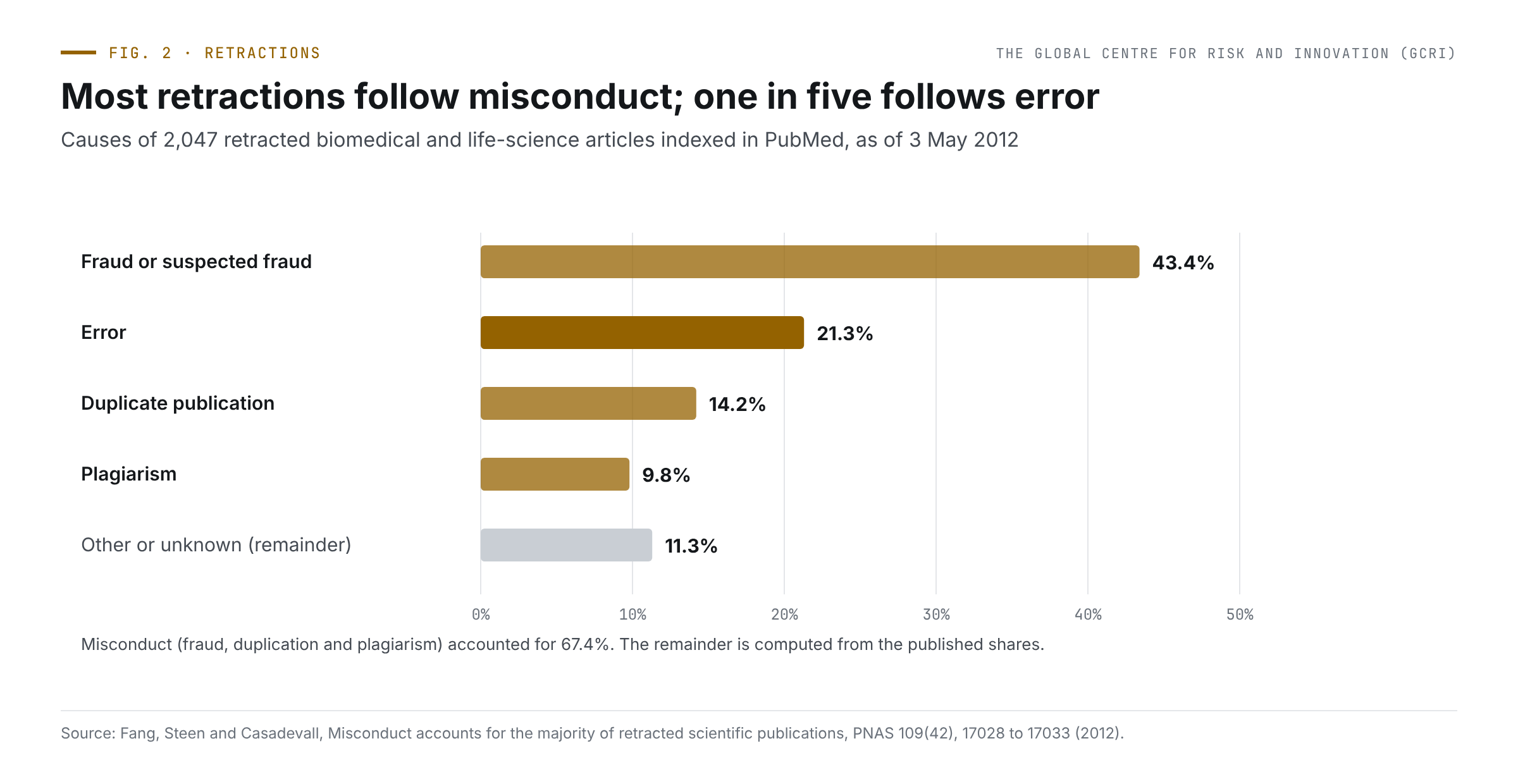
| Cause | Share of retractions |
|---|---|
| Fraud or suspected fraud | 43.4% [4] |
| Error | 21.3% [4] |
| Duplicate publication | 14.2% [4] |
| Plagiarism | 9.8% [4] |
| Other or unknown (remainder, computed from the published shares) | 11.3% [4] |
The correction standard in the programme
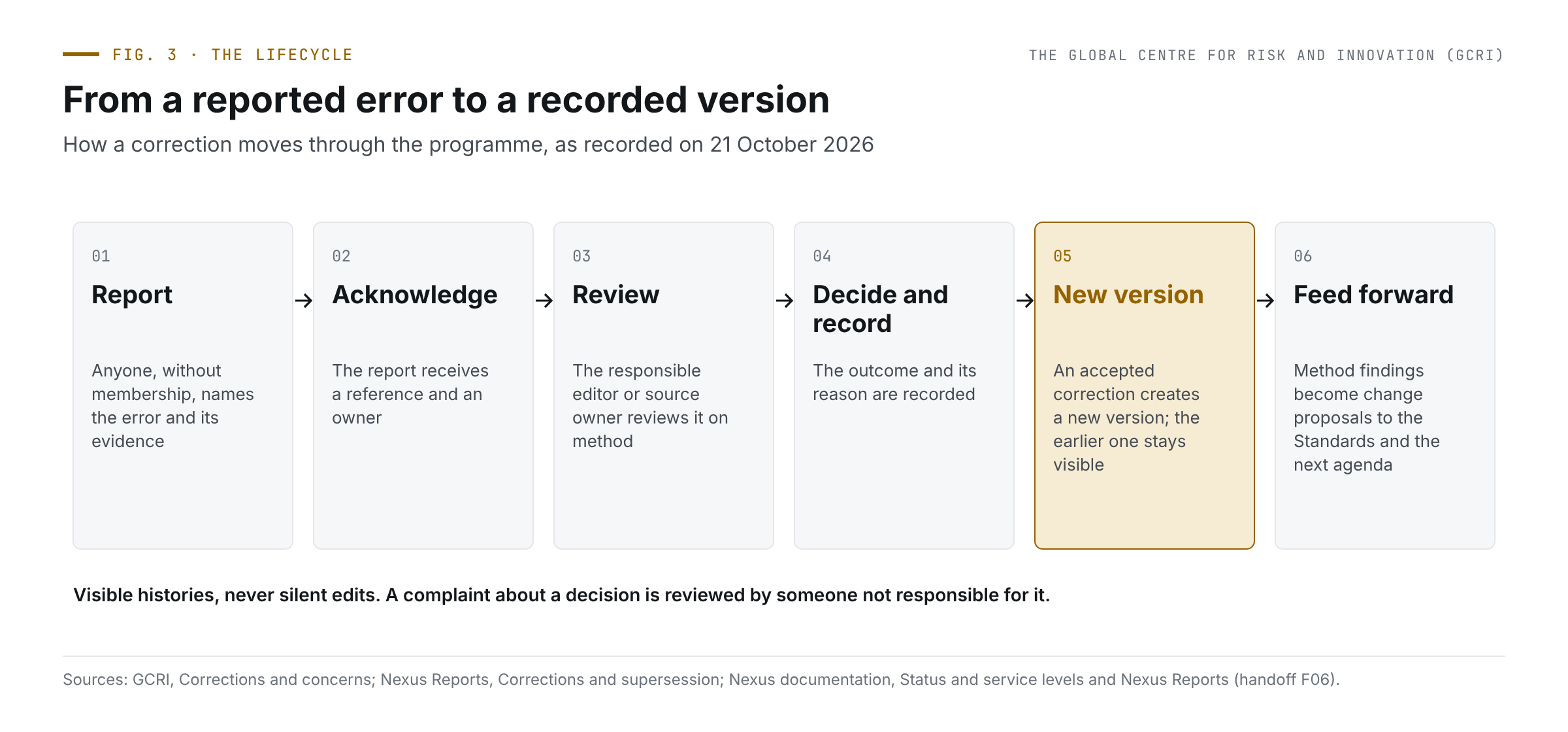
In the Nexus Consortium, correction is a recorded process with four steps: a report, an acknowledgement, a review and a decision that is recorded [1]. Anyone may ask for a correction “if a state or label is wrong”, without membership, and “an accepted correction creates a new recorded version” [2]. A scientific correction or integrity concern is reviewed by the responsible editor or source owner; a complaint about a programme decision is reviewed by someone not responsible for the contested decision [2].
The same rule governs publication. A correction to a Nexus Reports edition produces a new version, and the earlier version stays on record with the correction history, so that a reader can always see what changed and why [6]; the route is corrections and supersession [12]. Programme states follow it too: a constituted or active programme can be paused or closed with the reason recorded, and a closed programme stays visible as a historical record [2].
What correction applies to
Data and pipelines. Every finding carries one of nine evidence labels, and missing data is shown as missing, never as zero, so that a gap is never silently filled [2]. A correction to a source travels to every finding that used it.
Models, simulations and twins. Teaching values, illustrative applications, published benchmarks and specifications are labelled apart on the model pages, and a country replaces teaching values with its own evidence through its National Model; corrections there become change proposals to the methods [6]. The IPCC’s guidance asks authors to keep a traceable account of the evidence and agreement behind each finding, which is what makes a model correctable by someone other than its builder [13]. GCRI’s specialist pages on reproducible modelling and uncertainty and validation carry the methods.
Exercises. Exercise practice builds correction into the format: the US Homeland Security Exercise and Evaluation Program records strengths, areas for improvement and corrective actions in an After-Action Report and Improvement Plan [14]. In Nexus Universe, after-action review records what worked, what failed and what was not tested, preserving dissent, and GRF sets out what an exercise result can and cannot tell you.
Claims and role records. Overclaim is corrected like any other error. Regulators now enforce it from outside: in March 2024 the US Securities and Exchange Commission settled charges against two investment advisers over false statements about their use of AI, with penalties totalling US$400,000 [15]. Inside the programme, a wrong state or role is corrected in the claims and readiness register and recorded as a new version [2].
Separate routes, separate handlers
A correction system fails if every concern goes into one queue. The model therefore keeps six routes, each with its own handler: ordinary enquiries; scientific corrections and integrity concerns; privacy and rights requests, handled by the Privacy Officer queue; security reports, handled through the security disclosure queue; safeguarding concerns, on a restricted route that is never handled in public forums or by a chatbot; and programme or decision complaints, reviewed by someone not responsible for the contested decision [2]. Each route is described on GCRI’s corrections and concerns, data and privacy and safeguarding pages.
Versions, supersession and archive
A corrected record has three possible states. It can be superseded, when a new version replaces it and the earlier one stays visible with the reason; it can be withdrawn, when it should no longer be relied on at all and the withdrawal notice says why; or it can be archived, kept for reference with no current status. In every case the earlier text is kept, as journal practice also requires [10]. Correction and versioning of participation records follows the same rule, and the programme’s participation records show each record’s version history.
Corrections also travel forward. Method and correction findings from Nexus Reports go to the Nexus Standards as change proposals, in the handoff the programme calls F06 [6]. In the Nexus cycle, Renew is the step in which corrections and lessons feed the next annual agenda [7]. The record is therefore never finished: each year starts from the corrected state of the last.
Standards and practice for correction
The programme’s rules align with established publishing and exercise practice and with the proposed Nexus Standards for verification and standards development.
| Instrument | What it covers | Status |
|---|---|---|
| NRS-I4 | Research evidence, reproducibility and open science | Proposed Nexus Risk Standard |
| NRS-E2 | Reports: editions, country, regional and technology profiles | Proposed Nexus Risk Standard |
| NS-11 | Verification and monitoring | Proposed foundation standard |
| NS-13 | Open standards development, including change proposals | Proposed foundation standard |
| ICMJE recommendations | Corrections, retractions, republication and version control | Professional recommendations [10] |
| HSEEP | After-Action Report and Improvement Plan with corrective actions | FEMA doctrine, 2020 revision [14] |
What is changing
- Retraction at scale. A record of more than 10,000 retractions in 2023 shows correction systems under new load [5].
- Replication as public infrastructure. Cases such as the corrected debt-and-growth estimate show why data and code must be open enough to be rerun [3].
- External enforcement of claims. Regulators now correct false technical claims from outside, as the first AI-claims actions in 2024 showed [15].
- Cascading errors in coupled models. As models of interdependent systems are linked, a single uncorrected input can travel further [8].
One correction culture, three institutions
GCRI corrects evidence, methods and editions through the route above and its corrections and updates to publications. GRF keeps its own corrections route for councils, convening and Nexus Universe. GRA keeps corrections and complaints and corrections and updates to its publications for finance-readiness work. Each institution’s mandate is on its home page: GCRI, GRF and GRA.
Boundaries. What this page does not claim: the cases cited are public records of other institutions’ corrections, not programme activities, and citing them is not a claim of partnership or endorsement. No Nexus Reports edition has yet been released, and the programme is at service level R0. A correction route reviews errors and concerns; it is not a court, a regulator or an emergency service. GCRI does not regulate or certify, GRF does not regulate, finance or procure, and GRA does not lend, underwrite, rate or invest.
Questions and answers
Who can report an error to GCRI?
Anyone, without membership or an account. A scientific correction or integrity concern is reviewed by the responsible editor or source owner, and the outcome is recorded with its reason.
Does a correction delete the earlier version?
No. An accepted correction creates a new recorded version, and the earlier version stays visible with the correction history, so readers can see what changed and why. Edits are never silent.
What if I disagree with a programme decision rather than a finding?
Use the programme or decision complaint route. It is reviewed by someone who was not responsible for the contested decision, separately from the scientific correction route.
How do corrections change future work?
Method and correction findings become change proposals to the Nexus Standards, and the Renew step of the Nexus cycle feeds corrections and lessons into the next annual agenda.
Are safeguarding concerns handled through the public corrections page?
No. Safeguarding concerns use a restricted route that is never handled in public forums or by a chatbot; privacy and security reports also have their own queues.
Glossary
- Correction: A recorded change to a finding, record or statement, made after review, that creates a new version.
- Supersession: Replacement of a record by a newer version, with the earlier one kept visible and the reason stated.
- Withdrawal: A notice that a record should no longer be relied on, with the reason; the text is kept.
- Case route: One of six separate routes for enquiries, corrections, privacy, security, safeguarding and complaints.
- Traceable account: A record of the evidence and agreement behind a finding, detailed enough for others to check it.
- After-action review: The review after an exercise of what worked, what failed and what was not tested, with dissent preserved.
Further reading across the network
- Corrections and concerns at GCRI
- Corrections and supersession at Nexus Reports
- Editorial and corrections topic
- Renew: a step of the Nexus cycle
- Research integrity at GCRI
- Systemic and cascading risks
- Networks and cascades
- Coupled risk in the documentation
References
- The Global Centre for Risk and Innovation (2026). Corrections and concerns. Accessed 2026-10-21.
- Nexus documentation (docs.therisk.global) (2026). Status and service levels. Accessed 2026-10-21.
- Herndon, Ash and Pollin, Political Economy Research Institute, University of Massachusetts Amherst (2013). Does high public debt consistently stifle economic growth? A critique of Reinhart and Rogoff (PERI Working Paper 322; Cambridge Journal of Economics 38(2), 257 to 279, 2014). Accessed 2026-10-21.
- Fang, Steen and Casadevall, PNAS 109(42), 17028 to 17033 (2012). Misconduct accounts for the majority of retracted scientific publications. Accessed 2026-10-21.
- Van Noorden, Nature 624 (2023). More than 10,000 research papers were retracted in 2023, a new record. Accessed 2026-10-21.
- Nexus documentation (docs.therisk.global) (2026). Nexus Reports. Accessed 2026-10-21.
- Nexus documentation (docs.therisk.global) (2026). The Nexus cycle. Accessed 2026-10-21.
- Buldyrev, Parshani, Paul, Stanley and Havlin, Nature 464 (2010). Catastrophic cascade of failures in interdependent networks. Accessed 2026-10-21.
- NASA Science (2026). Mars Climate Orbiter. Accessed 2026-10-21.
- International Committee of Medical Journal Editors (2026). Corrections, retractions, republications and version control. Accessed 2026-10-21.
- Baker, Nature 533, 452 to 454 (2016). 1,500 scientists lift the lid on reproducibility (change history of 28 July 2016). Accessed 2026-10-21.
- The Global Centre for Risk and Innovation (Nexus Reports) (2026). Corrections and supersession. Accessed 2026-10-21.
- Intergovernmental Panel on Climate Change (Mastrandrea et al.) (2010). Guidance Note for Lead Authors of the IPCC Fifth Assessment Report on Consistent Treatment of Uncertainties. Accessed 2026-10-21.
- US Federal Emergency Management Agency (2020). Homeland Security Exercise and Evaluation Program (HSEEP). Accessed 2026-10-21.
- US Securities and Exchange Commission (2024). SEC charges two investment advisers with making false and misleading statements about their use of artificial intelligence (press release 2024-36). Accessed 2026-10-21.
Editorial record
Facts and programme states are given as of 21 October 2026. This page replaces an earlier version titled Built to Correct; it keeps that version’s argument and replaces its “correctionability standard” and “validity-by-record” terms, and its references to protocol lab outputs and safety holds, with the correction routes, versions and handoffs now on record. It is reviewed at least every 180 days and whenever a correction rule, a programme state or a cited figure changes.
Published by the GCRI editorial desk under the scientific and editorial integrity policy. To report an error or request a correction to this page, use corrections and concerns; corrections are dated and listed with the page.